


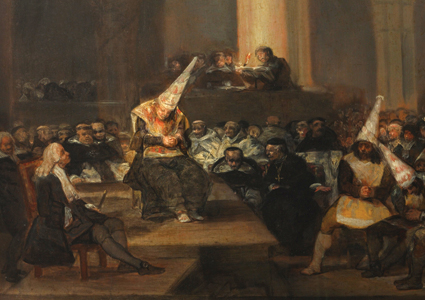
 Not so terrible: The Spanish Inquisition, as depicted by Francisco de Goya
Can historians ever be detached about the past, or is their judgment inevitably affected by their own loyalties and affiliations? In the introduction to his Saints, Sacrilege, and Sedition, Eamon Duffy, Professor of Christian History at Cambridge University, indignantly refuted the charge that he, and other Catholic historians, were biased in their revisionist view that the Protestant Reformation was not welcomed by the English, who were only weaned from the old religion after more than a century of cruel coercion. Was it, he asked, because he was the son of a Welsh nonconformist minister that the journalist Sir Simon Jenkins could still insist, despite all the evidence, that the English had “come to regard the Roman church as an alien, corrupt agent of intellectual oppression, awash with magic and superstition”?
Professor Rodney Stark, the author of Bearing False Witness: Debunking Centuries of Anti-Catholic History, is at pains to point out that he is not a Catholic. He was raised a Lutheran, and teaches at a Baptist university in the United States, but in the course of a long career teaching and writing on the sociology of religion, he was struck by the blatant anti-Catholic prejudice still to be found among historians: “I did not write this book in defence of the Church. I wrote it in defence of history.”
Professor Stark refutes ten anti-Catholic calumnies still “deeply embedded in our common culture”. The institutional Church was not anti-Semitic; it did not suppress the apocryphal gospels; it did not persecute pagans; it did not plunge Europe into “a millennium of ignorance and backwardness” in the Dark Ages. The Crusades were not motivated by greed, and the Spanish Inquisition did not torture and murder “whuge numbers of innocent people”. The Church did not impede the development of science; nor did it condone slavery or support authoritarian regimes except where they defended Catholics from persecution; and it did not thwart economic enterprise prior to the Protestant Reformation.
Stark does not ask his readers to take his word for his debunking of anti-Catholic history: each of his ten chapters has a boxed display containing the names and credentials of the historians whose researches he has drawn upon to make his case. Stark’s villains are the Protestant propagandists at the time of the Reformation, and the anti-clerical philosophes of the Enlightenment — “Voltaire, Rousseau, Diderot, Hume, Gibbon . . .” together with “their modern counterparts such as Carl Sagan, Daniel Dennett, and Richard Dawkins”. Undoubtedly the most sensitive question is the reputed anti-Semitism of the Catholic Church. Following the conversion of Constantine and the establishment of Christianity as the state religion, Jews were subject to discriminatory laws, and there were the pogroms in the Rhineland during the First Crusade; but, as Stark points out, the killing of Jews was not instigated by the Church. Quite to the contrary, the popes repeatedly issued Encyclicals forbidding the persecution of Jews and forced conversions, and where possible during the Rhineland pogroms, Jews were protected by the Catholic bishops. Stark thinks it possible that, without the Church’s protection, the Jewish communities in Europe might not have survived.
Like this article? Share, save or print using the icons below:


- Cultural Climate Change
- The American mind continues to close
- Opposites meet in the land of Scrugletopia
- The West must restore a sense of the sacred
- Sweet singing in the choir
- Home from home for the Bolshevik elite
- A portrait of the artists as a pair of young wastrels
- The new Leviathan: Trump and the nation state
10:05 PM
2:05 PM
9:04 AM