


The authors have their own dilemma to contend with: we see them arguing over whether this is a human story about a man and his passions, or about the developing science of logic.
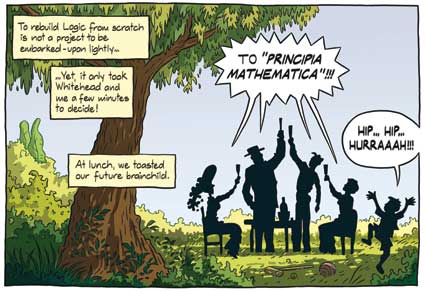
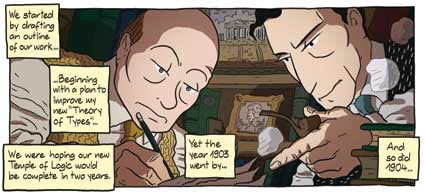
Along the way, we visit 1940s New York, sunny present-day Athens, turn-of-the-century Paris, and the quads of Cambridge, and meet Frege, G. E. Moore, Gödel and Wittgenstein. Brilliantly sketched, these intellectual giants endlessly debate and even brawl over the finer points of logic. In the cartoon format, their arguments must be reduced to the bare essentials, with complex ideas shrunk to the size of a speech bubble. The book is also rather beautiful: the climactic moments of the story, such as Wittgenstein's epiphany in the trenches of the First World War, are spread out over full pages of glorious colour.
As the story progresses, we realise that Russell is closer to a tragic hero of Greek myth than an American-style comic crusader. A flawed man who is cruel to his first wife, he is driven by his fear of the dark family taint of madness, striving for the unattainable goal of perfect knowledge which must forever slip from his grasp. At the end of the book, the authors attend a performance of the Oresteia, in which the dark chaotic Furies are brought within the rational polis of Athens, and realise that reason and unreason can and must coexist. It's a resolution that Russell himself does not reach.


