


Second, Charousek was not the breath of something new in chess but the final flowering of the Romantic style, in the tradition of an earlier generation — which is why it is not just because of his TB that he has aptly been called "the Keats of chess". Charousek seemed to have completely ignored the teachings of Wilhelm Steinitz, who by the mid-1870s had pioneered a much more measured and strategic style of play, an approach which all subsequent world champions have needed to absorb. Still, the result is that Charousek has left a glittering legacy of fabulous — almost baroque — games suffused with the author's love of beauty rather than desire for functional efficiency.
Gyula Breyer, who died of heart disease aged 28, was another Hungarian genius — and much more significant, even though less celebrated. Unlike Charousek, Breyer was an innovator, perhaps the most radical of the so-called hypermoderns who revolutionised chess strategy in the 1920s. Given that he died before Réti and Nimzovitch got round to publishing their treatises that turned chess theory upside down, Breyer can be seen as the most original of them all.
Here is just one example of his astonishing radicalism, with the Black pieces against the future world champion Max Euwe in 1921 (the year of Breyer's death): 1.e4 Nc6 2.Nc3 Nf6 3.d4 e5 4.dxe5 Nxe5 5.f4 Nc6 6.e5 Ng8 7.Bc4 d6 8.Nf3 Bg4 9.0-0 Qd7 10.Qe1 0-0-0...Black seems to have broken almost every rule in the book, but in reality he stands well; 20 moves later, the bamboozled Euwe resigned. Breyer's name is most often associated with a variation which is a testament to his theories of qualitative (as opposed to quantitative) development. In the Breyer defence to the once-deadly Spanish Opening, Black on move 9 retreats his Queen's Knight to its starting position. At first sight it looks not just provocative, but perverse. Yet its true merits have been appreciated by much later generations. The Breyer variation was Boris Spassky's main defensive weapon in his 1972 match against Bobby Fischer and is now a particular favourite of the world's highest-ranked player, Magnus Carlsen. Breyer lives!
Puzzle: One of Rudolf Charousek’s immortals, played when he was 19. With White to play his 17th move, the position seems immensely double-edged; but Charousek has seen a forced mate. Can you?
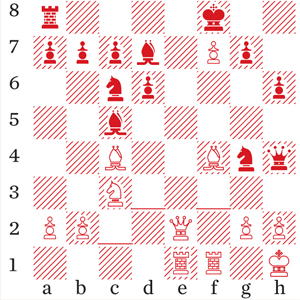
Solution: Charousek played 17.Qe8+!! Rxe8 18.f7xe8(Q)+ Bxe8 19.Bxd6 double check and mate! The final position is itself a thing of beauty, suitable for framing.


Post your comment

- The Zombie Argument that Refuses to Die
- Online Only: The Price Paid for Criticising Islam
- Overrated: Dan Brown
- Is the Brain the Key to Understanding Religion?
- Overrated: George Monbiot
- Time to Wise Up to the Muslim Brotherhood
- 'Please Sir, I Just Want to Learn More'
- The Alternative History of an Undivided India
- The Zombie Argument that Refuses to Die
- Online Only: The Price Paid for Criticising Islam
- Overrated: Dan Brown
- Is the Brain the Key to Understanding Religion?
- Overrated: George Monbiot
- Time to Wise Up to the Muslim Brotherhood
- 'Please Sir, I Just Want to Learn More'
- The Alternative History of an Undivided India
- Decline and Fall of the History Men
- Uncritical Theorists Who Misread the Nazis
- The Zombie Argument that Refuses to Die
- The Banality of Hannah Arendt
- From Kitsch to Cool: Picasso and Modern Art
- Is the Brain the Key to Understanding Religion?
- Time to Wise Up to the Muslim Brotherhood
- Midfield Virtuoso Finds His Perfect Pitch