


Charousek and Breyer were victims of medical conditions which today need not be fatal. This was not the cause of Klaus Junge's early death: born in the Chilean city of Concepción on January 1, 1924, he was killed at the age of 21 at Lüneburg Heath, April 17, 1945, three weeks before the end of the war in Europe. As a teenager Junge had come first equal with the world champion Alexander Alekhine in a 1942 tournament in Nazi-occupied Prague; there seems little doubt that had he survived the war he would have been a contender for the ultimate title. The games he played in Nazi-organised tournaments remain obscure and even tainted; but the future world champion Mikhail Botvinnik was certainly paying attention. What we now call "the Botvinnik variation" of the Queen's Gambit was played no fewer than six times by Junge in those wartime events, before the Russian began using it to devastating effect in his own tournament games.
A rare photograph of Junge in play, against the Swedish champion Gösta Stoltz in Munich in 1942, shows him in full military uniform, complete with swastika armband. To what extent the young man was a true Nazi, fighting to the bitter end out of political conviction, is not clear. It is however known that his father Otto — who emigrated to Germany with his family from Chile in 1928 — was an early and committed Nazi party member. All his three sons perished in the war that Hitler willed. Alongside this, consider also that had Charousek and Breyer lived to full maturity they would most likely, as Hungarian Jews, have been exterminated in the Nazis' gas chambers.
Here is one of Junge's remarkable games with his own variation, played in Rostock in 1942 against the German master Heinz Lehmann. 1.d4 d5 2.c4 e6 3.Nc3 c6 4.Nf3 Nf6 5.Bg5 dxc4 6.e4 b5! (This is Junge's ultra-sharp line, made famous by Botvinnik and still widely used today) 7. e5 h6 8.Bh4 g5 9.Nxg5 hxg5 10.Bxg5 Nbd7 11.Qf3 Bb7 12.Be2 Rg8 13.h4 Qb6 14.exf6 c5 15.d5 b4 16.Bxc4 bxc3 17.dxe6! cxb2! (Junge rightly does not accept the Queen sacrifice: after 17...Bxf3 18.exf7+ Kd8 19.fxg8(Q) cxb2 20.0-0 bxa1(Q) 21.Rxa1 White stands very well, despite his piece minus. The key in this hair-raising variation is to keep the initiative at all costs) 18.Rb1 Rxg5! (Again correctly declining to take Lehmann's Queen) 19.exd7+ Kd8 20.Qc3 Rxg2 21.Rxb2 Qc7 22.Rh3?? (Perhaps not surprisingly, Lehmann cracks: 22.Bxf7 was essential) Rg1+ 23.Ke2 Bg2 24.Rg3 Bf1+ 25.Kd1 Qd6+! 26.Rd2 Qxg3!! (An astounding blow and a terrible shock for Lehmann: 27. Qxg3 Rxg3 28.Bxf1 Rg1 is a massacre of White's army. But what if he just takes the Queen with the pawn?) 27.fxg3 Bd3 checkmate.
Puzzle: One of Rudolf Charousek’s immortals, played when he was 19. With White to play his 17th move, the position seems immensely double-edged; but Charousek has seen a forced mate. Can you?
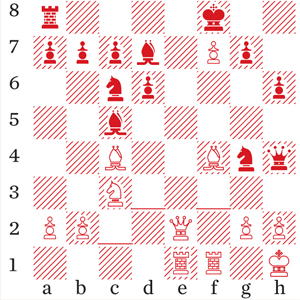
Solution: Charousek played 17.Qe8+!! Rxe8 18.f7xe8(Q)+ Bxe8 19.Bxd6 double check and mate! The final position is itself a thing of beauty, suitable for framing.


Post your comment

- The Zombie Argument that Refuses to Die
- Online Only: The Price Paid for Criticising Islam
- Overrated: Dan Brown
- Is the Brain the Key to Understanding Religion?
- Overrated: George Monbiot
- Time to Wise Up to the Muslim Brotherhood
- 'Please Sir, I Just Want to Learn More'
- The Alternative History of an Undivided India
- The Zombie Argument that Refuses to Die
- Online Only: The Price Paid for Criticising Islam
- Overrated: Dan Brown
- Is the Brain the Key to Understanding Religion?
- Overrated: George Monbiot
- Time to Wise Up to the Muslim Brotherhood
- 'Please Sir, I Just Want to Learn More'
- The Alternative History of an Undivided India
- Decline and Fall of the History Men
- Uncritical Theorists Who Misread the Nazis
- The Zombie Argument that Refuses to Die
- The Banality of Hannah Arendt
- From Kitsch to Cool: Picasso and Modern Art
- Is the Brain the Key to Understanding Religion?
- Time to Wise Up to the Muslim Brotherhood
- Midfield Virtuoso Finds His Perfect Pitch