



In this context of absolute censorship, it's understandable that Sosonko wanted to establish, for the record, what it was really like to live among the chess elite of the Soviet Union, especially as the age of Communist chess supremacy is something which young chess players today find hard to believe existed. "I wanted to show how these incredible champions — all of whom vividly expressed their individuality — got along in the times in which they lived, and how the times got along with them." For these champions, chess was a language which transcended both the vicious politics of the time and place, and even the intense personal animosities inevitable when it was possible that everyone was informing on everyone else. "I saw famous champions . . . when they weren't speaking at all and didn't even greet each other. Those same people would analyse a game they had just played, for a long time, and with excitement; then after the analysis revert again to their usual relationship — not on speaking terms."
His chapter on the first Soviet world champion, the terrifyingly determined Mikhail Botvinnik, is especially gripping in this regard. He describes how when "someone who was visiting him incautiously mentioned the name of Bondarevsky [a rival] over dinner, Botvinnik got up slowly, went over to his desk, opened a drawer and took out a piece of paper with some kind of list on it: the names of these people are not mentioned in my home." This was the era of Stalin (of whom Botvinnik was an unapologetic admirer): people really did just become unmentionable.
In 1960 Botvinnik lost his world title to the most dazzlingly talented of all the Soviet champions, a 23-year-old Latvian Jew named Mikhail Tal. Sosonko's reminiscences of this self-destructive, alcoholic, morphine-addicted, womanising "half angel, half devil" form the pulsing heart of his latest memoir. To those of us who love chess — and especially the astonishing games created by Tal in his all-too-short prime — Genna's account amounts almost to heavenly revelation: "A glance from his burning eyes, which penetrated the board and his opponent, a movement of his lips, the unbelievable pressure of his ideas — these couldn't be withstood emotionally by the weak."
Although Tal also suffered at the hands of the Soviet system — being banned from travel after getting into a drunken fight in a Cuban bar — Sosonko's admirably objective conclusion is that the same system was indispensible in nurturing a unique talent: "Mikhail Tal, thrown into the flow of Western life, would have spun in the whirlwind of permissiveness and pleasure with such force that chess would simply have dissolved . . . and even if Tal had managed to fulfil his promise in this case, too, he would hardly have managed to fly like such a shining rocket: the extraordinarily rich chess atmosphere of the Soviet Union didn't exist in any other country."
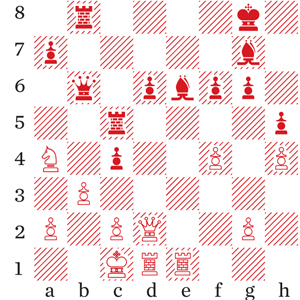
Puzzle: Sosonko won many brilliant games with the Dragon variation of the Sicilian, characterised by the “fire-breathing” Bishop on g7. Here, Black, to move, against the Dutch player Zuidema; his Queen and Rook have been forked by White’s knight on a4. How did he resolve this apparent problem?
Solution: Sosonko played 22...cxb3!! The game continued 23.Nxb6 bxa2 24.Kb2 (after 24.Qd4 f5 25.Qa4 a1=Q+ 26.Qxa1 Bxa1 the Dragon bishop has done its work) Rxb6+ 25.Ka3 Ra6+ 26.Kb4 Rc4+ 27.Kb5 Rb6+ 28.Ka5 f5 29.Re3 Rb1 30.Ra3 Bc3+ and after this last blast of flame from the Dragon, Zuidema resigned. If 31.Rxc3 a1=Q+ and if 31.Ka6 the King-hunt ends with 31...Bc8+ 32.Kxa7 Rc7+ 33.Ka8 Bb7+ 34.Ka7 Bd5+ 35.Ka6 Bc4 mate.


