


After a gap of very nearly half a century chess moves are returning to BBC radio. The credit is entirely that of Radio 4's controller since September 2010, Gwyneth Williams. In a letter to me she observed that "although not much of a player, I admire the game; it has entered (like cricket) into the language and culture and it somehow matters." And, to my delight, she asked your columnist to be the presenter of this new series.
Williams's analogy with cricket is pertinent. Radio 4 is of course the home of Test Match Special, in which experts and ex-players bring the game to life in a way which defies the listener's apparent handicap of not being able to see what can be a highly complex struggle. But the chess programme I am to present, Across The Board, is not to be just a commentary on games between masters. The format, of what I hope might be the first of more than one series, consists of quite personal interviews with people eminent in other fields, but who have devoted part of their lives to chess.
My interviewees include the former undefeated world heavyweight boxing champion Lennox Lewis and the former British girls' under-14 chess champion-better known as the present Shadow Secretary of State for Work and Pensions, Rachel Reeves. These interviews take place while we play a game against each other. Only in one of the programmes do I take on a professional grandmaster: none other than the women's world champion, the 19-year-old Chinese prodigy Yifan Hou.
The programmes are scheduled for transmission on five consecutive days, starting Monday December 30, and will each last for 15 minutes — the concentrated essence of interviews conducted over the course of an hour, with the players allocated half an hour each to complete all moves. I have also been fortunate that the producer with the difficult task of cutting the material down is David Edmonds. As well as being a long-term BBC man, Edmonds is the author (with John Eidinow) of the best-selling book Bobby Fischer Goes To War: How The Soviets Lost The Most Extraordinary Chess Match Of All Time.
In fact Bobby Fischer took part in the original BBC Radio chess series — which ran from 1958 until 1964 on what was then called Network Three. The most popular element in the programmes were the "consultation games" in which two teams of two players each were put in separate cubicles and each recorded their thoughts as they discussed what moves to play against the other. It was in 1961 that the 18-year-old Fischer — already one of the strongest players in the world — took part, teamed with Leonard Barden (who won the British championship jointly with Jonathan Penrose in 1963) against Penrose himself and Peter Clarke, four-times runner-up in the British championship.
To find out more about this, I contacted Leonard Barden — who at 84 still writes the weekly chess column in the Guardian and who was one of the most important figures in the revival of British chess in the 1970s and 1980s. Barden told me: "The broadcast was recorded in September or October 1960. I had become friendly with Bobby Fischer during the Leipzig chess Olympiad of 1960 and was a contributor to the Network Three programme, hence the idea of a consultation match. Bobby was paid £50, which pleased him. He had come to London to buy a Savile Row suit, and this covered the costs of the suit. I was nominally Bobby's consultation partner, but my true function was to get him to talk. He was fluent and articulate for the whole of the session, which lasted eight hours and only stopped when the studio time ran out. Bobby was annoyed at the end when Penrose and Clarke would not resign."
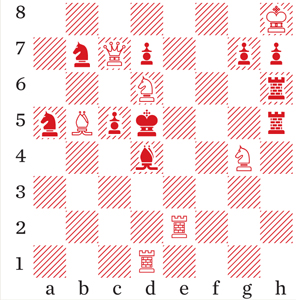
Puzzle: The BBC's radio chess programme of half a century ago had several episodes devoted to the abstrusely artistic world of chess problems. One that was discussed is this, composed in 1922 by the Italian Alberto Mari. White, to play, can force checkmate in two moves-even though Black has the immediate threat, by moving his g-pawn, of giving discovered check to the White King on h8. Can you see White's key first move?
Solution: 1.Ne4!! The threat is 2.Nc3 mate, exploiting the vital fact that Black's d4 Bishop is pinned. If Black tries to flee with his King with 1...Ke6 then 2.Qxd7 is mate (not 2.Ng5+, which this item's presenter, the problem composer Michael Lipton, declared). But what if Black gives discovered check? Well, after 1.Ne4!! g6+ 2.N(e4) f6 is mate, as the pawn on g6 now blocks the defence 2...Rxf6. And after 1.Ne4!! g5+ 2.Qe5 is mate, as the pawn on g5 blocks the defence 2...Rxe5. As Lipton aptly concluded: "To play through a problem like this is a genuine artistic experience."


- Islam and the French Republic
- Why On Earth Should Anyone Study Philosophy?
- The Dying Days Of Zuma's South Africa
- His Master's Voice: Scruton On Wagner
- Why The Most Civilised Of Men Felt Like A Fraud
- Political Misconduct
- Cicero's Analysis Of Decline Offers Lessons For The West
- Trump's Appeal Is More Roosevelt Than Reagan
11:12 PM