



Perhaps he was never likely to become world champion and not just because he came to the game so late. His love of chess as a form of art was wonderfully evident in his best games, which have a geometric beauty that touches on the sublime. But his defensive skills were not of the highest — and it is impossible to become world champion without that.
Stein himself would not have thought so, however, and he was preparing hard for the 1973 Interzonal in Brazil, from which the top three would qualify for the world championship candidates matches — and he was an undoubted favourite, especially now that FIDE had revoked the absurd rule that effectively discriminated against players from the USSR. He told a friend: "You will be surprised . . . my whole life will take another course . . . then I'll really start to play chess."
Before this, however, Stein was to come to the UK, as part of the Soviet team in the European Team Championships, being held that year in the spa town of Bath. On the night before he was due to leave for England he died of a massive heart attack in his room in Moscow's Rossiya Hotel. Apparently he was not alone at the time, something that the traditionally prudish Soviet press hushed up but which his team members revealed to English chess organisers in Bath, who were naturally shocked to learn of Stein's sudden and otherwise unexplained death at the age of 38.
As with all artists cut down in their prime, it is agonising to consider how many masterpieces have been denied to the world. At the same time, we should be grateful for those which we have been given — and the sheer pyrotechnic brilliance of Stein was never better illustrated than in the following victory with the White pieces against the immensely solid ex-world champion Vassily Smyslov, in the USSR team championships of 1972. 1.c4 Nf6 2.Nc3 e6 3.Nf3 b6 4.e4 Bb7 5.Qe2 (an unusual development, in the style of a Russian romantic of an earlier era, Tchigorin) Bb4 6.e5 Ng8 7.d4 d6 8.a3!? (Stein is prepared to lose a tempo to ruin his own pawn structure!) Bxc3+ 9.bxc3 Ne7 10.h4! (Yet another strange-looking move, but its motive is clear: attack, at all costs) Nd7 11.h5 Bxf3 12.Qxf3 dxe5 13.h6 gxh6 14.Bxh6 exd4 15.Bg7 Rg8 16.Rxh7 Nf5 17.Bxd4 c5 18.g4! (A second battering ram, after the rush with the h-pawn) cxd4 19.gxf5 e5 20.Qd5 Rf8 21.cxd4 Rc8 22.Rd1 Qe7 23. Bg2 Rg8 24.Qb7 Rxc4 25.dxe5 (Stein could have won more simply here with 25.Qa8+ Qd8 26.Qd5 attacking both c4 and f7; but this banality would have denied us the game's sublime denouement) Qxe5+ 26.Kf1 Qb5 27.Kg1 Qc6 (Smyslov utilises the Rg8's pinning of Stein's Bg2, but there is a marvelous refutation) 28.Qxc6 Rxc6 29.Rh8!! (A rare form of cross-pin. The point is that if 29...Rxh8 30.Bxc6 and the Knight on d7 is now itself pinned and lost) Rg6 30.fxg6 Rxh8 31.Bc6 Rg8 32.Bxd7+ Ke7 33.Bf5 fxg6 34.Rd7+ Kf6 35.Bd3 and a doubtless somewhat shell-shocked Smyslov resigned. A glorious example of the geometric beauty of Stein's play.
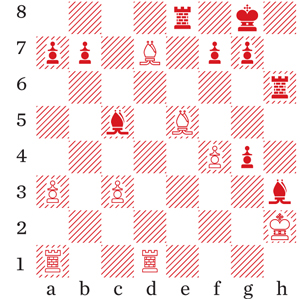
Puzzle: The very last game played by Stein (Black, to play), before his horribly premature death, ended with a characteristic flourish. Yevgeny Sveshnikov has just played 29.Bd7. Can you see how Stein's response forced immediate resignation?
Solution: Stein's final move (in every sense) was 29...Bf2! at which Sveshnikov stopped the clocks. The point of Bf2 is that it cuts the White King's escape square g3 and thus if 30.Bxe8 Bf1 is checkmate. The full beauty is seen if Sveshnikov had tried to challenge Stein's deadly h6 rook with 30.Rd6; there would have followed 30...g3+ 31.Kh1 Bf1+ 32.Rxh6 g2+! 33.Kh2 g1=Q checkmate.


