


Followers of chess, however, adore him for this attitude. Korchnoi has never played a "grandmaster draw": he fights to the bitter end every time he sits down. Of course, Korchnoi does not play like this for the benefit of the public. It is not, even, simply because he is a fighter; above all he loves chess with such a passion, that he cannot bear to leave the board — any board — unless there is absolutely no choice.
This has been beautifully described by Gennadi Sosonko, his friend and former assistant, who, as a Dutch resident, was also instrumental in Korchnoi's defection from the Soviet Union in Amsterdam in 1976. In his essay "Obsession", written to mark Korchnoi's 70th birthday, Sosonko wrote: "I am sure that the grey matter concerned with chess occupies a much greater volume in Korchnoi's brain than is the case with any other player — greater even than with the best-known names that are to be found today at the top of the strongest tournaments and in matches for the World Championship. Apart from enormous chess talent, tenacity and character, there are two qualities that distinguish Korchnoi among his many colleagues: his boundless love for the game, and his absolute honesty in analysis; honesty, which at times is merciless with regard to his opponent, but in particular to himself."
It was in part this honesty which led to Korchnoi's defection. He had long bridled at the restrictions the apparatchiks of the Soviet Chess Federation put on his freedom to express his views, although he was not really a political dissident: what he cared most of all about was his chess career, and he deeply resented it when the authorities made it clear that they would prefer it if he didn't beat his young rival, Anatoly Karpov.
Eventually, as a hated enemy of the Soviet state, Korchnoi fought two world championship matches against Karpov. He lost both, but the first, in 1978, was an extraordinarily ferocious fight, both on and off the board: with the scores tied after no fewer than 31 games, a physically-shattered Karpov somehow summoned up the willpower to win the 32nd game, and the match by six wins to five. Korchnoi was already considered a veteran back then. Who would have thought, not just that he would be unaffected by such a traumatic event, but that he would still be playing fighting chess more than 30 years later?
My own acquaintance with Korchnoi stems from the fact that I helped to organise and raise the funding for his 1983 world championship semi-final match against the 20-year-old Garry Kasparov in London. Although Kasparov eventually won the match, Korchnoi amazed us all by grinding the young genius into the dust in the very first game, despite the supposed disadvantage of playing Black. I vividly remember the dismissive expression on Korchnoi's face as he handed the future world champion this painful lesson in chess strategy:
1.d4 Nf6 2.c4 e6 3.Nf3 b6 4.Nc3 Bb7 5.a3 d5 6.cxd5 Nxd5 7.e3 g6 8.Bb5+ c6 9.Bd3 Bg7 10.e4 Nxc3 11.bxc3 c5 12.Bg5 Qd6 13.e5 Qd7 14.dxc5 0-0 15.cxb6 axb6 16.0-0 Qc7 17.Bb5 Bxe5 18.Bh6 Bg7 19.Bxg7 Kxg7 20.Qd4+ Kg8 21.Ng5 h6 22.Ne4 Bxe4 23.Qxe4 Na6 24.Qe3 Qc5 25.Qxc5 Nxc5 26.Rfb1 Rfd8 27.Bf1 Rd6 28.Rb4 Kf8 29.a4 Ra5 30.g3 Ke7 31.Kg2 f5 32.Bb5 Rd2 33.Rd4 Rxd4 34.cxd4 Nxa4 35.Rxa4 Rxb5 36.Ra7+ Kd6 37.Rh7 h5 38.Rg7 Rd5 39.Rxg6 b5 40.Kf3 b4 41.Ke3 b3 42.Kd2 Rxd4+ 43.Kc3 b2 44.Kxb2 Rd2+ 45.Kc3 Rxf2 46.h4 f4 47.Rg5 Rf3+ 48.Kd4 Rxg3 49.Rxh5 Re3 50.Rh6 Ke7 51.h5 e5+ 52.Kd5 f3 and Kasparov resigned.
Puzzle: White: Averbakh, Black: Korchnoi. Hard to believe, but in this position from a game in 1965 Korchnoi played a problem-like move which forced immediate resignation. Can you see it?
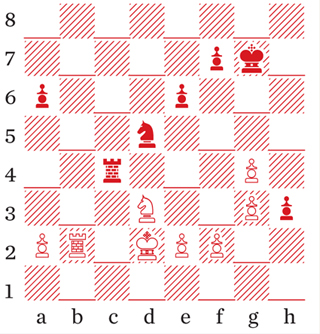
Solution: Korchnoi played the line-cutting 39…Rc1!! Whichever way White captures, he will block his own Rook from covering the Queening square h1, and the Black h-pawn will touch down.


