


Without that telos — which is best observed in the symbolism of the English coronation rite — executive, legislature, judiciary, the other agencies of the state, the forms of voluntary association in civil society, can only be disoriented in the original sense of that word. They can only be without clear orientation to a good. Too much modern human-rights talk elevates freedom over virtue, not realising that any significant freedom — as distinct from my indifferently choosing a vanilla rather than a chocolate-flavoured ice cream — is always freedom for the good.
In comparison, secular liberalism, even where not anti-humane, is pretty thin gruel. Those who have adopted a secular mindset from -exalted motives may view a secular state as simply a pragmatic response to cultural diversity, albeit an important piece of pragmatism since it holds out the hope of social peace. They fail to see that every such response carries its own ideological load, which may include substantial negatives. Considered as a state ideology, secular liberalism, paradoxically enough, has one attribute in common with the Islamist militancy that is propelling it toward power and prospective hege-mony. It will not address questions of the common good in a way that can build up a firm texture for the social fabric. While Islamist terrorism seeks the outright dissolution of that texture, such liberalism merely allows it to unravel. But the result may be much the same: an atomism that destroys effective solidarity.
Nor is that by any means the only objection against this fashionable nostrum. Secular liberalism cannot help looking for a politics without memory, which is why it allies so readily with mass-media pundits bound to the instant contemporaneity captured in the soundbite. It seeks emancipation from the long process of historical time with its often fruitful ambiguities and replaces it by subjugation to the present. It is a modernism insouciant of the past, but its attempt to sever the past from the future produces an attitude to human living that devalues the real present, depriving it of richness of reference. The theorists of secular liberalism have their own (contractarian) “tradition”, which is not one of life but of thought-experiments by ratiocination, hence the inverted commas. It is a “tradition” defined by enquiry into what any rational agent would do to acquire minimum security, and hence is always inclined to deny history and particularity, including those of a religion.


- The US Can Still Help Save Syria — and Iraq
- Russian Resurgence has Blindsided Nato
- On Europe, Nothing Less than Treaty Change will do
- Putin has his Useful Idiots on the Left and the Right
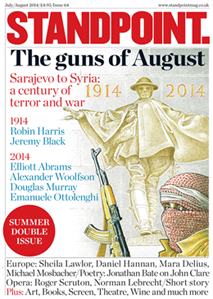
- Sarajevo: Where the Century of Terror Began
- Allen Lane’s Pelicans Take Wing Once More
- How Not to Remember the First World War
- Opera is Not Just Our Most Expensive Noise
- Jonathan Miller: One Man, Two Cultures
- Without a Big Idea, Cameron Will Lose
- A Christian Country? No, a Conservative One
- How to Get School Competition Right
- The War on the Firmest Bulwark of our Liberty
- How Modern Liberals Created Nigel Farage
- Caught in the Trap of His Own Metaphysics
- In Search of My Father, Agent of the Comintern
- Geoffrey Hill and the poetry of ideas
- Master of the Glories of the English Country Garden
- Independence Will Do Nothing for Scots
- Bullying and Bluff on the Road to Referendum

6:02 PM
11:07 AM
5:07 PM
11:06 AM