



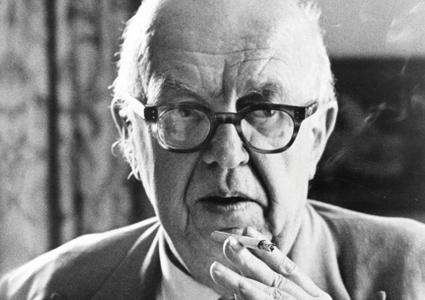
 C.P. Snow: He lamented the “ocean” that he saw between the boffins and the literati (©JHU SHERIDAN LIBRARIES/GADO/GETTY IMAGES)
The last few years have given us three good British films about four exceptionally brilliant mathematicians: The Theory of Everything (Hawking), The Imitation Game (Turing at Bletchley) and The Man Who Knew Infinity (G.H. Hardy and the Indian genius Ramanujan in Cambridge). They taught us something about these men (so that the semi-numerate could talk about maths) while issuing a challenge to the ignorant to find out what they actually discovered, which the films barely attempted to explain.
The films function as middlebrow bio-pics, but by engaging with mathematical matters they also put some viewers in mind of the novelist C.P. Snow and his seminal “Two Cultures” lecture of 1959. Snow lamented the “ocean” that he felt lay between the literati and scientists, and accused the former of being “natural Luddites”. He himself could bridge this sea because he had been a physicist. He approved of the way the Soviets were training huge numbers of physicists and engineers (they had “judged the situation sensibly”), and worried that Britain would be left behind because of the “traditional culture”. He explained that at a literary party, not a single guest could repeat the Second Law of Thermodynamics (“the response was cold. And also negative”: it’s clear that he wasn’t the life and soul). He succeeded in making it celebrated among scientific laws.
His call to action in education and literature struck an international chord; F.R. Leavis was so enraged by its success that he weighed in with an almost comically unhinged attack on Snow, published in the Spectator. Leavis thought that he had no obligation to know about science and that Snow’s pontificating showed that he was “as intellectually undistinguished as it is possible to be”, exposing “a complete ignorance”. In America Lionel Trilling more subtly analysed flaws in Snow’s argument — for example that it almost disregarded international politics.
The debate was surely the last major branching of an ancient cultural tree: Leavis’s attack was the old hostility that the Romantics had felt for the Utilitarians. Some of our best creative writers from Arnold to Orwell had produced impressive critiques of contemporary culture; and we had valued our sages and visionaries such as Carlyle, Ruskin, Shaw and Russell. But by the 1960s, we seemed, as a society, to be losing touch with such elevated thinking, and Leavis’s fury was probably self-defeating.
In the 50 years since, further scientific and cultural revolutions have happened. In the literary world, now much more diverse, some well-known writers have taken on scientists, including Michael Frayn in Copenhagen, his play about Bohr and Heisenberg; John Banville in his Revolutions trilogy; Harry Thompson in This Thing of Darkness, on the voyage of the Beagle; and the wonderful Penelope Fitzgerald in The Gate of Angels, about Cambridge physicists. Most, though, have been content to ignore Snow’s strictures. I know an excellent writer who said that he would despise a scientist who didn’t know some great literature; yet he could not quote a single scientific law or theorem, and admitted that he stood self-accused of hypocrisy.
Like this article? Share, save or print using the icons below:


- Cyril Ramaphosa's poisoned chalice
- Is South Africa about to fall apart?
- The inevitability of Fortress Europe
- The onslaught against the West's moral codes
- Technology menaces childhood and culture
- Is the mental illness epidemic just a myth?
- How Monet created motion pictures
- Presidents for life Putin and Xi menace the West
7:03 PM
12:03 PM
9:03 PM
5:03 PM
6:03 PM
5:03 PM
4:03 PM
3:03 PM
1:03 PM
11:03 PM