


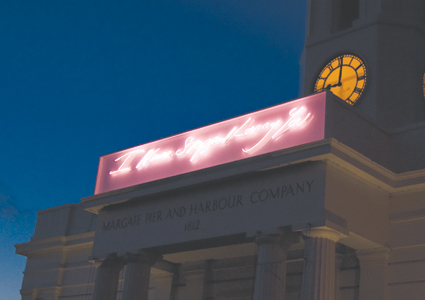
 Neon sentiment in Margate: “I Never Stopped Loving You”, 2010, by Tracey Emin (photo: Katie Hunt, via Flickr)
If last year’s debates about Britishness demonstrated anything, it’s that a culture cannot be reduced to a checklist of its most popular dishes and landmarks. Society is built, instead, upon the countless habits and rituals of its members, both living and dead. Since collective identity emerges imperceptibly from these everyday experiences, our understanding of ourselves is always rather nebulous and imprecise — like one of those optical illusions that, when one focuses too hard, dissolves back into the page. As each generation passes, we forget something essential — if intangible—about ou rselves. With the final breath of every dying person, some small spirit of the age escapes irretrievably into the air.
Throughout history, civilisations have compensated for this loss by stowing their shared memories in communal institutions. But today, for perhaps the first time in history, large chunks of our culture appear indifferent, even hostile, to their own past.
Look, for instance, at the art world. For many centuries, the West’s artistic traditions were held among its most precious assets, for they conveyed — by melody and brushstroke — so many things otherwise inexpressible about who we are. But at the beginning of the 20th century, culture suddenly took a different turn: artists, no longer content simply to loosen the ties and top buttons of convention, stripped themselves completely, doused their clothes in petrol, and set them alight.
Swept by the modernism surging through Europe’s veins, they sought to overturn and recreate everything anew. Declaring their own traditions irrelevant, they butchered them. Schoenberg irrevocably scrambled tonality. Duchamp scribbled a moustache on the Mona Lisa.
The great oaks of Western art were burned to the ground. Today, radical artists are left scouring through the embers, still looking for last traces of life. Their primary target is now the taboo — the unspoken memory of a once-communal system of values. Tracey Emin shows us her unmade bed, strewn with used condoms and bloodied underwear. Damien Hirst suggests that the 9/11 hijackers “need congratulating”. Every last inherited standard — every last comfort — must be torn from us once and for all.
But by trying so hard to wipe its own memory, art comes perilously close to losing its sense of self altogether. Once the shocks no longer shock, what does it stand for? A few generations after the narcotic highs of modernism, the art world has left itself largely brain-dead.
This tragedy acts as a miniature simulation of just how easily — and quickly — cultures can wither away. And it ought to alarm us to see the same pattern emerging right across Western society.
Consider the main philosophical movements of the 20th century. The majority followed the fearsome footsteps of Friedrich Nietzsche — the man who killed God and buried good and evil at His side. And though they grappled with his legacy in a variety of ways, they shared, more or less, the same key assumption: that the traditional pursuits of thought — truth, beauty, meaning — were fundamentally misguided. Philosophy, unable to comment on the world, turned instead to — and on — itself. “Having broken its pledge to be at one with reality,” Theodor Adorno wrote, “philosophy is obliged to ruthlessly criticise itself.”
Like this article? Share, save or print using the icons below:


3:09 PM
4:07 PM
8:07 PM
4:07 PM
5:07 PM
7:07 AM
1:07 AM
5:06 PM
1:06 AM
10:06 PM