

You are here:   Civilisation >  Critique > The Drumming of an Army


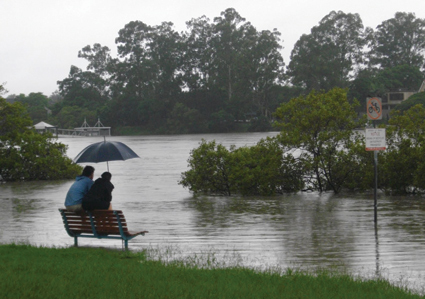
It never rains: Brisbane, January 2011 

Poetry, said Auden, makes nothing happen. Usually it doesn't, but sometimes a poem gets quoted in a national argument because everybody knows it, or at least part of it, and for the occasion a few lines of familiar poetry suddenly seem the best way of summing up a viewpoint. Just such an occasion has occurred recently in Australia.  By the time the heavy rains first hit Queensland early this year, the theory of Catastrophic Anthropogenic Global Warming (CAGW, to borrow the unlovely acronym) was ceasing to exercise unquestioned thrall in the minds of Australia's progressive voters. But spokespersons for the Green party clung on to it, encouraged by the fact that the theory, in its Climate Change form, was readily applicable to any circumstances.  

Before the floods, proponents of the CAGW view had argued that there would never be enough rain again, because of Climate Change. When it became clear that there might be more than enough rain, the view was adapted: the floods, too, were the result of Climate Change. In other words, they were something unprecedented. Those opposing this view — those who believed that in Australia nothing could be less unprecedented than a flood unless it was a drought — took to quoting Dorothea Mackellar's poem "My Country", which until recently every Australian youngster was obliged to hear recited in school. In my day we sometimes had to recite it ourselves, and weren't allowed to go home until we had given evidence that we could remember at least the first four lines of the second stanza, which runs like this. 

I love a sunburnt country,
A land of sweeping plains,
Of ragged mountain ranges,
Of droughts and flooding rains.
I love her far horizons,
I love her jewel-sea,
Her beauty and her terror —
The wide brown land for me.

The first four lines of the stanza are the bit that everybody knows, partly because they are so addictively crafted, and partly because they fit the national experience of what Australia's geography and climate are actually like. In any household, the seniors (known in Australia as "the wrinklies") remember the droughts and the flooding rains of their childhood. I myself remember the Maitland floods of the early 1950s. The whole of the central seaboard of New South Wales was under water. I can remember rain you couldn't see through: right there in my southern suburb of Sydney, the creek flooded the park, and the lake in the park spilled into the bottom of our street, prompting the construction of a galvanised iron canoe in which three of us sailed to what would have been certain death if the contraption had floated for more than a few seconds.  

View Full Article
 
Share/Save


Cheryl
March 5th, 2011
9:03 AM
Thank you Mr James, a great and timely piece. As you no doubt know our PM, be that Gillard or Brown - no one is sure any more, has announced the introduction of a 'carbon' tax from 1 July 2012 (they have dropped the dioxide). Flim Flannery is being paid $180,000.00 per annum for the next 4 years, for just 3 days work per week, to convince the public that this is good policy. The good news is that by 2100 we will save the temperature rising by some 0.0005 degrees centigrade. Well worth the $billions, don't you think? /sarc

Wayneofperth
March 5th, 2011
9:03 AM
At last simple common sense but I despair that it will carry the day. When I see the first dam built in Australia in 30 odd years I will celebrate.

Helen Morgan
March 5th, 2011
7:03 AM
I have just read this article in "The Australian", and I have to say I have lost a bit of my afternoon nap over disappointment with you Clive. What you say is always entertaining, and in this case, possibly true. In fact, when the rains were falling and the water rising here in Brisbane, I did think back to Dorothea McKellar. The problem is, when you speak, people listen, and that is the nub of the issue for me. The problem is that we keep distracting ourselves into tit-for-tat debate over the environment, which is in a critical state, instead of acting decisively. In any risk mitigation strategy I know of, if Professor Fenner (inventor of cure for Small Pox, and a very eminent scientist who has given a part of his life to studying the environment) and others with similar credentials were making horrifying predictions about the extinction of the human race within 100 years, we would be jumping up and taking radical actions, JUST IN CASE it was true. Not standing around debating the details of this statement. Why? Because the prediction is so horrifying, and the people making it have spent quite a few years studying the subject. I don't personally find scientists 'alarmist' or 'emotionally reactive', as those on the side of the environment in this debate are often painted. Most scientists I have ever known are calm and fairly logical and prone to gathering evidence before speaking out. If not one, but a chorus of eminent scientists is saying "the human race is in danger of extinction within an uncomfortably short timeframe", then I don't think it is up to the "men of letters" to engage in witty debate about it. Clive, forgive me for saying so, but compared to my children, you are not long for this world. I don't think it is right that you use your influence to distract this debate. It doesn't bloody well matter, at all, whether the weather is changing because of the influence of man on the planet, or not. What matters is that human beings (not least because of the advent of the cheap products overseas manufacturing boom of the last 20 years, combined with population growth, the planned obsolescence of products, and the belief that consumption brings happiness)are consuming under an economical model that is not sustainable for the earth. In the words of Professor Fenner and others, our demise will be as a result of food shortages, catastrophic weather, conflict over resources, among other things. So let's remove "catastrophic weather" from that line, because it is distracting us too much. Can we please just accept some possibilities, and then think what to do. Let's do it for our children, just in case its true. There are more than a few indicators that we are in trouble on the earth and we need to act decisively, and in unison.

Keith
March 5th, 2011
6:03 AM
Brilliant Clive. May many a climatologist and bureaucrat hear the drumming of your words. An army disciplined and marshalled into the service of sense and sanity.

Anonymous
March 5th, 2011
6:03 AM
And yet, Mr James, the world is warming.

Tony Downes
March 5th, 2011
6:03 AM
An absolute gem is our Clive James, a living treasure in my book. I always find you can tell the people who don't know the poem so well when they use rugged instead of ragged. Everytime my family travels outside the city i say, "you know what this reminds me of?" (my wife exclaims no not again) then I recite the poem to all in the car. The ups and downs of the Australian climate don't detract for one second on it truly being the lucky country, My Country. Tony Downes Brisbane

keithm
March 5th, 2011
6:03 AM
It's curtains for climate change alarmists when even literary essays call them warmists. Bye bye, global warming... But whoops, the correct spelling is Gunnedah.

Colin Stent
March 5th, 2011
6:03 AM
We see and hear much too little of live James.

John Williams
March 5th, 2011
6:03 AM
You're always such a bloody good read Clive! .."Pride comes from facing facts, and in Australia the facts are that the climate will starve you or wash you away, unless you build something." Yes, we might get a dam or three past these numbskulls now, but we will have to put a few down first...and we are not talking four-legged animals here.

DaleC
March 5th, 2011
5:03 AM
And likewise... SAID HANRAHAN by John O'Brien "We'll all be rooned," said Hanrahan, In accents most forlorn, Outside the church, ere Mass began, One frosty Sunday morn. The congregation stood about, Coat-collars to the ears, And talked of stock, and crops, and drought, As it had done for years. "It's looking crook," said Daniel Croke; "Bedad, it's cruke, me lad, For never since the banks went broke Has seasons been so bad." "It's dry, all right," said young O'Neil, With which astute remark He squatted down upon his heel And chewed a piece of bark. And so around the chorus ran "It's keepin' dry, no doubt." "We'll all be rooned," said Hanrahan, "Before the year is out." "The crops are done; ye'll have your work To save one bag of grain; From here way out to Back-o'-Bourke They're singin' out for rain. "They're singin' out for rain," he said, "And all the tanks are dry." The congregation scratched its head, And gazed around the sky. "There won't be grass, in any case, Enough to feed an ass; There's not a blade on Casey's place As I came down to Mass." "If rain don't come this month," said Dan, And cleared his throat to speak - "We'll all be rooned," said Hanrahan, "If rain don't come this week." A heavy silence seemed to steal On all at this remark; And each man squatted on his heel, And chewed a piece of bark. "We want an inch of rain, we do," O'Neil observed at last; But Croke "maintained" we wanted two To put the danger past. "If we don't get three inches, man, Or four to break this drought, We'll all be rooned," said Hanrahan, "Before the year is out." In God's good time down came the rain; And all the afternoon On iron roof and window-pane It drummed a homely tune. And through the night it pattered still, And lightsome, gladsome elves On dripping spout and window-sill Kept talking to themselves. It pelted, pelted all day long, A-singing at its work, Till every heart took up the song Way out to Back-o'-Bourke. And every creek a banker ran, And dams filled overtop; "We'll all be rooned," said Hanrahan, "If this rain doesn't stop." And stop it did, in God's good time; And spring came in to fold A mantle o'er the hills sublime Of green and pink and gold. And days went by on dancing feet, With harvest-hopes immense, And laughing eyes beheld the wheat Nid-nodding o'er the fence. And, oh, the smiles on every face, As happy lad and lass Through grass knee-deep on Casey's place Went riding down to Mass. While round the church in clothes genteel Discoursed the men of mark, And each man squatted on his heel, And chewed his piece of bark. "There'll be bush-fires for sure, me man, There will, without a doubt; We'll all be rooned," said Hanrahan, "Before the year is out." Around the Boree Log and Other Verses, 1921

Post your comment

CAPTCHA
This question is for testing whether you are a human visitor and to prevent automated spam submissions.