



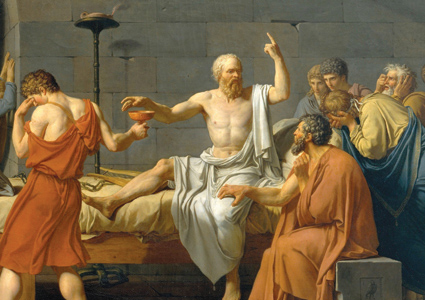
 Detail of “The Death of Socrates”, by Jacques-Louis David, 1787
This autumn, our youngest daughter went to university to read philosophy. Some of the family were not entirely sure that this choice of subject was a good idea: what, they asked, would a philosophy degree do to help her earn a living? I, however, defended her decision — not that it would have mattered if I hadn’t, as she is a determined young woman — on the grounds that philosophy not only teaches practical skills — to think, argue and write well, for example — but that it is a good thing to study for its own sake. Philosophy is the cornerstone of high culture, or so I have believed ever since I discovered its pleasures at school in the dialogues of Plato and the aphorisms of Nietzsche. No educated person ought to be entirely ignorant of philosophy, any more than of science or mathematics, literature or the arts. How are we to make sense of the world, of other people, or of ourselves, without the tools with which the great philosophers have provided us? Above all, though, philosophy can be fun. Where would we be without Ockham’s Razor or Zeno’s Arrow, the Principle of Sufficient Reason or the Categorical Imperative, the Veil of Ignorance or the Liar’s Paradox? To philosophise is not only to learn how to die, but also how to live life to the full.
That, at least, is what I told my family and myself. But is it really true? There are at least three things wrong with the way philosophy is practised and taught at our universities today. The first (“Objection 1”) is that so much philosophy now takes the form of specialised, highly technical and often quite recondite commentary on other philosophers’ work. This is hardly a novel phenomenon: in the 16th century Montaigne already complained of such learned obscurity: “There is more business in interpreting interpretations than in interpreting things, and more books on books than on any other subject: all we do is gloss each other.” Even if the Scholastics had debated how many angels could dance on a pin-head, which in fact they never did, they could never have competed with the pointy-headed pointlessness of many present-day philosophical debates.
The second caveat (“Objection 2”) is that insofar as contemporary philosophy does come up with intelligible conclusions, they are frequently banal. Take, for example, On What Matters, the Oxford philosopher Derek Parfit’s two-volume magnum opus, published in 2011. His 1,400-odd pages are unusually clear and cogent; it was generally praised as a major work making original contributions to the whole field of present-day philosophical debate. Yet his answer to the question “What matters most?” is underwhelming. In Volume One he writes: “What now matters most is that we rich people give up some of our luxuries, ceasing to overheat the Earth’s atmosphere, and taking care of this planet in other ways, so that it continues to support intelligent life.” This seems to me to be not much better than a statement of today’s — probably ephemeral — conventional wisdom. Philosophers have no special insight into natural phenomena such as climate change; you don’t need to study ethics to renounce luxuries or take care of the planet. Volume Two concludes: “What matters most is that we avoid ending human history.” This may be true; but apart from mad dictators or religious fanatics, such as the Supreme Leaders of North Korea and Iran, Kim Jong-un and Ayatollah Khameini, who on earth would disagree? If this is the best that philosophers can do to explain the meaning of life, the rest of us may well think that we can save ourselves the trouble of reading them.
Like this article? Share, save or print using the icons below:


- Why On Earth Should Anyone Study Philosophy?
- The Dying Days Of Zuma's South Africa
- His Master's Voice: Scruton On Wagner
- Why The Most Civilised Of Men Felt Like A Fraud
- Political Misconduct
- Cicero's Analysis Of Decline Offers Lessons For The West
- The Dead End Of Identity Politics
- Trump's Appeal Is More Roosevelt Than Reagan
1:09 AM
1:09 AM
9:09 PM
6:09 PM
3:09 PM
4:09 AM
2:09 AM
2:09 AM
2:09 AM