



Mao's forces "liberated" East Turkestan from local leaders in 1949. He was convinced that the territories held the resources China needed for an industrial future and the room for both its exploding population and atomic testing. Xinjiang became central to the communists' master plan for superpower status. Han settlers began to trickle into the Chinese frontier. They arrived in Islamic oasis towns unchanged since the Middle Ages, utterly different from the crowded East Asian villages. The pioneers were a mixture of fanatical young communists and the bedraggled remains of the trounced armies of the nationalist generalissimo Chiang Kai-Shek. Many of China's own gulags, the laogai, were built in the region. Like neighbouring Siberia, Xinjiang was a desert of promise and exile during the Cold War. Rumours have circulated since the 1960s that the territory housed the largest prison camps in the world, with up to 500,000 inmates.
Only in the past 30 years of reform has Beijing had the muscle and determination to turn East Turkestan into Xinjiang. The figures speak for themselves. Han Chinese constituted fewer than seven per cent of the population in 1949, climbing to 33 per cent by 1964 and 40 per cent by 2000. The Han are now the overwhelming majority in the northern and eastern parts of Xinjiang, although these numbers do not include army personnel serving in Xinjiang and their families or the large numbers of unregistered migrant workers, the floating peasants, who can be found in any Chinese region. Kashgar, at the foothill of the Pamir range and closer to Islamabad than even the regional capital of Urumqi, is the last stronghold of the Uighurs.
The rules just got worse." Muhammad is a green-eyed driver with a taste for Uighur jazz — a fusion of recorded gunshots, trumpet and saxophone. "After the riots, the rules got worse." Muhammad is referring to how China carried out its occupation and how its grip has tightened since violent unrest broke out last summer. The Uighurs I spoke to claimed they were not allowed to leave the country and that children were banned from religious instruction, attending the mosque or Ramadan fasting. They say that they are allowed to pray using only a state-approved Koran at party-sanctioned mosques and that a job in the state sector means no headscarves or beards.
They say Uighurs cannot own internet cafés, gather in large groups without a permit and are cut out of job opportunities. To campaign for independence, however non-violently, is banned. The use of the Uighur word for China — the originally Russian Kitai — is also banned. This only encourages its use. Xinjiang cannot work on a different time zone — China, despite its size, is one big time-zone — despite being further from Beijing than London is from Istanbul. All signs must be in Mandarin with Uighur as an option, despite locals estimating that fewer than 20 per cent of people there speak Mandarin. They say they are second-class citizens who find it much harder than the Han Chinese to get work.
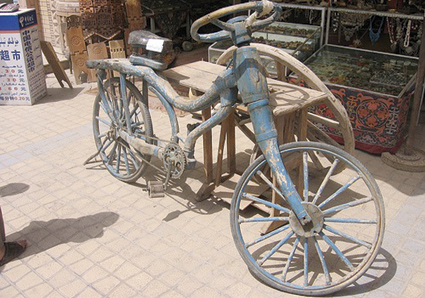
A wooden bicycle
Uighurs are terrified that by mid-century they will have become the Apache or Cherokee of China's Wild West. They believe that Beijing plans to move up to 200 million Han to Xinjiang.
In the East, the Chinese I meet are incredulous at the suggestion that the Uighurs are frightened of the future. Why are they not grateful for the millions of dollars and the impressive infrastructure lavished on the region? They are exempt from the one-child policy and have positive discrimination to attend university: how can they complain? Surely only a terrorist would want to exit the world's biggest booming economy in favour of creating another Islamic 'stan? Many are frightened of terrorism but most Han think all Uighurs are untrustworthy potential thieves. They seemed confused that Westerners could support Tibetan or Uighur rights. How would America react if China started supporting native American separatists?


- Beirut: Hariri — An Assassination Too Far
- New York: A ‘Post-racial’ American vs an Old Coot
- Pristina: Kosovo's Liberal Islam
- Oslo: Courage and Cowardice in Scandinavia
- ONLINE ONLY: Washington, D.C.: It's Not Rocket Science!
- La Hague: Recycling the French Model
- Jerusalem: No Via Media for Anglicans
- ONLINE ONLY: Beirut: Blood Holiday
- Rome: Arrivederci Roma
- Darfur: Panic at the Palace
- ONLINE ONLY: Letter from Bamian
- Caucasus: Diary, August-September, 2008
- ONLINE ONLY: South-East Asia: The Demons of Ignorance
- New York: Diary
- Ypres: Never Say Never Again
- New York: A Cousin in the White House
- Caracas: Chávez's Secret Fan Club
- Prague: Diary
- Park City, Utah: Movie that Pulls Aside the Veil
- Beirut: Blood on the Streets
- India: Tariq Ali's Plan for Pakistan
- Berlin and Cologne: A Tale of Two German Cities
- Mumbai: On the 'Slumdog' Trail
- Budapest: Screwed Left, Right and Centre
- Paris: Mayhem in the Marais
- Stanford, CA: Intellectual Life Under Obama
- Colombia: A Nation Reborn
- Paris: Prisoner of the Barbarians
- United States: The Path to Rome via San Francisco
- ONLINE ONLY: Black Russian
- South Africa: The ANC'S Health Lesson for Obama
- Lisieux, France: Relics of Thérèse
- Germany: Heidegger - Being, Time and Place
- Moscow: Putin's Empire Strikes Out
- Connecticut: My Battle Against Google
- Montana: Home From Home on the Range
- Siberia: In Search of the Gulag
- Rio's Heart of Darkness
- Mogadishu: Armageddon on Steroids
- Havana: The Castros Will Not Be Absolved
- Kaliningrad: Russia's Outpost in Europe's Heart
- Bishkek: Bloodsoaked Revolution
- Bishkek: Downfall of a Dictator
- Oslo: Signing OFF on Human Rights
- Bajaur: A Talk with the Taliban
- Bahrain: Women Drivers Welcome Here
- Tajikistan: In Search of the Yeti
- ONLINE Only: Ankara's Proxy
- Johannesburg: Hard Pressed
- Istanbul: Press Freedom Alla Turca
- Xinjiang: Taming China's Wild West
- The Lesson of Oz
- The Surge is Working — So Far
- A Tale of Love, Bulls and Goats
- Old-order Collapse
- Egypt's New Dawn Chorus
- From Carthage to Kasserine
- After Gaddafi: A New Libya Emerges
- To the Polo Saddle Born
- The Settlements: Life Between the Lines
- Exposed: Carnita's Cover Story
- "At last, I feel proud to be Libyan"
- Books Do Furnish a Little Freedom
- Fat Chance for Christie—This Time
- Easy Lies the Head that Wears the Crown
- Putin's Chinese Whispers
- Cain Isn't Able and Newt Defies Gravity
- The Ten Years' War against the Taliban
- We The People Say: Get Out of The Way
- Wanted: A New Ronald Reagan
- Time to Crunch the Numbers
- Who's Really Supreme?
- From Art as Life to Blood and Soil
- Talking Tactics
- The Wagner Family Soap Opera Rolls On
- Winning the Veepstakes
- Romney Takes a Risk with Ryan
- Window Brothels Get the Red Light
- Can Romney Spring an October surprise?
- Canada's Crusader for Conservatism
- No-Go Areas on the Campaign Trail
- Republicans Must Avoid Civil War
- Norway's Problem with Anti-Semitism
- Turks, Arabs and Jews: The Middle East in Crisis
- Nations United in Hypocrisy
- Siberia: Shamans, Spies and the Secret Police
- Barracked by Obama's Oratory
- Women Come Last in Syrian Refugee Camps
- The Dawn of Obamageddon
- Americans Know Her True Worth. Do We?
- Hapless Hollande’s French Farce Flops
- Save the NYPD So It Can Save the City
- Obama's Secrets Start Unravelling
- Syria Isn't Bosnia: Don't Arm the Rebels
- Who Can Stop Hilary in 2016?
- Teaching China's Anglophiles
- On Pilgrimage with the Hasids
- From Eastern Europe to the East End
- True Grits
- The Rise and Rise of Marine Le Pen
- Cold Comfort On Global Warming
- Hunting the Lynx with the Old Believers
- High-tech Israelis Aim For The Moon
- The Russians Are Coming
- The Turbulent Minister is Right
- Bad Times for Good Samaritans
- This Expat Paradise is a Woman’s Nightmare
- Two Generations Lost to Communism
- Strangers in their own Holy Land
- The Isles are Full of Big Noises
- The Kurds: Israel's not so Improbable Allies
- Islam and Innocence: Canada’s Predicament
- The Fifth Republic’s Darkest Days?
- Let's Make Putin's London Cronies Sweat
- The Global Politics Of Netanyahu's Victory
- A Grim Prospect For South Africa's Jews
- No End In Sight To The Exodus From Libya
- Undeterred, Erdogan Usurps Ataturk's Legacy
- Gaza Withdrawal Symptoms
- Red Flags Flying Over Parliament Square
- Mutinous Talk In The Highlands
- Our Principles Are All We Have
- Why The Swedes Have Had Enough
- Canada's First Nations Come Last
- Islam and the French Republic
- Unconventional Convention
- The Dying Days Of Zuma's South Africa
- I'm Not Antisemitic, But...
- The ELM, Dispatches and Awlaki
- A Larger Than Life Predator

8:10 PM