



Although the victorious Allies punished few people after 1945 for Nazi war crimes, several members of Toepfer's boards and prize panels were sentenced to death: one committed suicide after his capture; another died of illness while awaiting trial; others were jailed. Toepfer fared better. After a two-year internment, he was freed in 1947. By this time, food shortages meant that the British occupation authorities needed his firm's expertise in agricultural trading. During internment, Toepfer's lawyers had obtained the usual testimonies (from, among others, Ernst Jünger) claiming that he had been associated at great personal risk in the 20 July 1944 plot to assassinate Hitler, had stood up for Jewish grain merchants in Hamburg, had refused to join the Nazi party, and so forth. The fact that the Nazis had arrested and detained him in 1937-38 became an asset.
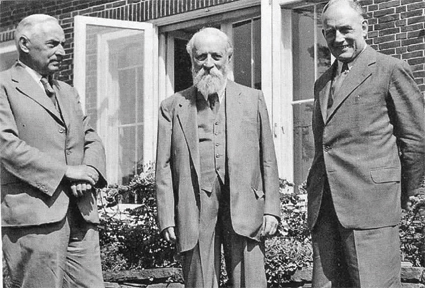
The Jewish philosopher Martin Buber with Toepfer in 1953 at the Toepfer Foundation's guesthouse
His arrest in 1937 was a central plank of Toepfer's story during his internment in 1945-47 and has remained a feature of the Toepfer defence ever since. Crucial to this version is the thesis that the arrest was for political rather than economic reasons. The weight of evidence does not support this. His arrest was one of several separate cases involving alleged currency offences by import-export merchants. It followed an anonymous poison-pen letter sent to the German authorities by a member of Toepfer's staff. The main charge was that his and his brother's complex structure of foundations was an artificial tax-avoidance device.
A subsidiary allegation concerned his connection with the writer Ernst Niekisch. An anti-democratic, anti-Semitic nationalist and socialist, Niekisch had (with financial backing from Toepfer) edited a journal titled Resistance. At the time, the "resistance" in question had been against the Weimar Republic, not as Toepfer later implied, against the Nazis. When Hitler came to power in 1933, Toepfer welcomed this development. Niekisch did not and was eventually sentenced to life imprisonment for "literary treason". Investigations by the Hamburg Gestapo in 1937 produced scant evidence of a continuing link between the two men.
Toepfer retained his wartime profits and rapidly expanded his grain business, building a considerable fleet of ships for the purpose. From the late 1940s, he used his wealth to run a double life. On the surface, he was politically correct, announcing his conversion to the idea of a united Europe. He restarted his highly funded prizes, now taking care to include a smattering of Jews in the winners' roster. In 1951, the Jewish philosopher Martin Buber won the "Hanseatic Goethe Prize". Toepfer started to make awards to West German, Austrian, French and British politicians. French acting President Alain Poher and Georges Pompidou's Interior Minister, André Bord, were among them.
Toepfer's CBE was one of an extraordinary variety of degrees, medals and awards showered upon the Hamburg multi-millionaire. Toepfer's purchase of honours was on a scale worthy of Maundy Gregory. (The chairman of Oxford's selection committee for the Hanseatic Scholarships later felt that the award of the CBE was sufficient proof that Toepfer was a man of honour. This may help to explain the university's failure to investigate further.)
For a man who claimed to have been a non-Nazi and indeed an active anti-Nazi, Toepfer was extraordinarily generous and close to some of the most senior and most rabidly anti-Semitic members of the old political order. By giving prizes mainly to famous writers, architects and artists, Toepfer made it respectable to bestow other awards on Nazi associates and a series of anti-Semitic, völkisch (racist) writers and scholars.
The two faces of the Hamburg businessman are illustrated by his daughter Gerda's visit to Oxford in 1951. Gerda stayed for months at the home near the Dragon School of Herma Fiedler, the daughter of the professor who had lobbied for the original Hanseatic Scholarships. In December 1951, Gerda Toepfer and Herma Fiedler visited the elderly poet laureate John Masefield to give him the Shakespeare Prize originally granted in 1938. Coinciding with the prize-giving at the poet's home, there was a public ceremony in Hamburg.


- The inevitability of Fortress Europe
- Why the World Cup is a game of tribes
- Why Israel needs its new nation-state law
- The devout sceptic: hope for those of little faith
- Will Trump's foreign policy revolution fail?
- After Draghi departs, eurozone deluge looms
- The poor need the rich to always be with us
- Is the mental illness epidemic just a myth?
- No need to sell your oil shares just yet
- Can Macron wear the General's uniform?
- Trump prefers energy dominance to Paris
- A spectre haunting Europe: Karl Marx
- The battle for British Muslims' integration
- Did Winnie's crimes open Nelson's eyes?
- Belated revenge of the 1968 generation
- Jean-Paul Sartre: the supernova of the far Left
- Presidents for life Putin and Xi menace the West
- Nation states could save the Middle East
- The Trump Presidency is bigger than the man
- Great power politics means greater dangers

- Cyril Ramaphosa's poisoned chalice
- Is South Africa about to fall apart?
- The onslaught against the West's moral codes
- Technology menaces childhood and culture
- Will the genius of the common law survive?
- Presidents for life Putin and Xi menace the West
- How Monet created motion pictures
- Is the mental illness epidemic just a myth?
7:11 AM
3:04 AM