



Toepfer, who insisted on remaining anonymous as the donor, was a self-made man whose Hamburg grain business was flourishing. Fearing the power of Jews to harm his commercial interests in New York and Buenos Aires, he hesitated to declare his Nazi sympathies. He was so secretive that he sent letters to close colleagues within Germany under the pseudonym "Mr Hoffmann". He combined a nose for tax evasion and currency manipulation with strong nationalist feelings. By using charitable foundations already set up by 1931 and by moving money between banks in New York, Amsterdam, London and Liechtenstein, he could aid the Nazi regime while escaping the restrictions of its currency-exchange regulations. In fact, he was arrested in 1937 for suspected infringements of these controls. He finally escaped punishment largely because of his high Nazi — and especially SS — patronage. On 10 December 1937, The Times reported that Hermann Goering had made representations on his behalf.
A few weeks before Grimm's approach to Oxford, Toepfer published a financial report showing he was in lockstep with Nazi foreign policy: "For Britons, the world; for the Germans, the leadership of the Continent." By courting and lulling British opinion-formers, Germany would be freer to carry out its aggressive aims against Austria, Czechoslovakia and France. In 1936, Goebbels praised Toepfer in his diary as a clever, generous and enthusiastic patron.
Outwardly, Toepfer's cryptically named FVS and JWG Foundations existed to award lucrative prizes to leading European intellectuals. In Britain, a newly-created "Shakespeare Prize" was awarded in 1937 to Ralph Vaughan Williams. On the Continent, most members of the prize juries and most of the prize-winners were Nazis. They included prominent intellectual godparents of the Holocaust as well as pro-Nazi activists in countries across and beyond Germany's existing borders. Prize-giving ceremonies were swastika-clad gatherings of Hitler's elite supporters.
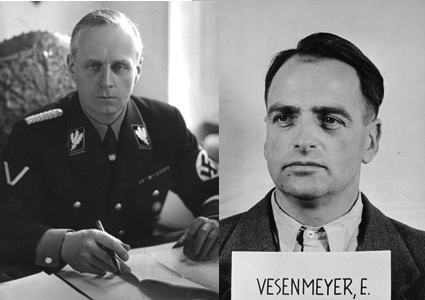
Joachim von Ribbentrop, Hitler's Foreign Minister and patron of Toepfer's Hanseatic Scholarships for Britons; SS Brigadier Edmund Veesenmayer, whom Toepfer employed after the war
The FVS and JWG Foundations had vital covert functions as well. American, Swiss and French diplomatic and intelligence archives, war crimes trials and documents in the — albeit expurgated — Alfred Toepfer Archive provide ample proof.
From the late 1920s, Toepfer purchased country estates in Germany and surrounding countries. In the 1930s, they accommodated residential courses for German Nazi cadres and potential recruits from surrounding lands. They served too as secluded gathering points for Nazi dignitaries (such as Deputy Führer Rudolf Hess and his staff), for party leaders from Austria (where the Nazi Party was banned from 1934-38) and from the Sudetenland.
The leader of Austria's clandestine Hitler Youth, SS Colonel Paul Minke, was active on Toepfer's board of directors. Minke ran the Hitler Youth's leadership school in Potsdam, made regular secret visits to Austria after 1934 and arranged for top Austrian Nazis to gather at the Toepfer mansion, Gut Siggen in East Holstein. They included Odilo Globocnik, who went on to head the notorious Operation Reinhard death camps in Poland, and Friedrich Rainer (later gauleiter, SS Lieutenant-General and Holocaust perpetrator). Rainer and SA Major-General Franz Hueber, Hermann Goering's Austrian brother-in-law, became Toepfer board members. In 1935 Toepfer made the Kalkhorst castle available to groups from Austria and other target states. Run initially by the Folk League for Germanhood Abroad (VDA) and then by the SS, the project enabled Toepfer to cultivate some of Himmler's most senior SS officers, including Werner Best, head of the Gestapo's administration and legal department, and Werner Lorenz, head of VOMI, the Ethnic German Liaison Office. An Austrian SS colonel, Franz Wehofsich, supervised the courses.
The Sudeten German leader Konrad Henlein (later a gauleiter and an SS Lieutenant-General) stayed secretly at one of Toepfer's mansions for several weeks in 1935. Reich Writers' Chamber president and Toepfer board member Hans Friedrich Blunck recorded that "Mr Hoffmann" and "the great unknown" (Henlein) hatched a "very big programme" for Nazi Germany and Czechoslovakia. Henlein became a leading board member of both main Toepfer foundations. During the Munich crisis of 1938, when Henlein's agitators and thugs needed a place of refuge on the German side of the Czech-German border, Toepfer offered them the free run of his properties.


- The inevitability of Fortress Europe
- Why the World Cup is a game of tribes
- Why Israel needs its new nation-state law
- The devout sceptic: hope for those of little faith
- Will Trump's foreign policy revolution fail?
- After Draghi departs, eurozone deluge looms
- The poor need the rich to always be with us
- Is the mental illness epidemic just a myth?
- No need to sell your oil shares just yet
- Can Macron wear the General's uniform?
- Trump prefers energy dominance to Paris
- A spectre haunting Europe: Karl Marx
- The battle for British Muslims' integration
- Did Winnie's crimes open Nelson's eyes?
- Belated revenge of the 1968 generation
- Jean-Paul Sartre: the supernova of the far Left
- Presidents for life Putin and Xi menace the West
- Nation states could save the Middle East
- The Trump Presidency is bigger than the man
- Great power politics means greater dangers

- Cyril Ramaphosa's poisoned chalice
- Is South Africa about to fall apart?
- The onslaught against the West's moral codes
- Technology menaces childhood and culture
- Will the genius of the common law survive?
- Presidents for life Putin and Xi menace the West
- How Monet created motion pictures
- Is the mental illness epidemic just a myth?
7:11 AM
3:04 AM