



Issues now confronting Oxford's Committee to Review Donations and a special Oxford-Cambridge sub-committee set up to decide whether to end the association with the Alfred Toepfer Foundation include how far Toepfer was involved in Nazi activities and whether the foundation bearing his name today misrepresents his record. If so, do either the source of the money or the legend that accompanies it matter? Is the way in which the Holocaust is taught — or, more accurately, is relatively little taught — at Oxford affected by the university's sources of funding?
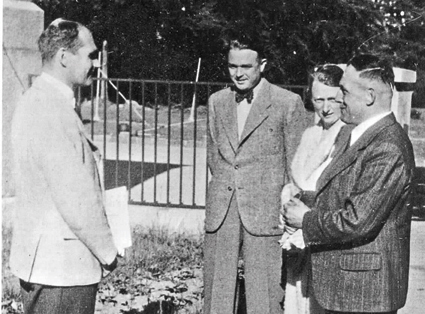
Alfred Toepfer (right) and his wife with Hitler's deputy Rudolf Hess (left) in June 1939
But the most important underlying issue is the trivialisation of the Holocaust implicit in the foundation's accounts of its founder's career. This is what has most angered a number of German and French historians.
Grimm's Oxford counterpart, Professor Hermann Fiedler, was the mainstay of the Taylorian and his bust still presides over its entrance. Fiedler was valuable to the Hitler regime. As former Oxford tutor of the Prince of Wales, later King Edward VIII, Fiedler had good connections. The fact that he was an Aryan with close family in Germany provided a useful lever. It was Fiedler who wrote to the editor of The Times in May 1937 that he was "appalled" that Oxford had refused to send an official representative to celebrate the 150th anniversary of Göttingen University, by then purged of Jews. Fiedler added that he had accepted Göttingen's invitation to him to be present.
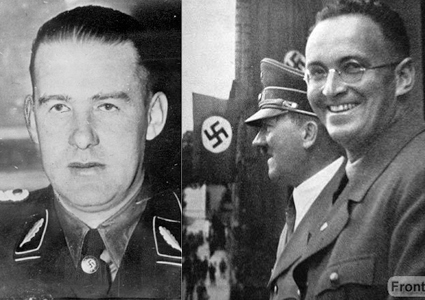
Death camp supremo Odilo Globocnik, whom Toepfer entertained at his country mansion; SS Lieutenant-General and Sudeten German leader Konrad Henlein, a board member of Toepfer's foundations before the war
Oxford was a priority target of Nazi cultural diplomacy. The presence of so many Jewish refugee academics provided daily reminders to the dons of Nazi racism. However, active appeasers, such as the Marquis of Lothian, were also associated with the university and with the Rhodes Scholarships. So it was not surprising that Joachim von Ribbentrop, Hitler's ambassador-at-large who headed the Nazi radicals within the German Foreign Office, took a personal interest in the project of scholarships to Germany for British graduates. Ribbentrop corresponded with Toepfer, addressed the Anglo-German Fellowship about the proposed Hanseatic Scholarships and became their patron. The British Prime Minister, Neville Chamberlain, was persuaded to issue a statement welcoming the first awards, an event publicised worldwide.


- Brexit may trigger a European revolution
- Wrong turn — or an inevitable process?
- Brexit and the UK constitution
- Wanted: a post-Brexit vision of national life
- How can Theresa May survive Brexit?
- Disestablish the C of E? Ask Corbyn
- Angry anthems of a doomed war poet
- In Corbyn’s mind, there is no place for the Jews
- The last Republican in the age of Trump
- A martial nation needs Churchill to inspire us
- Death of a bookman: the rise and fall of a publisher
- The inevitability of Fortress Europe
- Why the World Cup is a game of tribes
- Why Israel needs its new nation-state law
- The devout sceptic: hope for those of little faith
- Will Trump's foreign policy revolution fail?
- After Draghi departs, eurozone deluge looms
- The poor need the rich to always be with us
- Is the mental illness epidemic just a myth?
- No need to sell your oil shares just yet

- Cyril Ramaphosa's poisoned chalice
- Is South Africa about to fall apart?
- The inevitability of Fortress Europe
- In Corbyn’s mind, there is no place for the Jews
- The devout sceptic: hope for those of little faith
- How Monet created motion pictures
- Is the mental illness epidemic just a myth?
- Presidents for life Putin and Xi menace the West
7:11 AM
3:04 AM