


By persuading Gordon Brown to remain in Downing Street even when the realistic prospects of a coalition between the Liberal Democrats and Labour were remote, the Liberal Democrats were able to manoeuvre the Tories into agreeing a referendum on the Alternative Vote, something they had so far refused to concede. The Conservatives believed, wrongly, that Labour had offered AV to the Liberal Democrats without a referendum. David Laws admitted with notable euphemism that "there was some mangling across the parties" and "confusion" about what Labour had in fact offered the Liberal Democrats.
So, is it realistic to conclude that Nick Clegg became Deputy Prime Minister as a result of the propaganda emanating from the Cabinet Secretary and from his academic advisers about the constitutional need for inter-party coalition negotiations, following a hung election? Close observers such as the Conservative academic Lord Norton of Louth have argued that the personal chemistry between David Cameron and Clegg together with the electoral arithmetic were the most important factors in producing the coalition agreement. This may well be the case. Nevertheless, the impact of the Cabinet Secretary's pre-election statements cannot be discounted. They effectively authorised the constitutional reformers to manage public expectations, to "educate" the media to love coalitions and to pressure Gordon Brown to postpone the time of his resignation.
Only days before the May 2010 poll, Robert Hazell wrote in the Mail on Sunday that in the event of a hung parliament in which Gordon Brown received considerably fewer seats than the Conservatives, Brown would have a "duty to stay in office until it becomes clear which party or combination of parties can command the most support in the new Parliament". He then went even further: "The Queen would not wish to accept his resignation until it was clear who could command confidence in his place." For a British monarch to refuse to permit a Prime Minister to resign would be unprecedented in modern times and no justification for this view has subsequently been given. In the political context of the 2010 election, the statement was clearly designed to put pressure on Brown and his advisers to accept the auction method.
In another press article just before the election, Hazell exchanged the role of constitutional expert for that of Clegg's political advocate. The piece, in the Guardian of April 26, was headlined: "A memo to Nick Clegg: In a hung parliament the Lib Dems could at last end the two-party system. So, Nick, here's what you should do." The key was to "conduct simultaneous negotiations with both parties, to see which party is willing to offer the better deal." At the same time he was to "avoid being seen as unprincipled."


- The US Can Still Help Save Syria — and Iraq
- Russian Resurgence has Blindsided Nato
- On Europe, Nothing Less than Treaty Change will do
- Putin has his Useful Idiots on the Left and the Right
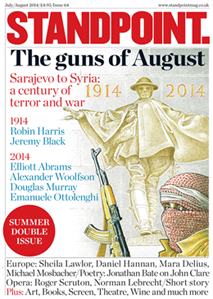
- Sarajevo: Where the Century of Terror Began
- Allen Lane’s Pelicans Take Wing Once More
- How Not to Remember the First World War
- Opera is Not Just Our Most Expensive Noise
- Jonathan Miller: One Man, Two Cultures
- Without a Big Idea, Cameron Will Lose
- A Christian Country? No, a Conservative One
- How to Get School Competition Right
- The War on the Firmest Bulwark of our Liberty
- How Modern Liberals Created Nigel Farage
- Caught in the Trap of His Own Metaphysics
- In Search of My Father, Agent of the Comintern
- Geoffrey Hill and the poetry of ideas
- Master of the Glories of the English Country Garden
- Independence Will Do Nothing for Scots
- Bullying and Bluff on the Road to Referendum

- Conduct Unbecoming: The Classical Commentaries of Norman Lebrecht in Standpoint
- Propaganda Shouldn’t Pay
- The US Can Still Help Save Syria — and Iraq
- Putin has his Useful Idiots on the Left and the Right
- Strangers in their own Holy Land
- A Putrid Pact between Devils
- The Taboo of the Tombola
- Russian Resurgence has Blindsided Nato
12:04 PM
5:03 PM
1:03 PM