


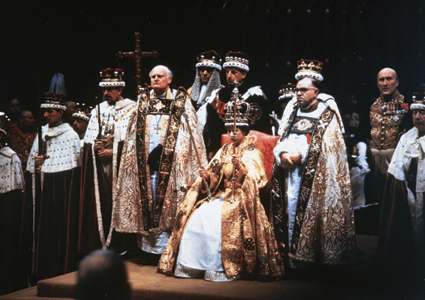
By the grace of God: The Coronation service signifies that the head of state must be authorised from above (Getty)
What follows is an argument in favour of the establishment or public privileging of the Church of England. Since "establishment" can mean all manner of thing — as a survey of European, indeed British, arrangements would quickly reveal — let me make clear right at the beginning what I have in mind.
First there is the Coronation Service, in which the head of state, kneeling, receives authorisation from above, not from below. Contrary to the populist orthodoxy that prevails among us, the moral legitimacy of government issues primarily from its faithfulness to the given principles of justice, and not from its reflection of popular will — as the fate of the Weimar Republic in the early 1930s should have taught us. In an era that finds it hard to think of political legitimacy except in terms of popular election, and which is therefore inclined to collapse a healthily mixed constitution into its democratic element, the Coronation Service makes an important and dramatic cautionary statement — and in our circumstances, a prophetic one.
Second is the affirmation by the head of state of the established church through the monarch's special association with it. While the disqualification of Roman Catholics from succession should be removed, the requirement of communion with the Church of England should remain. If the Roman Catholic church chooses to continue to prohibit members from such communion, then that is a problem for Rome.
Third comes the sitting of Anglican bishops in the Upper House of Parliament. An Upper House ought to give us an "aristocracy" of expertise, perchance wisdom, and not a mirror-image of the Lower House. Therefore, its composition ought to guarantee the representation of civil society in all its variety — including the Church of England. Since direct elections cannot guarantee such representation, appointments will be necessary. It is true that support in the House of Commons for the recommendation by the Wakeham Commission (2000) of a predominantly appointed — rather than elected — Upper House has waned; but, given what is at stake, I see no reason simply to go with the flow. It is also true that, if seats in the Upper House were opened up to representatives of non-Anglican religious communities, it might be difficult to agree on a formula for distribution that would keep everyone's nose entirely in joint. But since when in politics was there ever an agreement that made everyone entirely happy? Frustration is a routine feature of political life, and tolerating it is a definitive feature of liberal political mores.


- Admit It, Mr Kerry: You Blundered
- Bismarck Versus Blair — A Foreign Policy Crossroads
- Arab Spring, Islamist Summer — What Next?
- The Diplomat the Whole World Ignores
- The Blob Has Run Schools For Decades. Not Any More
- Would You Intervene — Or Pass On The Other Side?
- He Died That Others Might Live In Peace
- The Hero's Journey is Hollywood's McMyth
- Online Only: Countering the Counter-Jihadists
- Online Only: The Price Paid for Criticising Islam
- 'Please Sir, I Just Want to Learn More'
- Why Students Should Be Glad To Pay Tuition Fees
- A 'Liberal Racist'? Me? I Felt Like a Heretic
- Demolish the Relics of Yesterday's Future
- Was Britain Right To Go To War In 1914?
- German Victorians Who Helped Transform Britain
- The Alternative History of an Undivided India
- Online Only: Heirs to the Left
- ONLINE ONLY: The Hayward Gallery's Fashionable Primitives
- ONLINE ONLY: A Spiritual Corner of Southwark

- The Zombie Argument that Refuses to Die
- Online Only: The Price Paid for Criticising Islam
- Overrated: Dan Brown
- Overrated: George Monbiot
- Is the Brain the Key to Understanding Religion?
- 'Please Sir, I Just Want to Learn More'
- An Assault on Free Speech at the LSE
- The Alternative History of an Undivided India
- The Zombie Argument that Refuses to Die
- Online Only: The Price Paid for Criticising Islam
- Overrated: Dan Brown
- Overrated: George Monbiot
- Is the Brain the Key to Understanding Religion?
- 'Please Sir, I Just Want to Learn More'
- An Assault on Free Speech at the LSE
- The Alternative History of an Undivided India
- Decline and Fall of the History Men
- Uncritical Theorists Who Misread the Nazis
- The Zombie Argument that Refuses to Die
- The Banality of Hannah Arendt
- From Kitsch to Cool: Picasso and Modern Art
- Is the Brain the Key to Understanding Religion?
- Time to Wise Up to the Muslim Brotherhood
- Midfield Virtuoso Finds His Perfect Pitch
2:03 PM
1:03 PM
12:03 PM