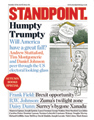



On policy, there is major potential difficulty, however. The EU is a particularly tricky area for Boris because the Mayor's attempts to present himself as a tough Eurosceptic are somewhat undermined by reality. In essence he is for reform and staying in, every bit as much as David Cameron, which may well end up being the position of many British voters if there is a referendum and they do not want to be on the same side as Nigel Farage. But before he runs for leader — next year or in several years' time — Boris will come under intense pressure from Eurosceptic Tory MPs and activists battered by UKIP to explain himself.
The inheritance is not straightforward in other respects either. The main mistake made by the Tory modernisers once Cameron became leader in 2005 was their attempt to define themselves and the party they led by distancing themselves from a large part of their core vote, in an effort to prove to supposedly centrist moderates that the Tories had changed. The arrogant assumption throughout was that these disowned voters had nowhere else to go, when Nigel Farage and UKIP were on hand. The result today is a badly divided Right.
Not all of this is the Cameroons' fault and the British Conservative experience is not unique. Elsewhere in Europe populist parties are on the rise, capitalising on fears about globalisation and identity, concerns about the impact of immigration and a generalised distaste for established authority. UKIP and the Scottish National Party are manifestions of a malaise that goes well beyond Clacton and Cowdenbeath.
This means that the next leader of the Conservative party will be confronted with an epic task. Already the two main parties are struggling in the low 30s in the polls; the Liberal Democrats are on death row; the Greens are nudging upwards; the separatists in Scotland are surging past Labour ahead of next year's Westminster election; and UKIP is still polling upwards of 15 per cent. If the decay seemed like a temporary mid-term phenomenon it might be easy for a new leader to deal with. But it does not. The longer it carries on the more likely it is that this is a serious electoral shift, with the gravitational pull of devolution in Scotland and voters' widespread resentment of elites combining to produce a scenario in which it will be perpetually difficult for anyone to win outright.
Only an optimistic leader with extraordinary charisma and unifying appeal could do it and bring a divided country together. Only Boris, say his supporters, stands a hope in hell of producing that piece of magic. Even former President George W. Bush is impressed by him: "He sounds kind of like Churchill, doesn't he? Very strong use of words." It is an entertaining illusion, say the sceptics who warn that it would be madness for an adventurer to be let loose in the highest office. And as with almost every set of circumstances in Tory affairs, there is a Churchill story to fit.
On the evening of Friday May 10, 1940, as the Germans rolled into Holland, Belgium and Luxembourg, the King sent for Churchill. As he was driven to the Palace to become Prime Minister, the civil servant John Colville walked from Number 10 to the Foreign Office to see Rab Butler, then a junior minister, and Chips Channon MP, Butler's Parliamentary Private Secretary. Butler, a supporter of appeasement, was appalled at the prospect of a Churchill premiership. Colville, who would become a devoted servant of Churchill, wrote in his diary: "Rab said that he thought the good clean tradition of English politics, that of Pitt as opposed to Fox, had been sold to the greatest adventurer of modern political history . . . they had weakly surrendered to a half-breed American whose main support was that of inefficient but talkative people of a similar type."
Churchill's moment of destiny had come. The "half-breed American" became Prime Minister. Rab Butler never did. And Boris Johnson was born in America.
The inheritance is not straightforward in other respects either. The main mistake made by the Tory modernisers once Cameron became leader in 2005 was their attempt to define themselves and the party they led by distancing themselves from a large part of their core vote, in an effort to prove to supposedly centrist moderates that the Tories had changed. The arrogant assumption throughout was that these disowned voters had nowhere else to go, when Nigel Farage and UKIP were on hand. The result today is a badly divided Right.
Not all of this is the Cameroons' fault and the British Conservative experience is not unique. Elsewhere in Europe populist parties are on the rise, capitalising on fears about globalisation and identity, concerns about the impact of immigration and a generalised distaste for established authority. UKIP and the Scottish National Party are manifestions of a malaise that goes well beyond Clacton and Cowdenbeath.
This means that the next leader of the Conservative party will be confronted with an epic task. Already the two main parties are struggling in the low 30s in the polls; the Liberal Democrats are on death row; the Greens are nudging upwards; the separatists in Scotland are surging past Labour ahead of next year's Westminster election; and UKIP is still polling upwards of 15 per cent. If the decay seemed like a temporary mid-term phenomenon it might be easy for a new leader to deal with. But it does not. The longer it carries on the more likely it is that this is a serious electoral shift, with the gravitational pull of devolution in Scotland and voters' widespread resentment of elites combining to produce a scenario in which it will be perpetually difficult for anyone to win outright.
Only an optimistic leader with extraordinary charisma and unifying appeal could do it and bring a divided country together. Only Boris, say his supporters, stands a hope in hell of producing that piece of magic. Even former President George W. Bush is impressed by him: "He sounds kind of like Churchill, doesn't he? Very strong use of words." It is an entertaining illusion, say the sceptics who warn that it would be madness for an adventurer to be let loose in the highest office. And as with almost every set of circumstances in Tory affairs, there is a Churchill story to fit.
On the evening of Friday May 10, 1940, as the Germans rolled into Holland, Belgium and Luxembourg, the King sent for Churchill. As he was driven to the Palace to become Prime Minister, the civil servant John Colville walked from Number 10 to the Foreign Office to see Rab Butler, then a junior minister, and Chips Channon MP, Butler's Parliamentary Private Secretary. Butler, a supporter of appeasement, was appalled at the prospect of a Churchill premiership. Colville, who would become a devoted servant of Churchill, wrote in his diary: "Rab said that he thought the good clean tradition of English politics, that of Pitt as opposed to Fox, had been sold to the greatest adventurer of modern political history . . . they had weakly surrendered to a half-breed American whose main support was that of inefficient but talkative people of a similar type."
Churchill's moment of destiny had come. The "half-breed American" became Prime Minister. Rab Butler never did. And Boris Johnson was born in America.
Like this article? Share, save or print using the icons below:


More Features
- Race To The White House Through The Looking-Glass
- Brexit Gives Us A Historic Opportunity
- American Conservatives Must Stand Up To Trump
- Cicero's Analysis Of Decline Offers Lessons For The West
- Deepdene: Rise and Fall of the House of Hope
- Debunking the EU Referendum Myths
- Britain's Opportunity Is Europe's Warning
- Controlling Immigration Is Good For Democracy
- The Pied Piper of Islington
- The West Cannot Afford To Ditch Nato
- End Of History — Or Clash Of Civilisations?
- We Can Defeat Islamist Terror — But Not On Our Own
- Without the Emperor, What is Left of Old Japan?
- Now Or Never
- Who Will Heal This Divided Country?
Popular Standpoint topics

1:12 PM