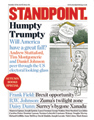



When PEN in New York honoured the surviving journalists, Francine Prose, a former president of PEN American Center, denounced it for feeding “cultural prejudices”. Peter Carey said that a free-speech organisation should not be “self-righteous” about journalists who were murdered for speaking freely. The late Gore Vidal said the three saddest words in the English language were “Joyce Carol Oates”. Oates proved him right when she joined other “dissenting” Anglo-Saxon authors in repeating the lie that Hebdo mocked black African women for being black African women.
Among the many virtues of Fourest’s book is that she identifies the compromises behind the smears. Charlie Hebdo was a part of an honourable strain on the Western Left which is all but dead now. It opposed racism and fundamentalism at the same time, and, as I am fond of saying, for the same reasons. Racism is a superstition. You judge a man or a woman on the colour of their skin or the country of their birth, and adjust your behaviour accordingly. Sectarian religion is a superstition. You judge a man or woman by whether they share your taboos. One might have thought that a liberal intelligentsia that is loud in its determination to fight bigotry and lachrymose in its sympathy for the demonised “other” would oppose religious prejudice and ally itself with its victims. But a stand on principle would make dangerous men “really angry because of this and that”, as John Kerry so ineptly explained. Better to avoid “this and that”. Better to cover your conscience by condemning all who condemn religious oppression as “racists” or the possessors of a pathological anti-Muslim phobia.
Fourest shows what an honourable Left looked like before the hypocrites took it over:
To put it another way, if opposing “Islamophobia” meant arresting the men who attacked women in the street for wearing a hijab, or arguing with the loudmouth who said that all Muslims were potential terrorists, there would be no difficulty. None at all. But fighting Islamophobia has come to mean banning criticism of religious beliefs and myths, including those myths that incite oppression and murder.
Among the many virtues of Fourest’s book is that she identifies the compromises behind the smears. Charlie Hebdo was a part of an honourable strain on the Western Left which is all but dead now. It opposed racism and fundamentalism at the same time, and, as I am fond of saying, for the same reasons. Racism is a superstition. You judge a man or a woman on the colour of their skin or the country of their birth, and adjust your behaviour accordingly. Sectarian religion is a superstition. You judge a man or woman by whether they share your taboos. One might have thought that a liberal intelligentsia that is loud in its determination to fight bigotry and lachrymose in its sympathy for the demonised “other” would oppose religious prejudice and ally itself with its victims. But a stand on principle would make dangerous men “really angry because of this and that”, as John Kerry so ineptly explained. Better to avoid “this and that”. Better to cover your conscience by condemning all who condemn religious oppression as “racists” or the possessors of a pathological anti-Muslim phobia.
Fourest shows what an honourable Left looked like before the hypocrites took it over:
“By naming things wrongly we add to the misfortunes of the world,” wrote Albert Camus. And the word “Islamophobia” does precisely that. Peddling the idea that the struggle against fanaticism is a form of racism has created one of the most dangerous political and semantic confusions of our time. What exactly is the issue here? Semantically this word does not signify a “phobia” towards Muslims but towards Islam: “Islamophobia” and not “Muslim-phobia”. Some people use it in perfectly good faith and others in totally bad faith. The fundamentalists use it to condemn all criticism of Islam, its dogma or abuses as being “phobic”, therefore problematic. Anti-racists use the same term to signify phobia towards Muslims, thus playing into the hands of the fundamentalists.
To put it another way, if opposing “Islamophobia” meant arresting the men who attacked women in the street for wearing a hijab, or arguing with the loudmouth who said that all Muslims were potential terrorists, there would be no difficulty. None at all. But fighting Islamophobia has come to mean banning criticism of religious beliefs and myths, including those myths that incite oppression and murder.
Like this article? Share, save or print using the icons below:


More Features
- Race To The White House Through The Looking-Glass
- Brexit Gives Us A Historic Opportunity
- American Conservatives Must Stand Up To Trump
- Cicero's Analysis Of Decline Offers Lessons For The West
- Deepdene: Rise and Fall of the House of Hope
- Debunking the EU Referendum Myths
- Britain's Opportunity Is Europe's Warning
- Controlling Immigration Is Good For Democracy
- The Pied Piper of Islington
- The West Cannot Afford To Ditch Nato
- End Of History — Or Clash Of Civilisations?
- We Can Defeat Islamist Terror — But Not On Our Own
- Without the Emperor, What is Left of Old Japan?
- Now Or Never
- Who Will Heal This Divided Country?
- What Made The West Great Is What Will Save Us
- Shock And Awe: Tales Of A Washington Insider
- We Shouldn't Let Old Men Rot Away In Jail
- Arnold Wesker’s Bid To Build A New Jerusalem
- Our EU Deal Gives Us The Best Of Both Worlds
Popular Standpoint topics

12:12 PM
10:12 AM
10:12 PM
8:12 PM
3:12 PM
2:12 PM
1:12 PM
6:12 AM
1:12 AM
8:12 PM