



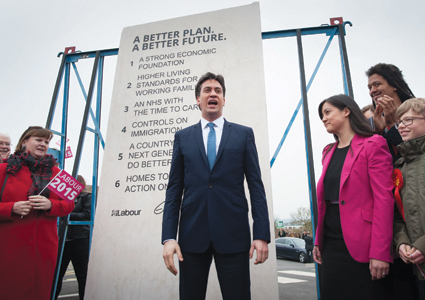
 Disastrous: Ed Miliband with the much-derided “Edstone” (photo: Stefan Rousseau/PA Wire)
I first saw Ed Miliband at the launch of a new book by Will Hutton. It was the autumn of 2010, and he had just become Labour’s leader. The party was full of leftish writers, who might be expected to help and support Miliband. But he didn’t want to charm them, or work the room and meet and greet. He just stood there awkward and alone. “Whatever his other qualities,” I thought, “this man isn’t a politician.”
It was the same every time I bumped into him. At a Miliband meet-the-press drinks party in Westminster, I kept wondering what was wrong. I scanned the party, double-checked and realised that the only journalists present were left-wing journalists. Miliband was making no attempt to woo reporters who weren’t already onside, to persuade them that he might have a case, or argue them into thinking twice before attacking him. He would talk only to the already convinced, and ignore anyone outside Labour’s “core”. He was living in a cocoon. But then so was much of the British Left.
I don’t think you can overestimate the disaster that has befallen it. The numbers don’t tell the full story — but the numbers are bad enough.
Labour saw the Tories win 99 more seats and two million more votes. It lost everywhere except in London. It lost Southampton Itchen, Ed Balls’s Morley and Outwood, Bolton West, Telford and Derby North: seats that even Gordon Brown had held in 2010, when an exhausted party staggered to the polls after presiding over the worst financial crisis of our lifetime. In what were once the Labour heartlands of Scotland, only one Labour MP survived. In virtually every one of the 40 seats the SNP took from Labour, the nationalists now have a five-figure majority. My friends in the Scottish Labour party say Scotland has been caught in a nationalist spasm, and Labour will come back when the mania passes. Perhaps they are right, but I suspect they are comforting themselves: you don’t push a landslide back up the hill just like that.
In the north of England and on the east coast the myth that UKIP would split the Right, while allowing a united Left to triumph, took the hammering it deserved. UKIP came second in 44 Labour and 76 Tory seats. It is not just that UKIP stopped Labour taking seats it should have won. It replaced Labour as the opposition in seats where it ought to be in contention. In working-class constituencies in Essex and Kent, where the Left ought to offer hope to struggling voters, Labour is not even in the game. The new battles are between Conservatives and UKIP. As for Wales, the lazy assumption is that it is a Labour fortress. But as Luke Akehurst — a hardheaded activist in a Labour movement filled with wishful thinkers — pointed out, the Tories held all their Welsh marginal seats and took two from Labour. Natalie Bennett, meanwhile, was one of the most useless party leaders Britain has ever seen — a mumbling ill-informed embarrassment. Nevertheless, the Greens took one million votes that in other circumstances Labour might have collected.
In short, despite being led by a mediocre Conservative prime minister, who has no answer to and often exacerbates the great problems Britain faces, despite the worst fall in real incomes since the 1920s, Britain has shifted to the Right.
The comforting notion that it has a “progressive majority,” which one way or another will keep the Conservatives in their box, died on May 7. In 2015, the combined vote share of all right-wing political parties (Conservatives, UKIP and the Ulster Unionists) rose to 50.5 per cent of all votes cast. The left-leaning political parties (Labour, SNP, Greens, Plaid Cymru and SDLP) gained just 39.8 per cent. My colleague Michael Harris of the Little Atoms website says that if you include Liberal Democrats on the right-hand side of the ledger — and as they were happy to vote for a party that had been in alliance with the Tories, you probably should — you get an even worse result for the Left. In all, 58.4 per cent of the public voted for parties on the Right.
Like this article? Share, save or print using the icons below:


More Features
- Race To The White House Through The Looking-Glass
- Brexit Gives Us A Historic Opportunity
- American Conservatives Must Stand Up To Trump
- Cicero's Analysis Of Decline Offers Lessons For The West
- Deepdene: Rise and Fall of the House of Hope
- Debunking the EU Referendum Myths
- Britain's Opportunity Is Europe's Warning
- Controlling Immigration Is Good For Democracy
- The Pied Piper of Islington
- The West Cannot Afford To Ditch Nato
- End Of History — Or Clash Of Civilisations?
- We Can Defeat Islamist Terror — But Not On Our Own
- Without the Emperor, What is Left of Old Japan?
- Now Or Never
- Who Will Heal This Divided Country?
- What Made The West Great Is What Will Save Us
- Shock And Awe: Tales Of A Washington Insider
- We Shouldn't Let Old Men Rot Away In Jail
- Arnold Wesker’s Bid To Build A New Jerusalem
- Our EU Deal Gives Us The Best Of Both Worlds
Popular Standpoint topics

6:05 PM
1:05 PM