


The universities are in crisis. Lord Mandelson, the minister responsible, has announced a £1 billion cut in the government's £14 billion budget, and the universities have cried panic. Margins throughout the sector are already so tight, and so many universities are already in deficit, that the chairman and the director general of the Russell Group, the association of the 20 leading universities, have confirmed that "it will take just six months to bring Britain's higher education system to its knees". The president of Universities UK, which represents all 133 British universities, has admitted that "as many as 30 universities may not survive" and that "institutions face having to close hundreds of courses, with fewer academic staff and bigger classes." More than 160,000 students face being turned away from degree courses in the autumn because demand is rising while the number of places falls.
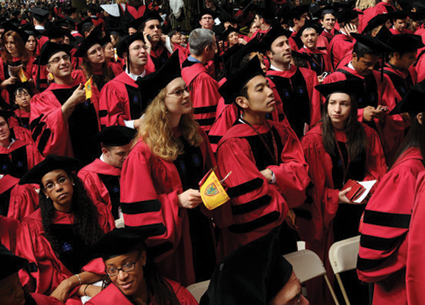
If they can't pay, the university will: Students at a Harvard commencement ceremony
Meanwhile, the University and College Union has predicted that up to 14,000 staff will be made redundant. Some leading universities, including Imperial College and King's College London, have already announced redundancies, while Leeds (where up to 750 staff may have to go) is just one of the universities where staff have voted to strike.
Yet this university crisis is unnecessary and has been caused by inappropriate government policies that crowd out private money.
The myth about universities is that they are public goods. The myth asserts that ordinary people would not, if left to their devices, invest sufficiently in their own and in their children's university education. Yet history disproves the myth. The universities were created by the private sector and their misfortune is that they have been nationalised under conditions that have displaced the private money that would have sustained them in good health.
The first European university was founded by students in Bologna around 1100, initially as a private law school to meet the burgeoning demands of the commercial courts. Soon universities were being created at Montpellier, Padua and other Mediterranean cities, as private student or professorial initiatives. By 1210, Oxford and Cambridge had also been set up as private foundations. But the medieval Church and state did not appreciate independent intellectual power bases, and soon, following the Church's takeover of the University of Paris (1160), all the European universities had been brought under its control, which is why so many academic titles, such as chancellor, dean, doctor, professor and lecturer are ecclesiastical in origin.


- Admit It, Mr Kerry: You Blundered
- Bismarck Versus Blair — A Foreign Policy Crossroads
- Arab Spring, Islamist Summer — What Next?
- The Diplomat the Whole World Ignores
- The Blob Has Run Schools For Decades. Not Any More
- Would You Intervene — Or Pass On The Other Side?
- He Died That Others Might Live In Peace
- The Hero's Journey is Hollywood's McMyth
- Online Only: Countering the Counter-Jihadists
- Online Only: The Price Paid for Criticising Islam
- 'Please Sir, I Just Want to Learn More'
- Why Students Should Be Glad To Pay Tuition Fees
- A 'Liberal Racist'? Me? I Felt Like a Heretic
- Demolish the Relics of Yesterday's Future
- Was Britain Right To Go To War In 1914?
- German Victorians Who Helped Transform Britain
- The Alternative History of an Undivided India
- Online Only: Heirs to the Left
- ONLINE ONLY: The Hayward Gallery's Fashionable Primitives
- ONLINE ONLY: A Spiritual Corner of Southwark

- The Zombie Argument that Refuses to Die
- Online Only: The Price Paid for Criticising Islam
- Overrated: Dan Brown
- Is the Brain the Key to Understanding Religion?
- Overrated: George Monbiot
- Time to Wise Up to the Muslim Brotherhood
- 'Please Sir, I Just Want to Learn More'
- The Alternative History of an Undivided India
- The Zombie Argument that Refuses to Die
- Online Only: The Price Paid for Criticising Islam
- Overrated: Dan Brown
- Is the Brain the Key to Understanding Religion?
- Overrated: George Monbiot
- Time to Wise Up to the Muslim Brotherhood
- 'Please Sir, I Just Want to Learn More'
- The Alternative History of an Undivided India
- Decline and Fall of the History Men
- Uncritical Theorists Who Misread the Nazis
- The Zombie Argument that Refuses to Die
- The Banality of Hannah Arendt
- From Kitsch to Cool: Picasso and Modern Art
- Is the Brain the Key to Understanding Religion?
- Time to Wise Up to the Muslim Brotherhood
- Midfield Virtuoso Finds His Perfect Pitch
- Online Only: The Price Paid for Criticising Islam
- Overrated: George Monbiot
- Letter from Ukraine: Reviving Lost Literature
- On Pilgrimage with the Hasids
- Tsar Of The Holy Land
- The Blob Has Run Schools For Decades. Not Any More
- Bismarck Versus Blair — A Foreign Policy Crossroads
- My Dieting Guide: Listen To Mother
5:04 PM
8:03 PM