




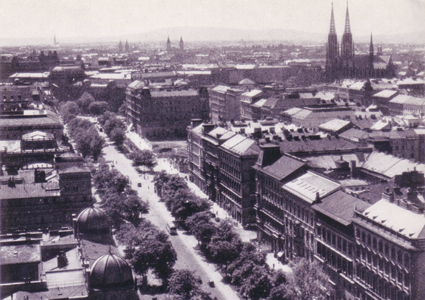
Viennese pearls: Palatial residences in the City's Ringstrasse district c.1900
It was a history of meteoric rise and precipitous eclipse; a story with few parallels. Jews had been pouring into Vienna since 1848 and this accelerated after the December constitution of 1867 granted religious freedom throughout the Empire. At their peak there may have been as many as a quarter of a million of them, making it the largest Jewish city in the German-speaking world. Today the figure is about 5 per cent of that, and then only that high because it has been augmented by the arrival of Jews from the former Soviet Union.
The poorer ones came from the shtetls of Galicia and the Bukovina (now mostly in Romania and the Ukraine) and settled in the 2nd District. Others made their way south from Brünn (Brno) or Nikolsburg (Mikulov) in Southern Moravia or west from Hungary. Once the city spilled out of its constricting medieval corset, the rich found their own more luxurious quarters in the solid new apartment blocks (or Zinshäuser) in the 9th District or in the network of streets built behind the new town hall. At the turn of the century many moved to the plush and leafy suburbs of Döbling or Hietzing. The latter is in the shadow of the royal summer palace at Schön-brunn and feels a bit like Kensington.
The richest of them all had their palaces on the wide Ringstrasse boulevard that replaced the city wall: the Ephrussis (now familiar from Edmund de Waal's The Hare with Amber Eyes), Epsteins, Gomperz, Schey von Koromlas, Todescos, Wiener von Weltens and Pollack-Parnaus. These all owned a palais bearing their name but many more lived on the floor above the beletage or piano nobile like my great-great aunts Ella Zirner at the Palais Gomperz or Malwida Kranz at the Palais Leitenberger. The latter is now the Radisson Blu hotel. I promise myself that one day I shall feel flush enough to stay there. Who knows? Maybe I shall end up sleeping in a room that was once part of the family home.
Malwida's brother-in-law, the notorious banker Josef Kranz, was one of those who had a whole palace to himself. The first Palais Kranz (now the Russian Trade Delegation) was in the Argentinierstrasse near the Belvedere Palace, but that proved too small and eventually he had the fashionable architect Friedrich Ohmann (who designed the monument to Empress "Sissy" in the Volksgarten) build him a new one, opposite the summer palace of the Princes Liechtenstein in the 9th. No luxury was spared: it was decorated by Oscar Strnad and Richard Teschner, two of the leading designers of the day and an Italian Renaissance fountain was set up in the garden.


- The Hijacking of the Human Rights Debate
- How to Save Marriage From Hitting the Rocks
- Liberalism, Marriage and Family Values
- Liberty, Faith and Obama's Leviathan
- Cameron Should Scrap His Tired Old Script
- We're Good Europeans Yet They All Hate Us
- Obama's Timidity Risks the World's Security
- How the Left Turned Against the Jews
- Universities Must Be Freed from Meddling
- Forget Wind: Time for Britain to Get Fracking
- Melvyn Bragg Misses the Art of the Matter
- Will Michael Gove Go All the Way to No 10?
- Chaotic Legacy of the Classroom Radicals
- Why Shouldn't I Cheat? Everybody Else Does
- Twelve More Years of Vladimir Putin? Nyet!
- Eternal Land of the Golden Fleecing
- Faded Glory: In The Footsteps of Old Fritz
- Web Only: The Asymmetry of Racism Awareness
- An Islamist Winter?
- The Secret of Cheap Energy: Fire Chris Huhne


6:03 PM