



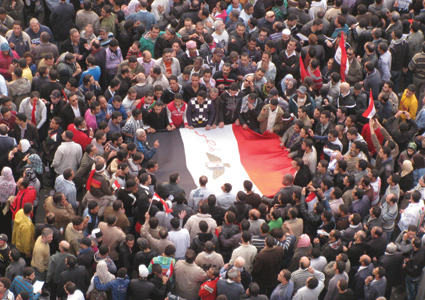
Flying the flag for freedom: Egyptians in Cairo's Tahrir Sqaure after the parliamentary elections in November (Stefan Simanowitz)
Is the Arab Spring morphing into an Islamic Winter? The question is haunting those interested in the outcome of the series of political earthquakes that, from the start of 2011, have shaken most of the 21 member states of the Arab League. Those who remember the initial days of the Arab uprising on Bourguiba Avenue in Tunisia and Tahrir Square in Cairo wonder what happened to the promise of the modern liberal society that was supposed to be about to be born out of the pages of Facebook accompanied by the jingles of mobile phones. Where have all the clean-shaven, jeans-wearing, cappuccino-imbibing young things gone? And where did all these bushy beards and extra-thick hijabs, absent from the early stages of the "revolution", come from?
To find an answer let us start with the certainties of the situation. First, it is too early to speak of an Arab revolution. Revolutions are baptised as such only after they have happened. What we have in the countries affected by the Arab Spring so far is the promise of a revolution. For the first time in decades almost all Arab societies are in a state of flux. Everywhere, the regimes in place have run out of the energy and imagination needed to keep themselves in power. Arab governing elites are no longer able to respond to the hopes, fears and aspirations of their peoples.
The emergence of modern Arab states in the Middle East and North Africa dates back to the disintegration of the Ottoman Empire after the First World War, and then the decolonisation movement that followed the Second. Initially, the Arab elites toyed with the idea of reviving the Islamic caliphate, a dream that haunted ambitious leaders from King Fouad of Egypt to King Abdul-Aziz of Saudi Arabia. However, the reality of the emerging Arab states was something else. These were states created around an army, even when, as was the case in Saudi Arabia and Transjordan, it consisted of a tribal band of irregulars. At the start, almost all the newly created states were monarchies under different names. In Yemen the monarch was called the imam, in Egypt he was the king and in Morocco the sultan.
From the late 1940s onwards, army officers, sometimes using a political party as interface, started to topple the monarchies and developed the military-security state in the name of pan-Arab unity, the "liberation of Palestine" and/or socialism. By the end of the 1960s, eight Arab nations lived under new-model military-security regimes claiming legitimacy based on empty slogans about pan-Arabism and socialism.
Although the Arab Spring has shaken every Arab regime, including monarchies such as Jordan, Saudi Arabia, Kuwait and Bahrain, its principal target has been the military-security regimes. At the time of writing only three were still in place: Syria, Sudan and Mauritania, all of which were also in various stages of popular revolt.


- A Recipe For Disaster
- Culture And Politics In The Age Of Trumpery
- Will Labour Listen To Its Eurosceptic Voters?
- Would Brexit Play Into Putin's Hands?
- Why Brexit Could Be A Blessing For Europe
- Will The Pollsters Get It Right On The Referendum?
- The Great Illusion: Why We Are Still Europe’s Fall Guys
- Make June 23 Britain’s Independence Day
- Don't Pit Generations Against Each Other
- Let Justice Be Done Though The Liberal Heavens Fall
- A Fascist Coup In Poland? Give Us Poles A Break
- It's Sharia, Not Alcohol, That Threatens Women
- Double Games Of The UK Muslim Brotherhood
- The Land Where History Repeats Itself As Tragedy
- Holocaust Survivors Are Still Waiting For Justice
- Rhodes, Race, And The Abuse Of History
- Shame On The Liberals Who Rationalise Terror
- France, Islam, And The Second Class Sex
- Isis Is Not Invincible — If The West Has The Will
- After Paris, Who Will Speak For France?

- Shame On The Liberals Who Rationalise Terror
- The Cowardice Of John Le Carré
- The Establishment Is In Denial — Yet Again
- Is There A Right Way To Write?
- A Fascist Coup In Poland? Give Us Poles A Break
- France, Islam, And The Second Class Sex
- The Stalinist Past Of Corbyn’s Strategist
- The Long Shadow Of Malthus
- Shame On The Liberals Who Rationalise Terror
- The Cowardice Of John Le Carré
- The Establishment Is In Denial — Yet Again
- Is There A Right Way To Write?
- A Fascist Coup In Poland? Give Us Poles A Break
- France, Islam, And The Second Class Sex
- The Stalinist Past Of Corbyn’s Strategist
- The Long Shadow Of Malthus
12:01 PM
7:01 AM
8:12 PM