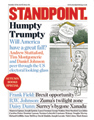



Merkel's cards remain undisclosed. In September, she faces a general election, and she sees no point in antagonising Germany's Eurosceptics, many of whom wish they had politicians prepared to be as outspoken as Cameron. Germany finds itself more than ever the preponderant continental power, but economic growth, and the crisis management needed to sustain the euro, have acted as a distraction from, or substitute for, addressing Europe's constitutional problems. In recent years Germany's export industries have been doing remarkably well. If that country had kept its national currency, its industries would be exporting less, for the mark would be less competitive than the euro.
Like Britain, Germany has global economic interests. It has a far more flourishing trade than we do with China, a country it is helping to modernise. Its trade with the euro area, though still very big, is becoming less important, and Germany appears to have no idea how to modernise the southern members of the euro, who are instead experiencing a savage contraction and rates of youth unemployment which must surely prove unsustainable. The euro members are not only failing to converge: they are getting wider apart.
The call goes up for Germany to bail these southern members out, and thereby save the euro. That is how currency unions work. But although German taxpayers recognise that they have derived benefits from the euro, they are profoundly unwilling to subsidise the Greeks, Spanish, Portuguese, Italians or indeed the French. The West Germans found it quite bad enough bailing out and modernising the East Germans, whose industry was destroyed after the currency union which accompanied German reunification, carried out by Helmut Kohl at a one-for-one exchange rate which he found politically irresistible, but which was economically disastrous.
Kohl likewise found the euro politically irresistible. It was not, at any rate, resisted by any worthwhile body of German politicians: the opposition Social Democrats believed in it more sincerely than Kohl's own Christian Democrats. The German public knew it would be disastrous to share a currency with the Italians, let alone the Greeks, but Germany's rulers were determined to believe all would somehow be well, for who could object to the pious idea of greater European union?


- Race To The White House Through The Looking-Glass
- Brexit Gives Us A Historic Opportunity
- American Conservatives Must Stand Up To Trump
- Cicero's Analysis Of Decline Offers Lessons For The West
- Deepdene: Rise and Fall of the House of Hope
- Debunking the EU Referendum Myths
- Britain's Opportunity Is Europe's Warning
- Controlling Immigration Is Good For Democracy
- The Pied Piper of Islington
- The West Cannot Afford To Ditch Nato
- End Of History — Or Clash Of Civilisations?
- We Can Defeat Islamist Terror — But Not On Our Own
- Without the Emperor, What is Left of Old Japan?
- Now Or Never
- Who Will Heal This Divided Country?
- What Made The West Great Is What Will Save Us
- Shock And Awe: Tales Of A Washington Insider
- We Shouldn't Let Old Men Rot Away In Jail
- Arnold Wesker’s Bid To Build A New Jerusalem
- Our EU Deal Gives Us The Best Of Both Worlds

4:03 AM