



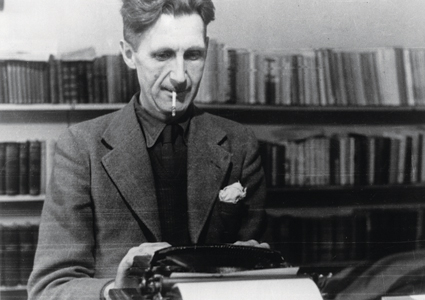
George Orwell: His essay "Politics and the English Language" remains influential, even if many prominent writers have ignored his advice (Mondadori Portfolio via Getty Images)
In his famous essay, "Politics and the English Language", George Orwell wrote: "In our time it is broadly true that political writing is bad writing. Where it is not true, it will generally be found that the writer is some kind of rebel, expressing his private opinions and not a ‘party line'. Orthodoxy, of whatever colour, seems to demand a lifeless, imitative style." Written nearly 70 years ago, Orwell's essay skewered six commonplace barbarities in contemporary political discourse so clearly and ruthlessly that it made it harder for succeeding political writers to perpetrate them.
However, each generation starts life afresh. Today political writing is evolving in a direction Orwell never predicted. A new method of expression has come into existence. Examples can be found in speeches, official documents and even the literature produced by academic institutions and charities. It has already spread into mainstream journalism, changing not just political writing, but also sports journalism, foreign reporting and column writing. The new method of expression has become the dominant form in blogs and social media.
It rejects conventional rules of grammar, and is no longer concerned with accuracy and truth. The writers criticised in Orwell's famous essay all assumed they were describing the outside world objectively. Indeed the worst political writing of the last century, from both Left and Right, stemmed from the writers' assumption that their politics was grounded in scientific truth.
The modern school has turned this assumption on its head. Instead of objectivity, it concentrates its attention on subjective experience. Instead of reason, it values emotion. Where once writers maintained distance from their subject matter, the new sensibility demands intimacy.
Each of the five passages below demonstrates some of the conventions that are now common in much of British discourse. I have only chosen passages from respected sources. They illustrate an outlook which has only become part of mainstream culture over the past few years, in which the writer's feelings about the subject are infinitely more important than the subject. It is almost inconceivable that any established writer would have written in this way about serious issues in Orwell's time.
I wanted to share with you my own experience of Mensch. You see a couple of months ago I ended up having coffee with her at Portcullis House . . . During our meeting, Mensch was at her most passionate and sincere when she talked about feminism . . . I'm sure I'll be accused of naïveté, but sitting there talking to her, I felt she was talking with the sort of depth that only comes from personal experience.Ellie Mae O'Hagan, New Statesman
Like this article? Share, save or print using the icons below:


More Features
- Is Trump the man for a Korean missile crisis?
- The PhD Generals
- Soft tones mask a sinister message of supremacy
- The PM must cheer up, keep calm and carry on
- Where have all the Tory party members gone?
- Don't betray Charlie Hebdo's heroic cause
- Pandering to the culture vultures and philistines
- A portrait of the artists as a pair of young wastrels
- We Need Churchill's Vison of Liberty More Than Ever
- The Play's The Thing, So Leave The Words Alone
- An Aesthetic and Moral Disaster
- How we Syrians destroyed our home — with your help
- Euphoric Labour won’t win power led by a pied piper
- Don’t be ‘difficult’ — try ‘formidable’, Mrs May
- Enough is enough of terror — but also of our self-doubt
- Iraq’s Christians pray for help that never comes
- The Atlantic alliance may be broken beyond repair
- Catholic tastes: both English and European
- Brexit as myth: Exodus, Reckoning, or Sacrifice?
- A Decent Woman Betrayed By Her Gruesome Twosome
Popular Standpoint topics

- Cultural Climate Change
- Opposites meet in the land of Scrugletopia
- Home from home for the Bolshevik elite
- Can Macron Save France — Or Is He Its Undertaker?
- Sweet singing in the choir
- A portrait of the artists as a pair of young wastrels
- Last Of The Great Elitists
- A Decent Woman Betrayed By Her Gruesome Twosome
11:02 AM
10:02 AM
10:02 AM