



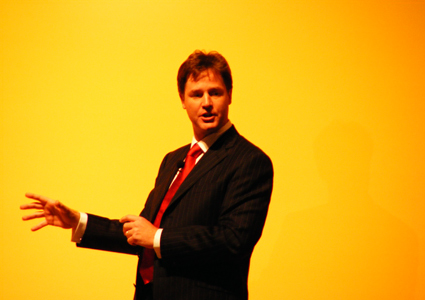
In December 2011 Nick Clegg delivered a lecture in Westminster under the auspices of the Open Society Foundation and the think-tank Demos. In it he spoke of "the values of the open society-social mobility; political pluralism; civil liberties; democracy; internationalism" as being "the source of my liberalism" and then set out his own vision of what society should be like. Having observed that "social institutions can be oppressive" and that "the constitution of my party warns that people can be enslaved not only by ignorance and poverty, but also by conformity" he proceeded:
The institutions of our society are constantly evolving. Just look at the way the roles of men and women, and attitudes to marriage and divorce, have changed over the last century. We should not take a particular version of the family institution, such as the 1950s model of suit-wearing, bread-winning dad and aproned, homemaking mother-and try and preserve it in aspic . . . that's why open society liberals do not agree that the state should use the tax system to encourage a particular family form . . . Open society liberals are progressive: we believe that the future can and ought to be better than the past.
Leaving aside the rhetorical aspects, it is worth considering the implicit liberal attitude to social institutions. Superficially, it might seem that what is proposed is that politics should simply follow the facts: accept whatever arrangements have evolved and be willing to change policies as and when they have fallen behind social developments. That, however, cannot be what is intended since some directions of development may be at odds with and even hostile to the favoured values of mobility, pluralism, liberties, democracy and internationalism. Moreover, there are questions as to what the facts are, which among them are relevant, and what the role of past policies has been in producing them.
A deeper interpretation, therefore, is that Clegg takes liberal values to be incompatible with certain kinds of social arrangements, or at odds with the state endorsing and supporting them, and these include a traditional understanding of marriage and the family. This reading, however, points to the paradox of progressive liberalism: on the one hand advancing a liberal social programme; on the other rejecting the right of the state to promote or protect particular social forms, such as the traditional family.


Post your comment
- The Hijacking of the Human Rights Debate
- How to Save Marriage From Hitting the Rocks
- Liberty, Faith and Obama's Leviathan
- Cameron Should Scrap His Tired Old Script
- We're Good Europeans Yet They All Hate Us
- Obama's Timidity Risks the World's Security
- How the Left Turned Against the Jews
- Universities Must Be Freed from Meddling
- Forget Wind: Time for Britain to Get Fracking
- Melvyn Bragg Misses the Art of the Matter
- Will Michael Gove Go All the Way to No 10?
- Chaotic Legacy of the Classroom Radicals
- Why Shouldn't I Cheat? Everybody Else Does
- Twelve More Years of Vladimir Putin? Nyet!
- Eternal Land of the Golden Fleecing
- In Search of Vienna's Vanished Jewish Elite
- Faded Glory: In The Footsteps of Old Fritz
- Web Only: The Asymmetry of Racism Awareness
- An Islamist Winter?
- The Secret of Cheap Energy: Fire Chris Huhne


