


But I still think that by reacting in this way, Cameron unintentionally fosters the idea that we are in fact divided into Two Nations. When the Daily Mail accused Ralph Miliband of hating Britain, it made the same mistake. It excluded a man who ought to have been included. One of the characteristics of our nation is its comprehensiveness. It includes all sorts of people who hold ridiculous or indeed pernicious opinions, but that does not stop them from being British. Unless they break the law, we tolerate such people, and are even faintly proud of ourselves for tolerating them. This is one of the ways in which we tame the dissenter: instead of taking his ideas as seriously as he takes them himself, we turn him into an amusing local character, who can be pointed out to visitors as one of the sights of the neighbourhood.
Cameron should do a bit more of that to Miliband. The Labour leader's pose as a man of the people is ridiculous. He is actually yet another PPE graduate, a policy wonk who, if anything, has even less experience of how ordinary people live than Cameron does. Miliband deserves to be treated as misguided rather than malevolent: a decent man whose main fault is his touching naivety, for his knowledge of the world is derived entirely from books and policy papers. Hence his wonkish belief (or am I muddling him up with Ed Balls?) that the answer to at least 11 different problems is to impose a new tax on the banks and spend the proceeds on some implausible state-run scheme. The day Miliband will know he has failed is the day he is laughed at by his own backbenchers, because Cameron has demonstrated to them that the Labour leader is a bit of a joke.
It is pointless for the Tories to attack either the Lib Dems or Labour. Lord Ashcroft demonstrated this in Minority Verdict, his account of what went wrong in the 2010 campaign: "The sheer pointlessness of attacking Gordon Brown was demonstrated once and for all in Rochdale on April 28, 2010, when he climbed into his car and, addressing not just his staff but his still-live lapel microphone and therefore the world, unburdened himself of the view that Mrs Gillian Duffy, the harmless pensioner to whom he had just been chatting, was a ‘bigoted woman'. This excruciating incident mesmerised the media and dominated the news for a day and a half, yet it had absolutely no discernible impact on voting intention polls. This was because people had long since formed a judgment about Mr Brown. Those who had taken against him had either already decided not to vote for him, or that they would vote for him even though he was prone to behaving like this."
If the Tories spend the next year and a half attacking either Clegg or Miliband, they will obscure the very good story about what they have been able to achieve in government, and will suggest that they too are just another bunch of snide, arrogant, untrustworthy, over-privileged scoundrels. That would be a waste, for the truth is that Cameron and his colleagues have been extraordinarily good at making coalition government work. As Matthew d'Ancona points out at the start of In It Together (Viking), his account of the inner workings of the coalition, the "guilty secret" of Cameron and Clegg "has often been that the two party leaders privately agree".
Why should Cameron feel guilty about this? It is to the credit of him and his colleagues at No 10 that they have been able to run a stable and productive government. He and Clegg managed in five days to form a coalition that looks as if it may last for five years. In the foreword to their agreement, published in May 2010, the two leaders said: "We have found that a combination of our parties' best ideas and attitudes has produced a programme for government that is more radical and comprehensive than our individual manifestos." This remains true. In fields such as welfare, education, taxation, pensions, employment and perhaps even health, the coalition is making reforms which are likely to endure. It is true that more could have been done, but it is also true that very much less might have been achieved. The whole thing could have collapsed in acrimony in a matter of months.


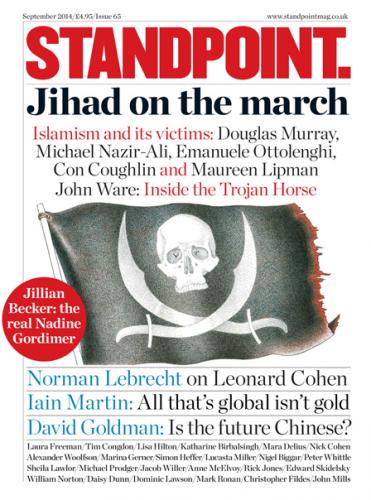
- The Plot to Islamise Birmingham’s Schools
- Nigeria, Iraq, Gaza—The Threat is the Same
- Radical Islam and its Invisible Victims
- The Man Who Tried to Teach us all a Lesson
- Globalisation and The Crisis of the Nation State
- The Medium Isn’t Always the Message
- What sort of Europe does Cameron Want?
- Is China outstripping the West at innovation?
- Piketty’s panacea will make inequality worse
- The Moral Strength of Leonard Cohen
- Designer who taught us to keep it simple
- The US Can Still Help Save Syria — and Iraq
- Russian Resurgence has Blindsided Nato
- On Europe, Nothing Less than Treaty Change will do
- Putin has his Useful Idiots on the Left and the Right
- Sarajevo: Where the Century of Terror Began
- Allen Lane’s Pelicans Take Wing Once More
- How Not to Remember the First World War
- Opera is Not Just Our Most Expensive Noise
- Jonathan Miller: One Man, Two Cultures

5:11 PM