



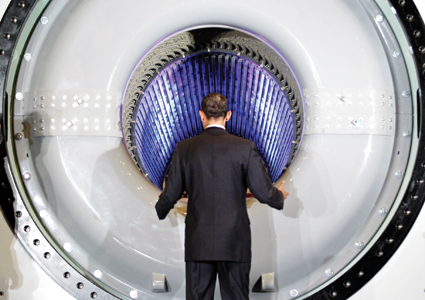
Where did all those green jobs go? President Obama visits a General Electric plant in Schenectady, New York (AP Photo)
The global warming fad is waning. At the same time, a majority of the American people have realised that the policies proposed to address global warming would cause increases in energy prices ranging from substantial to immense. This shift in public opinion presents an equally immense opportunity to President Obama's Republican opponent in the November 2012 election. Whether the Republican nominee takes advantage of the opportunity depends on two factors.
First, it depends on whether the issue is needed at all. The apparent collapse of America's feeble recovery and the fact that Obama's economic policies are counterproductive across the board make it possible that the president will be overwhelmingly defeated and hence no particular policy difference will matter. Second, the numerous Republican candidates for the nomination are not equally capable of making the issue stick or even of grasping what is at stake for America's future. In my opinion, Texas Governor Rick Perry is capable of taking full advantage of the opportunity and former Massachusetts Governor Mitt Romney clearly is not.
Nonetheless this could be the first presidential campaign in which global warming policies or, more precisely, energy-rationing policies that were initially promoted to address global warming, play a prominent role. It could be argued that Al Gore lost to George W. Bush in 2000 because of it, but that is not because Gore ran on the issue. Although Gore had already set himself up as the political leader of the global warming movement before Bill Clinton chose him as his running mate in 1992, he barely mentioned the issue in the 2000 campaign: even then his political operatives understood that it was a loser with the American electorate. If Gore had won West Virginia, hitherto a solidly Democratic state, he would have secured a majority in the electoral college and been elected president. He lost it because voters figured out that the first casualty of Gore's global warming agenda would be West Virginia's major industry: coal.
Nor did global warming play any role in the 2004 or 2008 presidential elections. Senator John Kerry, a global warming true believer, barely mentioned it in his 2004 campaign against President Bush, who had staked out an incoherent middle position on the issue. Bush accepted that global warming was a problem, but argued that doing anything about it would be too costly, while at the same time pursuing a number of piecemeal measures to reduce greenhouse gas emissions.


- Online Only: Back to the USSR
- A Free Press Means to Publish and be Damned
- Max Hastings, the Repentant Europhile
- David Cameron's Difficulties with Girls
- Europe's Implosion Could Save the UK
- How National Culture Fell into the Gutter
- LORD SACKS LECTURE: The Limits of Secularism
- Against the Obama Doctrine of Decline
- The Poor Need a Truly Creative Jobs Plan
- The Battle for the Soul of English Education
- The End of Europe's Fantasy is Now in Sight
- The Odd Couple who Presided over Disaster
- Banished but Unbroken Sisters
- Backing the Habit: Life as a Nun Today
- The Philosopher's Home from Home
- An Old Hatred Returns By Europe's Back Door
- Burdening Banks Will Sink the Recovery — and the Tories
- How to Reverse the West's Decline
- How Liberals And Looters Trashed My Town
- Teaching Rioters The Right Lessons


12:10 AM
1:09 PM
2:09 AM
10:09 PM