


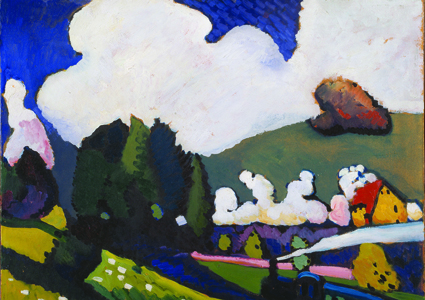
"Landscape near Murnau with Locomotive", 1909, by Vasily Kandinsky (credit: ARS/ADAGP)
One of the best art exhibitions of the year was Kenneth Clark: Looking for Civilisation at Tate Britain. But barely noticed was that there was just one abstract picture in the hundreds of drawings and paintings which filled six large rooms. Here was a major exhibition at Tate Britain, including two rooms full of modern masterpieces, and there was almost no abstract art at all.
Something has shifted in the art world recently, something so strange that it has almost gone unnoticed. Figurative art is back. Abstract art, in all its weird and wonderful forms, is on the way out.
This is the lesson of some of the most interesting and thought-provoking shows of the year. Some have been high-profile: the Clark show and Frank Auerbach at Tate Britain (with a major retrospective in 2015), Edward Hopper and Photography at the Whitney Museum in New York, and Constable: The Making of a Master at the V&A. But perhaps the most intriguing are shows like Malevich at the Tate Modern and Kandinsky at the Guggenheim in New York. Others are less high-profile but also interesting: Re-figuring the Fifties at the Ben Uri Gallery, London, this autumn and Scottish Figuration at the Flowers Gallery in Cork Street in August. Together, these exhibitions show how the balance between abstraction and figurative art is shifting; how important figurative art always was in Britain, whatever was happening in Paris or New York; and how we are starting to reconsider the place of figurative art in the past, not only in Britain but also in the work of great abstract masters like Malevich and Kandinsky.
This would seem perverse to anyone formed in the heyday of abstract art. That moment was perfectly summed up in Kathryn Hughes's review in the Guardian of Alexandra Harris's acclaimed book, Romantic Moderns (2010):
The modernism we know about, or think we do, was fierce and sharp-edged, all the better to scythe down the past and start all over again. During the interwar period, making things new became the mantra. History was a jumbled lumber-room of habits and beliefs that we would all do much better without: it had led, after all, to the carnage of the trenches. All those bits and pieces from previous centuries — the clutter, the junk, the sheer bulk of countless pointless objects — needed to be swept away. Homes, in the words of Le Corbusier, were to become "machines for living", complete with kitchenettes and pull-down beds. And instead of watercolour landscapes and ancestral portraits on the walls, there would be an art composed of white circles etched upon white squares floating upon white paper. If there were to be any colour in this weightless world, it was to be found checked within Mondrian's strict grids.
Like this article? Share, save or print using the icons below:


More Features
- Trump Is No Loser, But Government Will Be Harder
- Trump's Appeal Is More Roosevelt Than Reagan
- The Trump Presidency: A Worst-Case Scenario
- We Cannot Take Liberal Democracy For Granted
- No Need To Fear Russia. The Bear Is Broke
- Who Will Do Justice To Our Judiciary?
- Trust Westminster On Brexit: It's All We've Got
- Back to the "Future Of Socialism", Mr Corbyn?
- Would The Little Lady Like A Wee Dram?
- The Coalition We Need To Defeat Islamism
- Are We Losing The War On Home-Grown Terror?
- Cameron Gave Libyans A Chance. Pity They Blew It
- Brexit Will Give Global Free Trade A Boost
- The Real EU Referendum Winner May Surprise You
- Is Theresa May The True Heir To Mrs Thatcher?
- Race To The White House Through The Looking-Glass
- Brexit Gives Us A Historic Opportunity
- American Conservatives Must Stand Up To Trump
- Cicero's Analysis Of Decline Offers Lessons For The West
- Deepdene: Rise and Fall of the House of Hope
Popular Standpoint topics

- Why On Earth Should Anyone Study Philosophy?
- The Dying Days Of Zuma's South Africa
- His Master's Voice: Scruton On Wagner
- Why The Most Civilised Of Men Felt Like A Fraud
- Political Misconduct
- Trump's Appeal Is More Roosevelt Than Reagan
- Cicero's Analysis Of Decline Offers Lessons For The West
- Andalusia Was No Golden Age
12:10 PM
11:09 PM
10:09 PM
11:09 PM