



These are not popular claims to make, on either side of the English Channel (or either side of the Atlantic, for that matter). But that they are claims deserving close attention and not clownish dismissal (pace the New Atheists), only the truly rigid dogmatists of the secularist super-denomination will deny.
Those who wish to explore how Pope Benedict's analysis of the current civilisational crisis of the West is engaged by a serious mind can do so by reading the lectures given by Ratzinger and the German philosopher Jürgen Habermas at a joint appearance in Munich three months before Ratzinger's address to the Italian Senate. Many expected an intellectual donnybrook at the Catholic Academy of Bavaria on January 19, 2004: in one corner, the pre-eminent European secularist philosopher of "democratically enlightened common sense", himself deeply influenced by the neo-Marxism of the Frankfurt School; in the other, the Prefect of the Vatican's Congregation for the Doctrine of the Faith, inevitably described by most reporters as "the successor to the Inquisition". The question Habermas and Ratzinger were to examine was also contentious, especially in the context of a Europe then furiously debating whether Christianity ought to be mentioned when the draft European constitutional treaty described the sources of 21st century Europe's commitments to civility, tolerance, human rights, democracy and the rule of law. The issue put to Habermas and Ratzinger in the language of political theory — the question of the "pre-political moral foundations of a free state" — was in fact the very same question being argued passionately throughout Europe: do 21st-century democracies, in which political and spiritual authority is separate and the public sphere is "secular", depend for their legitimacy on moral presuppositions the secular state itself can't provide or guarantee?
Habermas, who had previously co-authored an op-ed article with the French post-modernist Jacques Derrida, arguing that the new Europe must be "neutral between worldviews", was expected by many to uphold the standard of the European naked public square: a space constitutionally shorn, not only of religious conviction, but of religious informed moral argument. Ratzinger, the guardian of Catholic orthodoxy, would, it was assumed, denounce the false claims of secularism and warn sternly that an apostate Europe would be an offence against God and man. Both men gravely disappointed the conventional expectations.
For his part, Habermas lamented "the transformation of the citizens of prosperous and peaceful liberal societies into isolated monads acting on the basis of their own self-interest, persons who use their subjective rights only as weapons against each other". He also expressed concern over what he termed (in language demonstrating that German philosophers continue to speak an idiom uniquely their own) "the ethical abstinence of postmetaphysical thinking, to which every universally obligatory concept of a good and exemplary life is foreign". The European future he imagined was one in which "secularised citizens" do not, "in their role as citizens of the state", deny "in principle that religious images of the world have the potential to express truth" — including the truths about the human person that are the moral-cultural foundations of democratic self-governance. Religious fellowships, Habermas conceded, had "preserved intact something which has elsewhere been lost". Might that "something" be the will to live in solidarity with others, coupled with the capacity to give a reasoned account of one's democratic commitments?
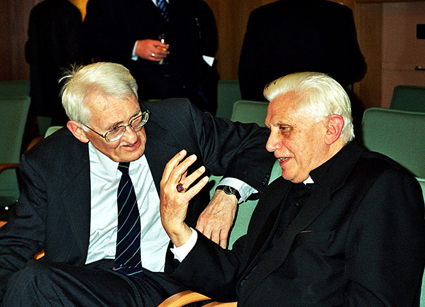
Moral foundations: Jürgen Habermas and Joseph Ratzinger in Munich, 2004


- Online Only: Heirs to the Left
- ONLINE ONLY: The Hayward Gallery's Fashionable Primitives
- ONLINE ONLY: A Spiritual Corner of Southwark
- ONLINE ONLY: Castles in Spain
- Time to Wise Up to the Muslim Brotherhood
- The BBC’s Groupthink on Immigration Stinks
- Decline and Fall of the History Men
- The Banality of Hannah Arendt
- Banging On About Europe is a Winner
- Britain Will Leave the European Union — Hélas!
- The Flawed Logic Of Our Abortion Laws
- We Owe Tom Sharpe a Thousand Laughs
- Midfield Virtuoso Finds His Perfect Pitch
- ONLINE ONLY: Overpopulation and the Reality of Grandchildren
- ONLINE ONLY: Sharia Threatens All Women, Muslim and Non-Muslim
- ONLINE ONLY: The Last Days of the Divvy
- A Party Overrun by Lads and Libertines
- The Myth of Cameron's Etonian 'Chumocracy'
- Here Lie the Remains of Tory Modernisation
- Forget 'Islamophobia'. Let's Tackle Islamism

2:09 PM
10:09 AM
5:09 PM
5:09 PM
1:08 PM