


And that, in turn, is why Ratzinger constantly asks the contemporary West to reconsider its hyper-secularist reading of the past, in which black legends of Christian perversity dominate the historical landscape and the dignity of man is asserted only with effective cultural and political force in the Enlightenment.
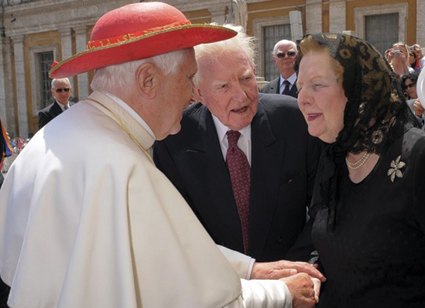
Papal audience: The Pope meets Baroness Thatcher and the historian Paul Johnson
Thus, in his lecture to the Italian Senate, Ratzinger, echoing the opening sequence in Kenneth Clark's TV series, Civilisation, reminded his audience that Christian monasticism saved European culture when it was in grave danger of losing hold of its classical and biblical heritage. In remote places such as Iona and Lindisfarne, the monks of St Benedict, he recalled, were the agents of a rebirth of culture, and did so precisely as "a force prior to and superior to political authority" (which, in the Dark Ages, had largely disappeared from the scene). Moreover, Ratzinger proposed, it was Christianity itself that initially suggested and defended that "separation" of religious and political authority (or, in the vulgate, the "separation of Church and state") so prized by modern secularists: in the first instance, when the late-fifth-century Pope Gelasius I drew a crisp distinction between priestly and political authority. Later, in the 11th century, when Pope Gregory VII defended the liberty of the Church against the Holy Roman Emperor Henry IV's attempts to turn the Church into a department of the state by controlling the appointment of bishops. Remove Gelasius I and Gregory VII, Ratzinger suggested, the rich social pluralism of European life in the first centuries of the second millennium would have been much less likely to develop — and, to bring the point home in terms of Britain, there would have been no Magna Carta and all that flowed from there. It was the Church, in other words, that made the first arguments for the "separation of Church and state", not the philosophes of the continental Enlightenment.
Which, as Ratzinger surveys contemporary European high culture, brings us to yet another irony: the inability of the rationalism proclaimed by the Enlightenment to sustain Europe's confidence in reason. As the late John Paul II saw it, and as Benedict XVI sees it, "Europe" is a civilisational enterprise and not simply a zone of mutual economic advantage. That civilisational project rests on three legs, which might be labelled "Jerusalem", "Athens", and "Rome": biblical religion, which taught Europe that the human person, as child of a benevolent Creator, is endowed with inalienable dignity and value; Greek rationality, which taught Europe that there are truths embedded in the world and in us, truths we can grasp by reason; and Roman jurisprudence, which taught Europe that the rule of law is superior to the rule of brute force. If Jerusalem goes — as it has in much of post-Enlightenment European high culture — Athens gets wobbly: as is plain in the sandbox of post-modernism, where there may be your truth and my truth, but nothing properly describable as the truth. And if both Jerusalem and Athens go, then Rome — the rule-of-law — is in grave trouble: as is plain when coercive state power is used throughout Europe and within European states to enforce regimes of moral relativism and to punish the politically incorrect.
The collapse of faith in reason, the embrace of crank theories of racial superiority and the emotive power of atavistic nationalism brought down the Weimar Republic and led to the brutal dictatorship of German National Socialism. The collapse of faith in reason today — the insouciance about truth displayed in post-modernism-will also have its consequences, in Ratzinger's view. Some are already evident, as in the soul-withering nihilism that is the cultural root of Europe's demographic suicide. Others lurk menacingly on the near-term political horizon, in the threat of what Ratzinger famously called, the day before his election as Pope, the prospect of a "dictatorship of relativism". For, as he put it to Italy's senators: "In recent years, I find myself noting how the more relativism becomes the generally accepted way of thinking, the more it tends towards intolerance, thereby becoming a new dogmatism." Thus relativism becomes a kind of new "denomination" that seeks to "subordinate" every other form of conviction "to the super-dogma of relativism".


- Online Only: Heirs to the Left
- ONLINE ONLY: The Hayward Gallery's Fashionable Primitives
- ONLINE ONLY: A Spiritual Corner of Southwark
- ONLINE ONLY: Castles in Spain
- Time to Wise Up to the Muslim Brotherhood
- The BBC’s Groupthink on Immigration Stinks
- Decline and Fall of the History Men
- The Banality of Hannah Arendt
- Banging On About Europe is a Winner
- Britain Will Leave the European Union — Hélas!
- The Flawed Logic Of Our Abortion Laws
- We Owe Tom Sharpe a Thousand Laughs
- Midfield Virtuoso Finds His Perfect Pitch
- ONLINE ONLY: Overpopulation and the Reality of Grandchildren
- ONLINE ONLY: Sharia Threatens All Women, Muslim and Non-Muslim
- ONLINE ONLY: The Last Days of the Divvy
- A Party Overrun by Lads and Libertines
- The Myth of Cameron's Etonian 'Chumocracy'
- Here Lie the Remains of Tory Modernisation
- Forget 'Islamophobia'. Let's Tackle Islamism

2:09 PM
10:09 AM
5:09 PM
5:09 PM
1:08 PM