


Contemplating with his customary scorn the artists who had embraced the Russian Revolution, Leon Trotsky wondered what it would take to break their attachment to a cause that would eventually murder many of them — and kill Trotsky too, although he was yet to know it. "As regards a fellow-traveller," he said, "the question always comes up — how far will he go?" Would the barbarism of the dictatorship of the proletariat persuade him to "change at one of the stations on to the train going the other way"? Or would he stay on for the rest of the ride?
As Trotsky implied, fellow-travelling with communism was not always akin to endorsing the creed. Communists accepted crimes committed in the name of the revolution without hesitation. The fellow-traveller looked away from communism's victims and invited others to do the same. Communists damned "bourgeois democracy". It disillusioned communism's fellow-travellers, too, but not enough to persuade them to give up on democratic politics completely and join the revolution. They wished the Soviet Union well and found its experiments on the human race bracing. But in the words of David Caute, the best historian of fellow-travelling, their support was a "commitment at a distance".
The absence of a positive commitment sets them apart from the intellectual friends of communism in the early- and mid-20th century. Modern fellow-travellers go along for a ride with ideas they would find repugnant if they could ever bring themselves to confront them.
The contortions the new ideology necessitates were on display at the Great Hall of Cooper Union College in Manhattan. The audience treated Ramadan as if he were a victim of oppression, which in a small way he was. The Bush administration had refused him permission to enter America in 2004. Citing the "ideological exclusion provisions of the Patriot Act", the State Department claimed that he had supported charities linked to Hamas. Ramadan did not suffer greatly. Oxford University, now a home for reactionary causes, made him its Professor of Contemporary Islamic Studies, while the Labour government consulted him about how to deal with Islamic extremism. Quite properly, the American Civil Liberties Union and the American branch of PEN successfully lobbied the courts to have his travel ban lifted. They argued that their fellow citizens were grown-ups who were entitled to hear what Ramadan says.
Defending freedom of speech is one thing. Permissively — or passively — agreeing with the speaker is another. At the end of his session, a questioner asked Ramadan for his response to Ayaan Hirsi Ali's feminist critique of Islam. Ramadan was scathing. Hirsi Ali believed that the only way to be a Muslim in an open society was to be an ex-Muslim, he replied. Her assertion that democracy and secularism were incompatible with Islam was very close "to what I get from racists" who target you "because you are a Muslim".
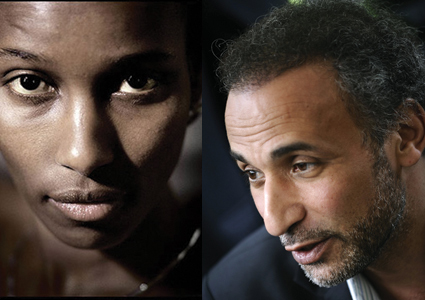
Ayaan Hirsi Ali: Clarity of writing and purpose; Tariq Ramadan: Islam's Luther or poster boy for the Muslim Brotherhood? (Getty Images)


- How Jeremy Corbyn's Coup Hijacked Labour
- Corbyn's Signpost Back To The Ghetto
- Unionists, Don't Despair: Scotland Is Not Lost — Yet
- Britain's Apologists For Child Abuse
- Lift The Fee Cap And Set Universities Free
- The Story Behind One Dead Man's Penny
- Hitler's 'Ecological Panic' Didn't Cause The Holocaust
- Meet The Montalvos: The First Global Family
- Mr Gove, Here Is Our Statute of Liberty
- A British Bill Of Rights
- Something For Nothing Just Won't Do Any More

11:08 AM