



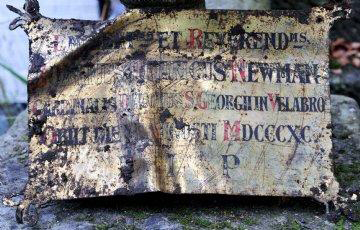
Ad sanctos: The brass plate from Newman's exhumed coffin
Before he died, Cardinal Newman left specific instructions. He wished to be buried at Rednal, outside Birmingham, in the ground reserved for the Fathers and Brothers of the Birmingham Oratory. "I wish with all my heart," he wrote on July 23, 1876, "to be buried in Father Ambrose St John's grave — and I give this as my last, imperative will." On February 13, 1881, he added a postscript: "This I confirm and insist on, and command."
Why this imperative? Did Newman have an intimation that his body might at some time be exhumed, in accordance with the practice of the Church for the beatified? Did he fear that his remains might be translated for veneration in the City Church of the Oratorians at Birmingham? Did he wish to circumvent that, per impossibile?
Apparently so. Why?
Newman was in no doubt about the intercession of the saints. His deep sensitivity to the spirit of a place, its genius loci, extended to the cemetery. His studies in the early Church had impressed upon him the centrality of the "holy places", where the saints were buried. Just as the catacombs, outside the city, were the natural gathering place of the faithful for prayer and mutual support, so did they become the supernatural ground of posthumous miracles and healing. The saints' burial places became the focal points of the nascent Church. And in the Early Church, the faithful wanted to be "buried near the saints".
The practice of burial ad sanctos shaped the history of the Christian Church for centuries to come. It was a practice inscribed in the Annals of the Christian Year. Newman was intimately familiar with, and imaginatively rooted in, these sources of Christian community, recorded in the lives of the Saints and remembered in the Church's Breviary. We, who are less familiar with these sources, may do well to consult a single page taken from the Lives of the Saints (ed. Alban Butler, 1894) under the entry for January 4:
St Gregory was one of the principal senators of Autun, and continued from the death of his wife a widower till the age of 57, at which time, for his singular virtues, he was consecrated Bishop of Langres, which see he governed with admirable prudence and zeal 33 years, sanctifying his pastoral labours by the most profound humility, assiduous prayer, and extraordinary abstinence and mortification.
An incredible number of infidels were converted by him from idolatry, and worldly Christians from their disorders.


- A Recipe For Disaster
- Culture And Politics In The Age Of Trumpery
- Will Labour Listen To Its Eurosceptic Voters?
- Would Brexit Play Into Putin's Hands?
- Why Brexit Could Be A Blessing For Europe
- Will The Pollsters Get It Right On The Referendum?
- The Great Illusion: Why We Are Still Europe’s Fall Guys
- Make June 23 Britain’s Independence Day
- Don't Pit Generations Against Each Other
- Let Justice Be Done Though The Liberal Heavens Fall
- A Fascist Coup In Poland? Give Us Poles A Break
- It's Sharia, Not Alcohol, That Threatens Women
- Double Games Of The UK Muslim Brotherhood
- The Land Where History Repeats Itself As Tragedy
- Holocaust Survivors Are Still Waiting For Justice
- Rhodes, Race, And The Abuse Of History
- Shame On The Liberals Who Rationalise Terror
- France, Islam, And The Second Class Sex
- Isis Is Not Invincible — If The West Has The Will
- After Paris, Who Will Speak For France?

8:10 PM
1:09 PM
11:09 PM
5:09 PM
4:09 PM