


Two great blocks mark the entrance, from which slabs in the form of sleepers run past a low platform, a representation of the siding where the transports would unload their human cargo. By the sleepers is one of the lines of upright stones, like dolmens, which designate the camp's perimeter. To the left of the "station", the site opens out into a meadow dominated by a squat, mushroom-shaped tower with a deliberate crack down the middle. The monument bears a carved menorah, or seven-branched candelabrum, and a Star of David. By its foot are rough tablets bearing the inscription "Never Again" in the same languages as before. A shallow pit of molten basalt represents the cremation of victims. But most remarkable is the "cemetery" of 17,000 jagged granite rocks dotted across the grass, many of them carrying the names of Polish Jewish communities obliterated by the Holocaust.
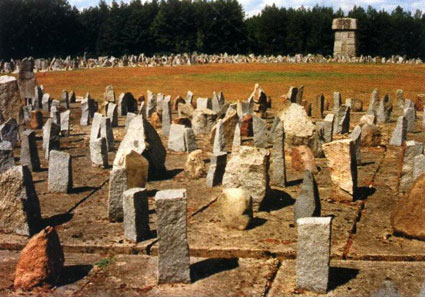
17, 000 stones commemorating Jewish communities annihilated at Treblinka death camp
Our visit took place at the end of May. The sky was cloudless, the leaves were freshly green, speedwell was out and a cuckoo called from the surrounding forest. Nature seemed to be saying: my beauty, and the passing of time, can salve any wound, however deep. And this in a place where multitudes of Jews were herded naked into the gas chambers, buried in mass graves, disinterred and cremated on the grill of a cyclopean furnace. Vasily Grossman, the Red Army correspondent who in 1944 interviewed some of the survivors, aptly called it "the hell of Treblinka". Against nature's seductive call, the mute stones cried out their warning: "Never Again...Jamais plus...Nie wieder...Nigdy wiecej...Nikogda bolshe...Keinmal ma'ar..."
For much of the period when this slaughterhouse was functioning, the architect of the Holocaust, Adolf Hitler, was 100 miles to the north in his East Prussian bunker complex, the Wolfschanze, or Wolf's Lair. He arrived there for the first time immediately after launching the biggest and most devastating action of the war, the invasion of the Soviet Union, codenamed Operation Barbarossa. When, later in that year, the German armies were checked outside Moscow, Hitler assumed personal command of the campaign, involving himself in decisions down to divisional level. The Wolfschanze, where he spent more than 800 days between June 1941 and November 1944, was the nerve centre of this colossal undertaking.


Post your comment
- Migrant Crisis? Europe Hasn't Seen Anything Yet
- Why Palmyra Should Matter To The West
- Corbyn's Rise Makes Cameron Redundant
- No, Jeremy: Politics Is All About Borders Now
- Why 'Lady Chatterley' Still Provokes Us
- For Climate Alarmism, The Poor Pay The Price
- Will Putin's Empire Outlast The Soviets?
- British Witnesses To Lenin's Revolution
- Bibliophiles Beware: Online Prices Are A Lottery
- How Jeremy Corbyn's Coup Hijacked Labour
- Corbyn's Signpost Back To The Ghetto
- Unionists, Don't Despair: Scotland Is Not Lost — Yet
- Britain's Apologists For Child Abuse
- Lift The Fee Cap And Set Universities Free
- The Story Behind One Dead Man's Penny
- Hitler's 'Ecological Panic' Didn't Cause The Holocaust
- Meet The Montalvos: The First Global Family
- Mr Gove, Here Is Our Statute of Liberty
- A British Bill Of Rights
- Something For Nothing Just Won't Do Any More
