



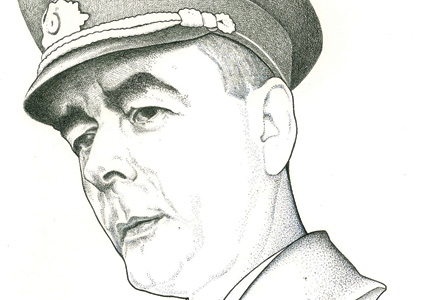
 Albert Speer: Not a mystery, merely a megalomaniac (illustration by Michael Daley)
Albert Speer was as fortunate in death as he was in birth. In 1981, on a visit to London — the city that, four decades earlier, he had tried to obliterate with the world’s first missile bombardment — he had dinner with the historian Norman Stone at Brown’s Hotel, chatting and carousing until 2 am. Next morning Stone interviewed him for the BBC. Stone found Speer “haunted by his past”. Perhaps he was; but the septuagenarian boasted that he had an assignation with a younger woman — an affair that finally disillusioned his loyal wife, Gretel — and seemed to be enjoying an Indian summer. Before Speer could take his lover to lunch, however, he had a stroke, dying later at St Mary’s Hospital in Paddington.
The obituaries were respectful, of course: Speer had always enjoyed a good press. But did he deserve it? Or was his reputation for integrity a shameless fabrication? Journalists, academics and clergymen were complicit in Speer’s construction of an image — the senior Nazi who was innocent of the Holocaust but who admitted his guilt anyway — that was convenient for millions of his countrymen, because it enabled them to be economical with the truth about what exactly they too had known or done. Speer: Hitler’s Architect (Yale, £20), a new biography by Martin Kitchen, paints an unsparing portrait of this “hollow man”.
Speer has always been seen as the most decent, or at any rate the least vicious, of Hitler’s courtiers. He presented himself as an apolitical technocrat, young enough to be “seduced” by Hitler. The Führer took a fancy to the young architect who could turn his megalomaniac dreams into reality. Speer finally turned against Hitler and sabotaged the latter’s “Nero Order”, which would have left nothing but scorched earth to the conquerors of the Reich. In an influential postwar report, the economist John Kenneth Galbraith endorsed this self-image: Speer had engineered a miracle as Hitler’s armaments minister, enabling Germany to fight on for years despite Allied bombing. Most historians have echoed this orthodoxy, but Kitchen demolishes it, showing that Speer cooked the books to make his achievement look better.
Above all, Speer was an artist. Educated Germans did not want to believe that such a cultured man — friend of the pianist Wilhelm Kempff and patron of sculptors such as Georg Kolbe — could have been tainted by the regime he served. Surely this cool, elegant, handsome professor was no gangster, let alone a war criminal? Kitchen shows that he was both. Speer owed his career as an architect entirely to the Nazis: lacking originality, he plagiarised Weimar design, from Max Reinhardt’s theatre to the Bauhaus, to create spectacles for the party. His “cathedral of light” at the 1936 Nuremberg rally was really Leni Riefenstahl’s idea and he was eager to flatter Hitler by promising to turn Berlin into “Germania”, a neoclassical monstrosity on an inhuman scale. As Inspector General of Buildings, he soon became rich by creaming off a 2 per cent commission on public building projects.
Like this article? Share, save or print using the icons below:


- Time To Revisit The Two Cultures
- The Battle Against The Philistines Never Ceases
- Who Will Do Justice To Our Judiciary?
- How The EU Elite Paved The Way For Populism
- Trump's Appeal Is More Roosevelt Than Reagan
- Anything Dennett Can Do, Scruton Does Meta
- Why France Is Revolting Against The Ancien Regime
- A Letter To Our Great-Grandchildren
3:09 PM