


Standpoint Blogs
James Linville
The Businesses of News
UPDATED
It's been a challenging year for the newspaper business.
With advertising revenue falling due to recession, and readers migrating to on-line news providers, papers throughout the US have been closing. In the UK, small local papers have been screaming bloody murder over BBC's attempt to create local on-line news services and so to challenge them directly. In January, Michael Hirschorn writing in The Atlantic asked if The New York Times had a future... a future beyond this May, when the paper, with $46 million in cash reserves, had $400 million dollars of debt due. The Times has since dodged the issue by selling half of its newly-built office building on eponymously-named Times Square. In the meantime, one wonders if the Times's publisher, "Pinch" Sulzberger, has devised any plans for this changing environment, other than cutting staff and selling the rest of their building. In the current issue of Vanity Fair, Mark Bowden asks exactly precisely this question... and is unable to get Sulzberger to consent to an interview.
Meanwhile, two readers of this column, noting the recently falling stock price of Rupert Murdoch's News Corporation and the recent short-term losses of that company's news divisions, asked, almost hopefully, whether Murdoch's recently-purchased Wall Street Journal would meet a similar fate.
I believe not. Because of the structure of Newscorp stock-holding, a largely family controlled affair, Murdoch is unlikely to watch Newscorp stock in the manner of, say, a Time-Warner executive, pushing for quarter upon quarter of high profit returns, and instead has the luxury to take a longer view. Would that more CEOs, especially of financial companies, were inclined to take such long views. Consider for a moment that the leading German media companies, including those that now own majority of US trade book publishers, are all privately owned.
The newspaper business is said to be "dying," but, with more eyes reading news than ever, it's not. Simply put, the news-text business is instead transforming... splitting between the new electronic news-text business, which so far is not much of a business since few people have figured how to make real money from its growing readership, and the old "dead tree" news-text business.
In this new environment Murdoch may be perfectly positioning himself for the next phase. While many papers across the US have been closing, Newscorp has been quietly buying many of the best small local papers. Murdoch appears to be betting that the top news text brands, like the Wall Street Journal, will survive, because they offer proprietary trusted information for business and consumer decisions. When a platform is developed to make the purchase of news articles safe, simple, instantaneous and inexpensive... a platform like itunes... or possibly itunes itself... the electronic news-text business, delivered to your computer, phone, or electronic reader, will be both lean and profitable. Even now, users of smartphones, with digital music and applications stores, are being conditioned much such transactions as a matter of course.
In the UK, The Guardian has just about perfected the on-line reading experience, and one would expect them to be at the forefront of such a change-over to metered news.
On the other hand, as many large metropolitan newspapers continue to die (and the NYT-owned Boston Globe is now on life support) those small local "dead tree" news products... sorry, NEWSPAPERS... will begin to thrive as their competition in the middle segment of the market disappears. I wouldn't want to imagine a future without the New York Times, which has been part of my daily life since I was a child, but if they do not devise a plan for adapting we may have to. Thus... if in this sad new world, you lived for instance in Brooklyn's Cobble Hill, you might open your door to find a small, scrappy local paper, to read over morning coffee or on the weekend. As you ventured out to commute, you'd turn on your Kindle or ipod for national and international news, from organizations that can still afford foreign bureaus.
Consider, instead, an alternative: if the New York Times were to simply mail every subscriber an Amazon Kindle electronic text reader, close the door to free on-line page views, and offer e-subscriptions at 35% of the dead-tree subscription rates... many readers who only get their news on-line (which includes most everyone under the age of 35) would likely opt for this subscription... and begin to pay for news text again, much as this generation learned through itunes to pay for their music.
Another alternative: perhaps it's time for Google finally to make their first "content play."
Meanwhile, Nicholas Lemann in The New Yorker looks back to news moguls of yesteryear HERE. The Washington Post (HERE) advances the notion of newspapers re-forming as nonprofit corporations, which would restrict their ability to endorse candidates. Mark Bowden pesters the New York Times for their story in Vanity Fair HERE.
With that, I'm turning to my bookshelf and opening the newly published 20th anniversary edition of David Fromkin's A PEACE TO END ALL PEACE. Before bed I'll be carefully turning the pages of David Ferry's translation of Horace's EPISTLES.
Apropos the future of print, I recommend you to the epistle by Horace entitled "To His Book."
Quintus Horatius Flaccus
UPDATE: The layers of editing and proofreading offered by traditional news organizations are not to be sniffed at. Egregious spelling in the first draft since corrected.
Nonproliferation Now - North Korea
Gary Samore, White House coordinator for nonproliferation, speaking as North Korea launches a three-stage rocket over Japan:
"I hate to speculate about North Korean motivations."
I fear the Obama administraton is showing an escapist mindset regarding the dangers facing the world from some actors with bad intentions.
Israel's Lurch to the Right
Far-right politician Avigdor Lieberman was last week made foreign minister of Israel's new right-wing government and he immediately made a speech that was deemed "controversial," leaving his listeners squirming uncomfortably. Especially noted was his rejection of the Annapolis accord of 2007, an initiative that was in fact never ratified by Israel's Knessert or the Olmert government.
Less noted was Lieberman's embrace of the 2003 "Road Map" diplomatic initiative, which was ratified, and which he had at the time voted against an MP. One does suspect Lieberman may be embracing this position as a posture... that he need never concern himself about a two-state solution (step "z") or relinquishing further settlements in the West Bank (step "Y") until terror networks are dismantled (putative step "x"). But, still, how to account for headlines that this man has not embraced a two-state solution when the document he aims to adhere to is inelegantly but hopefully entitled "A Performance-Based Roadmap to a Permanent Two-State Solution to the Israeli-Palestinian Confict"?
Meanwhile, the Israeli Arab minority are understandably alarmed by the ascension of this government. In the run-up to the election Lieberman ominously suggested that all Israeli citizens (though one suspects he especially had in mind that 20% of Israeli citizens of Palestinian-Arab descent) should sign a loyalty oath or submit to a loyalty test.
Afou Agbaria, an Israeli MP from Umm al-Fahm told the FT that "This is the worst point in the history of Israel's Arab minority."
How one wonders did Israel come to have such a government? I submit that a rainfall of rockets coming from Palestinian Gaza, an area where Israel had removed all its settlement just a few years earlier, might have something to do with that. One asks: what was the strategic aim for Hamas firing rockets into Israel? Though many were fired, they were largely ineffectual, and served no military purpose. The rockets did however radicalize the Israeli voting public, sending them lurching to the right in advance of an election, and they also of course provoked a horrific Israeli counterstrike in Gaza.
Once again, Hamas acts, and the Palestinian people suffer... in Gaza, and this time Palestinians in Israel too.
Meanwhile, word comes that President Obama is considering a meeting with President Assad of Syria. I suggest that before meeting with Assad, or indeed engaging in discussions with leaders of Iran, President Obama should publicly ask these leaders whether they too are committed to a two-state solution for that region (the question that constantly asked of Lieberman), and whether they are committed to the existence of Israel.
Beirut: The Valentine's Day Menacing, Vol 9
Street thugs be warned: when you attack three writers you're bound to get at least nine disparaging news stories.
Standpoint's own Jonathan Foreman, on the receiving end of a fairly-ineffectual sucker punch during the SSNP's Valentine's Day beat-down of Christopher Hitchens on Beirut's Hamra Street, offers his account of the incident in the current issue. It's also a fascinating look at Lebanon in the wake of the Cedar Revolution.
Hitchens himself "sets the record straight" in the Vanity Fair hitting newsstands today. Hitchens, however, neglects to name the "comrade" who took a punch for him (Jonathan) as well as the "comrade" who helped effect their escape, Michael Totten, The Week's 2007 on-line journalist of the year.
More ink has now been spilled on this matter than blood was that day.
Of course, I too was in Beirut for the commemoration of President Rafik Hariri, the Cedar Revolution "martyr," and am as guilty as the next scribe; but as I wrote earlier:
"In the wake of the commemoration the city was festive. At the time of their menacing, I was drinking tea at a cafe less than a mile away as bottles of Kefraya were being opened. May Beirut no longer be a battleground."
Read Foreman here, and Hitchens here. And go to Beirut, it's a wonderful city.
Picked-Up Pieces
Pankaj Mishra traces the parallels between India's Hindu nationalists and the newly resurgent Israeli right-wing. I don't buy his argument but he makes it in an interesting way. In the National here.
Melik Kaylan observes that western leaders' courtship of "moderate Islamists" leaves the true moderates and those looking for secular governance in the lurch.
North Korean plans to put two US journalists on trial. It looks to me as if the regime actually kidnapped them from Chinese territory. This is an outrage. Will the US not protect its citizens?
While we're at it... Iran is holding American journalist Roxana Saberi.
Michael Yon has pictures of dogs at work in "overseas contingency operations." Give them a bone.
Our era's greatest conspiracy-theory-debunker, Ed Epstein, examines whether the AIG Bailout was a nefarious conspiracy.
Bartle Bull asks if President Obama will be a one-term disaster. Seems a little early for that, though the President could use some help on the diplomatic and protocol front.
Blogger The Unliberaled Woman notes that NOW it's okay to report Iraq as a victory. "Obama... what a great general he is." (President Obama himself has not been ungracious to his predecessor, and I believe it will be he who confirms Bush's legacy as the most "mis-underestimated" president in history.)
President Obama is considering a meeting with Syrian President Assad... at a time when a UN tribunal at the Hague is examining evidence in the murder of Lebanese President Rafik Hariri? Given that Assad likely issued that assassination order this leaves a bad taste. If the meeting happens could be an augur that Assad will not be indicated.
And farewell Helen Levitt, an American photographer who looked at children and the street with a lyricism akin to Cartier-Bresson.
Lenin Unleashes
One of Russia's most famous statues, of Vladimir Lenin outside the Finland Station in St. Petersburgh, was strategically bombed yesterday so as to leave a gaping, three-foot hole in the Bolshevik leader's posterior.
The statue stands before the railway station where Lenin landed, in April 1917, on returning from exile to join the revolution against the Russian czar's government. In the intervening years of Soviet rule, the city was in fact named Leningrad in honor of the Soviet Union's first leader.
No one was hurt by the 4 AM blast. But, my, what an interesting choice by this demolitionist, who secured the charge inside the statue itself.
He could have taken the statue down.
He could have taken off that outstretched arm pointing to the horizon.
He could have placed the charge on the outside of the statue.
Instead, he chose a more expressive placement, as if to say, "You can take your Marxist &#*# and blow it out..."
Hat tip Moscow Times.
Newspeak: the Terms of a Conflict
The Obama adminstration has introduced new language for the conflict with militant political Islam. The Department of Homeland Security now cites the danger of "man-made disasters," a catch-all that includes terrorist incidents.
The term "War on Terror" is out of favor. Instead: "Overseas Contingency Operations."
Meanwhile, from the tribal provinces of Pakistan, Baitullah Mehsud, the Pakistani Taliban commander responsible for the assassination of former Prime Minister Benazir Bhutto as well as a deadly attack this week on the Pakistani police academy, uses the same-old familiar language:
"Soon we will launch an attack in Washington that will amaze everyone in the world,” Mehsud told The Associated Press recently by phone.
And this, earlier, in an interview with Al-Jazeera TV: “We want to eradicate Britain and America, and to shatter the arrogance and tyranny of the infidels. We pray that Allah will enable us to destroy the White House, New York, and London.”
Mehsud's candor is remarkable. The specificity of his language is almost a breath of fresh air. Almost.
As I've written earlier, regarding the Islamic Republic of Iran's stated aims: "Do you think they mean what they say?"
More about Mehsud at The Captain's Journal.
"Doesn't anybody here know how to play this game?"
We ask this question in relation to following from Toby Harnden, of a briefing book distributed by the Obama administration to US journalists travelling to the G20 summit:
The United Kingdom, we are told, is "slightly smaller than Oregon". As for the the British climate, it is "generally mild and temperate" and "subject to frequent changes but few extremes of temperature". A "group of islands close to continental Europe", Britain has been "subject to many invasions and migrations". We're taken through the Roman invasion ("brought more active contacts with the rest of Europe"), the Norman invasion (led to "active involvement in European affairs...for several hundred years") and various travails with the Welsh, Scots and Irish before the British empire reached its zenith in Victorian times. Then it all started to go wrong. "The losses and destruction of World War I, the depression of the 1930s, and decades of relatively slow growth eroded the United Kingdom's preeminent international position of the previous century".
In fairness the administration has in place neither an ambassador to the UK, nor many other key staff members. That said, I'd guess that most mainstream US journalists have a better idea of the size of Britain than they do of Oregon.
Hat tip Harnden.
Nora Arnezeder
Another good thing about French cinema... Nora Arnezeder, the nineteen-year-old singer and actress, and the star of "Paris 36."
The trailer here:
Economics - the Fix We're In
In London, down the hill, as anti-capitalist protesters, many of whom may have marched in recent years "for peace," turn violent, the G20 are meeting.
Why is this a group of 20, not 8? In fact, why simply are not 2 meeting... the US and its creditor China?
Politicians have alternately said that now is not the time to point fingers, and then they've pointed fingers.
On BBC President Obama is citing a "lack of regulation" as being the source of the problem.
Yet isn't it obvious? This crisis formed because the US government over the last two administrations pushed policies that enabled financiers with their eye on the nearest horizon to make fortunes by lending money to people who would never be able to pay it back.
Gmail Introduces Autopilot
The next service from Google...
As more and more everyday communication takes place over email, lots of people have complained about how hard it is to read and respond to every message. This is because they actually read and respond to all their messages.
Sign up here.
Iraq War: Is the end in sight?
I've written below about PressTV. At the link is the 17 March edition of "Forum," their one hour current-affairs program moderated by Andrew Gilligan, on which I appeared. The occasion was the sixth anniversary of the 2003 Iraq war. Other guest included:
Andrew Murrison – Shadow Defence Minister
Nick Palmer – Labour MP
Gilbert Achcar – Co-author, w/Noam Chomsky, Perilous Power
PressTV is an international news broadcaster funded by the government of the Islamic Republic of Iran. It "specializes in a Middle East perspective." In the UK they broadcast on SKY (next to the Al-Jazeera channel).
The program can be seen HERE.
Do read Frances Weaver's recent "Counterpoint" on the ethics of appearing on PressTV, here.
My own discussion of the questions Weaver raises can be read here.
On PressTV - Iran's International Broadcaster
The April issue of Standpoint contains an important note by Frances Weaver. She raises the matter of PressTV, the international broadcaster funded by the Islamic Republic of Iran.
The question she asks is whether western liberal commentators should appear on such a network, given the nature of the regime that supports it and the views of other commentators, views that may on occasion be unattractive or even vile and untrue.
As an example of the latter, Weaver points to an article on PressTV's website by Dr. Nicholas Kollerstrom, "The Walls of Auschwitz," that is a quisling attempt at extreme Holocaust diminishment, if not outright denial.
Weaver asks if individuals who appear on PressTV, such as Andrew Gilligan, Tariq Ramadan, Nick Ferrari, and Derek Conway, are naive, or simply don't realize they are being used to give the channel a veneer of respectability.
Speaking as someone who appeared last week on PressTV's "Forum" current-events debate show with Andrew Gilligan, I can attest that I was naive, certainly, in that I was unaware of the Kollerstrom article. I wouldn't say that my appearance lent the network a great deal of prestige or credibility. I did however hope that I might be able to use PressTV, to put forward my own ideas and to advance the cause of western liberalism, at least as much as PressTV might be using me.
I'd been reassured by producers beforehand that the other panelists were reasonable, the show would not be edited to excise content authorities would find objectionable, and that the program would be broadcast via satellite within Iran. I'll post a link to the program separately.
Meanwhile, in Washington, DC, my friend the New Republic writer Jamie Kirchick had a wholly different experience of PressTV, as I've written previously (link below).
I encourage others to offer opinion on this matter in the comments below. Perhaps they'll also offer accounts of their own experience, or advice to others who may be contemplating such an appearence. (Advice from Kirchick and Melik Kaylan was most helpful in preparing for my appearance, for which thanks.)
I maintain that the best response to an illiberal regime's use, or misuse and abuse, of modern technology and the west's freedom of expression is MORE free expression by people willing to defend the means and values those others attempt to turn against us.
On a separate but related note, the Iranian blogger Omid Reza Misayafi has died in prison, as noted in this column last week. Hoder Derakshan, the father of the Iranian blogosphere, remains jailed by the Islamic Republic.
Weaver's note here.
About Jamie Kirchick's experience on PressTV here.
About jailed Iranian on-line journalists here.
ps-next week I'll be writing in this column about a just-released report regarding human rights in Iran.
Michael Maccoby's Memories of Erich Fromm
Some time ago, when I was in Washington, DC, Michael Maccoby, a psychoanalyst, author, business consultant, and the patriach of the extraordinary clan that was hosting me, spoke about his mentor, the eminent psychoanalyst Erich Fromm.
I suggested to Michael he should write about such an important teaching relationship. He did so, and I offer it here. His account also gives a fascinating glimpse of an era.
In 1959 while I was finishing my doctorate at Harvard, David Riesman, the sociologist, introduced me to Erich Fromm who was looking for a psychologist with knowledge of statistics and projective testing to work with him on his study of a Mexican village. In exchange for working with him, Fromm offered me training in psychoanalysis at the Mexican Institute he had founded and analysis with him. That year before leaving for Mexico in 1960 with my wife Sandylee, I participated with Fromm, Riesman and others in two political meetings. One focused on the dangers of nuclear war with the Soviet Union which led to establishing a group called Committees of Correspondence. Riesman published a newsletter, The Correspondent, which both Fromm and I contributed to in the years that followed. The other was a meeting to discuss revitalizing the Socialist Party in the United States. Fromm had written a manifesto which was the topic of discussion. Although I agreed with much of what Fromm had written, I wasn’t convinced that a Socialist Party had any chance in America, a country where class differences are denied. Riesman, who was also at the meeting, and I decided our best hopes were to work within the Democratic Party, and subsequently, we presented a paper to a group of progressive Democratic Congressmen which was published in a collection of essays called The Liberal Papers(1961).From 1960 to 1970, I was Fromm’s student, analysand, apprentice, and colleague, co-author of a debate on thermonuclear war with Herman Kahn(1962) and finally the book Social Character in a Mexican Village (1970).
It is difficult to summarize a decade of profound learning and experiences with Fromm. The analysis was a deep exploration of self, rich in dreams and insights that woke up sleeping parts of the self and forced me to take full ownership of my life in making critical decisions. At one point, I had a dream of being in a Harvard examination hall with others. In front of us was a map of the world. I started to work on my map but I noticed the others just sitting there, not working. “That’s a good dream,” said Fromm, “We are all given the world as a test, but most people don’t know it’s a test they have to to take until it’s too late and they can no longer decide what they are here for.”
Fromm’s view of the self was like a mansion of many rooms in which most people lived in one or two with the others closed off. Like Freud, he agreed with Horace that “nothing human is alien to me”. One’s ability to experience and contain all the irrational as well as transcendent emotions, from the murderous to the loving and sublime, from deep despair to encompassing joy determined how deep the analysis could go. But to contain this awareness required a philosophical frame of meaning which Fromm had found first in Judaism but later in different forms of Buddhism and religious mysticism. Together with my analysis, Fromm had me read Aristotle’s and Spinoza’s Ethics, Herbert Marcuse’s study of Hegel, Kierkegaard’s Purity of Heart Is To Will One Thing, Meister Eckhardt’s stages of development and writings in Zen and Indian Buddhism.
During the time I knew him, including periodic meetings in the 1970s, Fromm significantly changed some of his views. In the early 1960s, his outlook combined a messianic belief in humanistic socialism with a practice of Zen Buddhism, learned from D. Suzuki. He was in contact with the Yugoslavian Paxis Marxist and encouraged me to lecture in Belgrade and Zagreb in 1964 and later to attend the meetings of Praxis in Korcula.
His analytic style at this time was very influenced by Zen and he had me practice Zen meditation every day. Like a Zen master he could be punishing when he thought I was holding back or being inauthentic. When I complained that he was not being helpful, he said “I am not here to be helpful but to analyze”. He repeated the Zen story of the master who smacks his disciple with a stick. “But I haven’t even said anything,” says the student. “Why should I wait?” says the master.
After his heart attack, Fromm became gentler, more sympathetic.He said that one could believe all illness was psychosomatic until you reached your 60s, In 1968, we both were very active in the anti Viet Nam war movement and Eugene McCarthy’s campaign for president. After the election was over, Fromm expected McCarthy to join him in leading a humanistic movement based on his book The Revolution of Hope, but McCarthy let him down, even failing to show up for an agreed-on meeting. Fromm became more pessimistic. The Messiah was not going to come any time soon. The Socialist movement was being buried in the rebellious acting out of the late 1960s, more in tune with what Fromm considered Herbert Marcuse’s distortion of both Freud and Marx than with Fromm’s humanism. He became more interested in individual spiritual development, more in tune with the Buddhist vision of transcendence, of becoming one with nature. In his New York apartment, he lay on the floor and showed me how he was practicing dying. His book To Have Or To Be expressed his conviction about purpose, the aspiration to fully love life and to not be held back by greed and enslaving attachments.
Working with Fromm could be difficult but also extremely enjoyable. Even when difficult, it was stimulating. Never before had any professor ripped my drafts apart and forced me to clarify my thoughts, fully express the logic of my arguments. Fromm had no patience with unfounded disagreements, but when we wrote together, he was open to my ideas and criticisms. One of the most memorable days of my life was when he asked me to critique his manuscript of The Anatomy of Human Destructiveness and we met in his New York apartment, dialoguing and arguing from 11:00 am to 11:00 pm, getting up only to go to the bath room. Food and drink was brought in by Annis, his wife. What intensity and concentration! Yet, at 11:00pm, neither of us was at all tired. We were fully awake, full of enthusiasm from the intellectual journey we had shared.
Fromm’s tough criticism was, I believe, a compliment, for he was equally tough on himself and extremely self critical of what he considered his narcissism. Like Freud, he saw himself as a narcissistic personality. However, in retrospect, I think he overemphasized the negative aspects of this personality type and underestimated the positive side, the lack of internalization of the father, replacing the superego with an ego ideal, giving one the freedom to create, for good or evil, one’s own sense of meaning without being tied to cultural norms.
Fromm and I both loved telling each other jokes. He had a wonderful sense of humor and a joyful laugh. He believed that a sense of humor is the emotional equivalent of a cognitive sense of reality. He especially enjoyed humor that punctured self importance.
Fromm became an idolized figure in Mexico, based on appreciation of his wisdom but also strengthened by transferential idealization. His disciples lacked his knowledge and vision and few questioned anything he pronounced. I once asked him how it felt to be idealized and he answered that it was frustrating in the sense that his followers, with few exceptions, only repeated what he gave them, that there was a lack of creativity in their followership. But this is a problem with many extremely creative thinkers who never finish learning and revising their ideas. It is the reason why the Freuds, Marxes and Fromms don’t want to be Freudians, Marxists or Frommians.
MEP: "You are the devalued prime minister of a devalued government"
This three-minute speech, or rather dressing down, delivered by MEP Daniel Hannan 24 hours ago, was ignored by the BBC and British newspapers.
It has, this evening, gone viral.
The POTUS's Press Conference
TOTUS's boss, the POTUS, held a press conference yesterday.
By prior arrangement, President Obama called on reporters from these organizations:
Ebony magazine
Stars and Stripes
Univision
Agence France-Presse
He did NOT call on reporters from these organizations:
The Washington Post
The New York Times.
The Los Angeles Times
The Chicago Tribune
The Wall Street Journal
USA Today
The last four of these were not called upon at last month's news conference, either.
Hat tip Howard Kurtz.
The Blog of the Teleprompter-in-Chief
The TOTUS... the Teleprompter (of the President) of the United States... is no longer invisible, he speaks, and even sits for interviews with conservative talk radio hosts:
RUSH L: Teleprompter, as a consumer of electricity, how do you feel about cap and trade?
TOTUS: This is a timely question, Rush, and I'm glad you asked it. You may have noticed last night that I went a bit 21st Century and pulled out my big, 52-inch LCD screen for the press conference. Big Boy has been having problems with my left and right screens on brackets, so instead of putting a third screen down on the floor in front of the podium like Gibbsy wanted, we went high-tech in the back of the room. Boy did I look hot.
And I was hot. Really hot. And that's the problem. According to Al Gore, use of my flatty module exponentially grew my carbon foot print by about 140%. What does this mean? None of us knows. He says he derived this statistic through a complex "algoreithym." But Tipper says it was probably the result of his nipping into her old prescription-drug supply from the 2000 recount.
Either way, none of us in the White House really cares. Big Boy's answer on cap and trade last night should have tipped you off. You see, it doesn't so much matter how much energy I am consume and waste, as it is does what I waste and consume it for. In this case, it was for a press conference where Big Guy said almost nothing, but was also able to slap Israel around, give the what-for to Republicans on Capitol Hill, and completely confuse the American people on everything from what the Big O knew about AIG bonuses to what he thinks he knows about the budget process of the United States. In other words, it was worth it.
The blog of TOTUS can be followed here.
Tannaz Hazemi
I recently had the pleasure of reading "Good People," an extraordinarily compelling, if sometimes alarming, first novel by Tannaz Hazemi... "the female Arturo Bandini."
Noruz pirooz, Tannaz.
Photo: Susan M. Kirschbaum
The Third Coming of Ska
The Specials announce a reunion tour.
Our friend Whit Stillman has been preparing a film set in Jamaica in the early 1960s.
Something tells me we're about to witness the third coming of ska.
It all began here, with this single... or rather Island Records began here, with this single.
The President's Message to the Iranian People
Noruz pirooz. Or here's wishing happy Persian new year to my Iranian friends.
President Obama yesterday sent the same message to all the Iranian people.
I'm sure many Iranians return the sentiment. However, Iran's "Supreme Leader" Ayatollah Ali Khanenei made no mention of this greeting when today he stated, "The world can't block Iran's nuclear path."
Meanwhile, I'm wondering who exactly is the leader of Iran, who or what group wields power. The more I look at it the more it's a mystery.
But happy new year to them, and to you.
Grey Gardens
Al and David Maysles's classic 1975 gothic documentary "Grey Gardens" was made into a hit stage show, and now a feature film for HBO. See in the film's trailer an unrecognizable Drew Barrymore and Jessica Lange playing the demented Jackie Kennedy cousins Edith Bouvier Beale and her daughter... Edith Bouvier Beale.
Postscript: twenty years ago Grey Gardens and its grounds were restored to their original state and it is one of the most beautiful classic homes on eastern Long Island. It's now owned by former Washington Post editor Ben Bradlee and is the summer residence of arts patron Frances Hayward.
Double-check that Teleprompter
President Obama, Wednesday night at a town hall meeting in California, regarding the transgressive, beleaguered, and now part-government owned financial AIG:
"It’s almost like they’ve got — they’ve got a bomb strapped to them and they’ve got their hand on the trigger. You don’t want them to blow up. But you’ve got to kind of talk them, ease that finger off the trigger."
What an unfortunate analogy. Given the dangers many in the world, including our soldiers, face, we don't need facile references to suicide bombers. Rather than compare finance workers to mass murderers, he should be at work with the Treasury Secretary firing the bad ones, and retaining the good ones.
Oh... and real suicide bombers... I believe in "talking to the enemy" and all, but real suicide bombers, I'm not entirely sure that diplomacy works when their finger is on the trigger.
See the report HERE.
An Interview with the Cleric
Robert Pollock of the WSJ has a fascinating interview with Grand Ayatollah Muhammad Hussein Fadhlullah, described by some as the "spiritual leader of Hezbollah."
Ayatollah Fadhullah comments on upcoming elections in Lebanon:
"We hope that that the elections will be as free as in civilized nations. Our problem in the Arab world is that people fear their rulers and therefore fall short of changing them, whereas the natural course of things is that rulers should fear their peoples. . . . We appreciate the way elections are run in America or the West; the Americans or the Europeans are not frozen over one personality. They study the success or failure of this president or this administration, and therefore they change it from time to time."
Read the whole thing HERE.
Iranian Blogger Dies in Prison
Iranian blogger Omid Reza Misayafi, 29, sentenced to two and a half years for allegedly insulting religious leaders and engaging in propaganda against the Islamic Republic, has died in prison.
Authorities claim that he "committed suicide."
Hoder Derakshan, the "father of the Iranian blogsphere," arrested in November remains in prison.
Caleb Carr on Gunter Grass's Life in the Double Lightning
Standpoint has run a fascinating piece on the allegation that Milan Kundera, as a young man in Czechoslovakia, informed on an anti-communist. As on-line comments mention, there may be parallels with Gunter Grass's service in the German Army during WW II, revealed by the author in a memoir. When Grass's memoir first appeared I received this missive from my friend Caleb Carr, the novelist and military historian. I offer Carr's words here with his permission:
First, as to the facts of Grass' case: 10th SS Panzer Division and its sister, the 9th, were called into being toward the end of the war as prime examples of desperation units. The average age of their troops was reportedly eighteen, but it was well-known that many were a good deal younger, and some were quite a bit older. Their first task, significantly, was to try to plug the proliferating leaks on the Eastern front. Now, a word about the Eastern front: Especially toward the end of the war, the German practice of shipping all "undesirables," i.e. nearly all indigenous peoples and certainly all Jews, gypsies, Poles, and anyone displaying personal "imperfections" back to Germany for slave labor was increasingly giving way to the practice of executing such people in larger and larger numbers on the spot. As Anthony Beevor makes irrefutably clear in his masterful study of "Stalingrad," there was NO German soldier -- regular army, SS, Waffen SS, whatever -- who did not or could not know about all these programs, no matter how hard he tried, and no German officer who did not know of the details. Therefore, to assert that Grass could have been involved in action on the Eastern front, especially in a Waffen SS division, yet simply have been a dutiful soldier ignorant of what was going on around him... It doesn't work. You would have a much harder time making that case for someone working in Abu Ghraib and not knowing what Lynndie England and her boyfriend(s) were up to; and, as some of you have so indignantly pointed out, that case can't be made, either.
But let's say that Grass joined 10th SS Panzer later, after it returned to Germany; it was then involved in the follow-up offensive to the Battle of the Bulge, "Nordwind," during which it came under the PERSONAL command of Heinrich Himmler. If anyone is in any doubt as to what that means in practical terms, let's just say that on at least one occasion a surrounded American armored unit was driven to any and every extreme to avoid massacre -- the same kind of massacre that Waffen SS troops had committed at Malmedy during the Battle of the Bulge. No one familiar with the Waffen SS will be surprised by any of this; it is only the worst kind of Nazi freaks and biker morons that keep the imagery and "romance" of the fighting arm of Himmler's private army alive; for the rest of us, the mere fact that Grass chose to join ANY unit of the Waffen SS is sufficient to nullify any social commentary he may have chosen to make during the rest of his life, UNLESS he had chosen to admit his past FIRST.
An entire generation of now-senior German intellectuals have, to a very large extent, ignored their own history (whether during the war or after it, when their mistreatment of Muslims created the problems that Europe is now faced with) while focusing on every misdeed of the United. In truth, the German intelligentsia since the war, as Grass has revealed, have practiced the same techniques that their nation perfected before and during the war.
-- C.C. (14 January 2007)
Read Michael Weiss in Standpoint on Milan Kundera here.
The Persian Version - Take 2
UPDATED, see below.
I mentioned last week my appearance on "Forum," a current affairs programme produced in London for PressTV, the international broadcaster funded by the Islamic Republic of Iran. The production staff were smart and professional, the moderator Andrew Gilligan on better behaviour than during his days at the BBC, and the audience was both young and civilized.
New Republic writer James Kirchick, appearing on another program produced by PressTV in Washington, had an entirely different experience. In an article he's sent me he suggests there was an element of deception in that his invitation supposedly came from a putative "Danish broadcaster." What's more, he was repeatedly prompted by a producer speaking to him via an earpiece to interject at particularly heated moments in the debate, only to be chastised by the moderator floridly: "Don't let this noble opportunity for debate plunge into the abyss of scurrility.”
Oh, and his interlocutor in debate was Taji Mustapha, a London-based member of the unattractive group Hizb ut-Tahrir.
Read Kirchick's account here. Watch the debate below.
I'll post a link to the Forum Iraq debate on which I appeared after it runs at the end of the week. I understand from Kirchick that PressTV does not broadcast in Iran. I've asked the broadcaster to let me know if those residing in Iran can access unedited versions of the programmes via the web. I'll be reporting back with an answer.
UPDATE: Editors of Standpoint have called my attention to other programs and articles presented by PressTV. We are alarmed. Read more about PressTV in the next issue of Standpoint, available on newsstands March 26th.
Hezbollah - "Could They Mean What They Say?"
I've written before that the American Democratic Party, to which I still belong, has increasingly become isolationist regarding foreign affairs, protectionist in matters of international free trade, and escapist regarding strategies to contend with militants who aim to harm American citizens.
Regarding the escapist mindset, I suggested last summer that when a Democrat becomes president many liberals, including most of the media, will wake up to the fact that the intransigent problems and tragic choices that a Republican administration had been facing were more complex than its critics were willing to admit, and would not disappear when a fresh and hopeful face appeared in the Oval Office.
Furthermore, in the wake of Iran's spurning President Obama's outstretched hand, editorialists have begun to ask apprehensively the Islamic Republic: "Could they mean what they say?"
For a couple of years now I've been a fan of the blog "Abu Muqawama," written by Andrew Exum and co-horts. Exum is not a member of the media (instead a former soldier, an academic and a commentator on counter-insurgency matters), but sometimes he writes as if he is. Yesterday, he opined regarding attempts by Hezbollah, the Iran-backed, armed and militant Lebanese "Party of God," to create a society of resistance:
"The danger of trying to create a society of resistance is that you might succeed. And once you do, it gets awfully tough to talk your constituents down from the rhetorical ledge you've constructed. So I worry that at this point it would be a lot more difficult for Hizballah's (sic) leadership to lead their constituents toward disarmament because they have constructed this external enemy that gives the organization its meaning."
Andrew Exum lived in Lebanon, and studied the country for at least four years. Has it really has taken him this long to figure that point out?
Read Exum's post HERE.
Kurt Vonnegut's Rules for Writing a Short Story
1. Use the time of a total stranger in such a way that he or she will not feel the time was wasted.
2. Give the reader at least one character he or she can root for.
3. Every character should want something, even if it is only a glass of water.
4. Every sentence must do one of two things—reveal character or advance the action.
5. Start as close to the end as possible.
6. Be a Sadist. No matter how sweet and innocent your leading characters, make awful things happen to them—in order that the reader may see what they are made of.
7. Write to please just one person. If you open a window and make love to the world, so to speak, your story will get pneumonia.
8. Give your readers as much information as possible as soon as possible. To hell with suspense. Readers should have such complete understanding of what is going on, where and why, that they could finish the story themselves, should cockroaches eat the last few pages.
Harold Brodkey
"The night crept on, swept on, late minutes, powdered with darkness, in the middle of a sleeping city, spring crawling like a plague of green snakes, bits of warmth in the air, at 4am smells of leaves when the stink of automobiles died down. Dawn came, so pink, so pastel, so silly."
Caleb Carr on Harry Potter, Ancient Symbols, and Soft Power
In response to a recent post about those who see nefarious subtexts in the Harry Potter stories (see link below), we received this note from our Misery Mountain correspondent, Caleb Carr, the novelist and military historian. Carr writes:
Sorry, there, but...
If you spin the emphases around just a little -- keep the idea that Harry Potter is the representative of the "other," use multiculturalism to throw in some Asian and nominally Muslim kids -- this is EXACTLY the same line that the extreme Right took against the Potter books and films: turn it from Potter being an exponent of dark forces working for Satan to attack Islam to Potter being an exponent of dark forces working for Satan to defeat the messianic fantasies of the Neo-con's and others. So what have you got? Two sides of the same coin, AS USUAL: the extremists from each side are just as bad as those from the other, and that's the main thing that's so scary about all this: the rational center is being choked off by wingnuts, who can and do set forth the fairly absurd extreme agenda of Armageddon, of the Messiah, and the whole boat that goes with that; and I am no more comfortable with the Western Right than the Iranians. In fact, in many ways, it's scarier, because it has such traction, here. Try reading the actual best-seller lists, those based on sales overall, not sales in intellectually approved bookstores; see what's there; even on the NYTBR bestseller list, a book of personal reborn-ing -- after violation by the exponents of the sick, worldly modern society -- recently held the No.1 spot in a phenomenal way that the Times and everyone else just chose to ignore, just like they chose to ignore all the "Left Behind" books, which have become a world unto themselves...
And this is my violent problem with the whole reliance on "soft power": it's not driven be any careful determination of world philosophies, etc: taking Harry Potter as the greatest recent example, it's based on sheer mercenary plagiarism, the repacking of dozens of ideas stolen from trendy pop religion and entertainment over the last year, including, yes, Madonna's and other celebs' preoccupation with Kabbalah -- and it is therefore a wildly loose cultural cannon, that can hurt us far more badly than it can help: for every sex-n-violence movie pirated in places like Iran, among the audiences that you hear interviewed and studies done hear by those who examine the views of these effects on the populations, particularly women in places like Iran or Afghanistan, where it's assumed the women and kids are all salivating for this stuff, the reality of soft power is far more complex and sinister than those who are trying to ram them into these countries -- who dismiss interviews like this one as "ha-ha, listen to the stone-age Muslims" -- would like us to believe. I heard ADM Mullen talking about this on Charlie Rose last night, and he's one of the great examples of who's really getting duped and used by these more mercenary commercial interests. Among all the all amazingly bland and unoriginal/unimpressive things he had to say (and he really takes the role of CJCS to new heights of banality) he states that there is some voo-doo in "soft power" that will make up for the need for hard confrontation: when in fact, soft power is serving the needs of the OTHER side, when it comes to deepening the recruiting of new soldiers, as often as anything else.
I'm sure I know what anyone in any way connected with the Potter books or films would say, if you can get them to say anything, in response, but the fact is, these people are not helping, they're hurting, when they throw around ancient and medieval symbols as if they're just silly toys for them to use. When you're fighting an enemy that's obsessively stuck in the Middle Ages, how can you possibly be so snotty and avaricious, instead of at least informed and concerned? When there's billions in merchandising to be made, if only you can make sure every kid on the planet is forced to believe that this is where reading and viewing begin and end, that's how.
In short, this tape is not the dismissable nonsense many people who would like to consider themselves informed and liberal thinkers may suppose; this is the problem of soft power in a nutshell, and we are going to get nowhere until we recognize that right now, it's a weapon we're using in the manner of a greedy kid horsing around with a loaded gun.
- CC
See the original Potter post HERE.
Gossip - A Strategy
"I would never insult someone right to their face. I believe in talking behind peoples' backs. That way, they hear it more than once."
- Fran Lebowitz
Meant for Each Other, A Story by Barry Yourgrau
After two more bottles, the girl falls asleep on her bar stool. “That’s our sweetheart,” grins the bartender, shaking his head at the girl’s snores.
“You mean you know her?” you inquire, uneasily.
“Sure, she’s here every night, with a different guy,” says the bartender. “Whoopee, whoopee.” He winks.
“Really,” you reply. You eye the unconscious girl slumped headfirst on the bar counter. And you decide no matter how cute she is, this first date will also be the last,thank you very much.
And this is how you two meet, you and the love of your life. Four months later you get married and move into a lovely apartment together, where you start to raise a large and happy family.
How you get from point A to point B is a long, complicated, heart-warming, and in many ways wonderfully unbelievable story. But alas it requires someone with far greater narrative powers than mine to properly relate.
Trust the message, if not the messenger
The most beautiful things are those that madness prompts and reason writes.
- Gide
The Coded Iconography of BBC's Question Time
Last evening I appeared on PressTV's FORUM, a one-hour live debate show akin to BBC News's Question Time, on the topic "The Iraq War, 6th Anniversary: Is the end in sight?" It was my first time on television and I only fumbled one question, I think... er, maybe two. And I learned that four seconds of dead air time can seem an eternity.
Andrew Gilligan moderated, and fellow panelists were Andrew Murrison (Shadow Defence Minister), Nick Palmer (Labor MP), and Gilber Ashcar (Co-Author with Noam Chomsky of Perilous Power). I'll post a link next week. PressTV is an international news broadcaster funded by the Iranian government. The producers, staff, other panelists, and audience were all well informed, and highly civilized. However, at the end, Gilligan had a disappointed look on his face. I suspect he was secretly hoping for some Jerry Springer-like action.
In the afternoon, rather than preparing crib notes for the debate, I was thinking about Harry Potter, and folding a US dollar bill every which way to its make various Masonic symbols even more prominent. It was one of those days. Perhaps I was downcast. Money certainly was on my mind. Following a sure-fire tip I'd put a fiver on Mighty Man in the 3:20 at Cheltenham, 33-1. Inexplicably, he'd lost. That evening, after appearing on Iranian TV, I repaired for a Guinness to the beloved Prince of Wales, where the week before a punter who'd been in and out of the bookies next door had give me that sure-thing tip. The tipster, a ruddy-faced older gent with an East End accent, was there, as always. I confronted him. "Mighty Man? No, no, my friend, I said Power Station." Please. A horse that wasn't in that race. This was my one wager in the last year. What's more, the truth is I don't particularly love Guinness. I'm a New Yorker, and the betting and Guinness were just a weak attempt to try to go native. I walked home and turned on "Question Time" to see how Jonathan Dimbleby handled debates and whether he knew wrath-stirring tricks that had eluded Gilligan.
But what ho! Dimbleby was wearing some weird tie... a tie that prominently featured a spider. A Spider?
The background of the BBC set was decorated with a vast cross-hatching, a sort of abstract colorful spider's web.
Consulting an Islamic Imagery manual, which I happened to have at hand... or in any case within a few clicks of the mouse... I read that "a spider web invokes a famous story in which the Prophet Mohammad, being pursued by the Quaraish, finds safety in a cave. The Prophet's position in the cave was concealed by... a... spider... web." Bingo.
If you look at things long enough they always connect. Dimbleby's producers may through such iconography be sending coded messages about their hidden control of the program to jihadists in the audience. Or something like that. I know that on Iranian TV I was sending coded secret coded messages to the other liberal internationalists in the audience, if there were any. The message was "Help." Did I mention? Four seconds of dead air time can feel like an eternity. I also kept trying to drop the term "neo-liberal" but couldn't find the opening.
But about "Question Time"... it was after all the show where Dimbleby reduced the American Ambassador to tears the week of 9/11. So his agenda is transparent, even if his coded messages are "veiled." It's wonderful when everything is clarified, and I'm glad I got something right this week. Still, shame about the horse.
I've put a call in to the BBC News press office to ask who gave Dimbleby the tie. I wonder: is Dimbleby witting? No answer back from the Beeb yet. STANDPOINT's other on-line columnist, Michael Burleigh, thinks it might be worth our looking into Jon Snow's socks. Perhaps, because his ties are unfortunate, the only message in them is "out of date."
Something to look into next week.
The Truths About Harry Potter
We saw that the Christian right had a problem with the Harry Potter series, and its depictions of magic.
Apparently some Muslim critics also find the series suspect, a Zionist propaganda conspiracy.
The World As It Is
How far we Democrats have lowered our aims.
Some years ago another politician said the following:
The Stryker Brigade Bait-and-Switch
As below, the US deputy commander in Iraq says they do not foresee troop cuts in 2009. I'm delighted President Obama has gone back on his campaign promise.
But has Obama pulled a political bait and switch, announcing the transfer of a Stryker brigade to Afghanistan, while quietly speeding up their replacement?
Meanwhile, the members of the first brigade had spent ten months learning Arabic, to prepare for service in Iraq, a language that will do them no good in Afghanistan.
The Mudville Gazette investigates and calls this a scam. Read the whole thing here. It would certainly appear to put politics before the needs of the president's commanders in the field.
Picked-Up Pieces
Today marks the fiftieth anniversary of Chinese rule in Tibet. Tibetans still seek the autonomy that had been promised them. Thupten Jinpa, the principal translator for the Dalai Lama, writes here.
A US commander in Iraq says they do not foresee troop cuts in 2009. I'm delighted President Obama has gone back on his campaign promise.
On Geithner's dilemma. (Apropos, why is Treasury discussing redecoration and additions when the house is on fire? Mr. Secretary grab a firehose.)
A scorecard of the Obama's Realist foreign policy positions... and by "Realist" one might instead say Kissinger-like.
Five Guantanomo detainees attest to planning the September 11th attacks.
Tunku Varadarajan asks what does it mean to be a "moderate Taliban"... the ones Obama says he'll talk with.
Meanwhile, a CNN correspondent is now the Communist candidate for the presidency of El Salvador. He identifies himself as "the Obama of El Salvador," vows "Yes, we can!" Wow, imagine if he wins... his first state visit to Washington, with a bust of Jose Marti under his arm, will be a real riot.
Solutions - A Clarification
"Only honest people and swindlers can find a solution for every situation, and someone who wants to be honest and a swindler at the same time has no solution."
- Anton Chekhov, "The Duel"
Alma Perdida by Valery Larbaud
To you, vague aspirations, enthusiasms,
Thoughts after lunch, emotional impulses,
Feelings that follow the gratification
Of natural needs, flashes of genius, agitation
Of the digestive process, appeasement
Of good digestion, inexplicable joys,
Circulatory problems, memories of love,
Scent of benzoin in the morning tub, dreams of love,
My tremendous Castilian joking, my vast
Puritan sadness, my special tastes,
Chocolate, candies so sweet they almost burn, iced drinks,
Drowsy cigars, you, sleepy cigarettes,
Joys of speed, sweetness of being seated, excellence
Of sleeping in total darkness,
Great poetry of banal things: news items, trips,
Gypsies, sleigh rides, rain on the sea,
Delirium of feverish nights, alone with a few books,
Ups and downs of temperature and temperament,
Recurring moments from another life, memories, prophesies,
O splendors of the common life and the usual this and that,
To you this lost soul.
Translated by Ron Padgett and Bill Zavatsky
via Alligatorzine. hat-tip to the heroic Jeannie Vanasco.
The President of all Americans, including Shareholders
This is not the way to speak to frightened citizens who happen to be shareholders:
Last Tuesday, President Obama, dismissing the plunge in equities since he was sworn into office, said, "What I'm looking at is not the day-to-day gyrations in the stock market, but the long-term ability for the United States and the entire world economy to regain its footing. The stock market is sort of like a tracking poll in politics, it bobs up and down, day to day. And if you spend all of your time worrying about that, then you're probably going to get the long-term strategy wrong."
Most U.S. shareholders are not rich, and shares make up the bulk of their retirement savings.
Article on Obama's statement here.
Charles Freeman on Mao Zedong
"Mao Zedong had a force and energy which none but men of equally great spiritual conviction could withstand. His animal appetites, we now know, matched his intellectual vigor. He was an object of adulation to his subjects and of mingled admiration and dread to his subordinates and intimates. While Mao lived, the brilliance of his personality illuminated the farthest corners of his country and inspired many would-be revolutionaries and romantics beyond it. Few indeed loved Chairman Mao's style of governance, but all but a few of those who despised it most loved the People's Republic he had founded more and hated him less than they feared him."
Charles Freeman is reported to be the Obama administration's selection for the head of the National Intelligence Council. These 2006 remarks, from of an address to the SAIS China Forum, may be read here.
Crossfire on Charles Freeman - Lee Smith Rips
The usually excellent James Fallows stumbles in, almost unwillingly, or perhaps unwittingly, to defend the much-criticized, "contrarian," and "too-close-to-the-Saudis" Charles Freeman... the Obama administration's selection for the head of the National Intelligence Council. Fallows writes:
"The more important point, he said, was that Freeman's longstanding contrarian inclination to challenge conventional wisdom of any sort, far from being an embarrassing liability, was exactly what a president needed from the person in this job."
Meanwhile, our friend Lee Smith sends us this missive in response to the Fallows piece, and raises the alarm:
"I am sick of this Freeman 'debate.' Sure, the President needs someone who will think outside the box and say the inconvenient or politically incorrect things no one else will say, such as perhaps... What if Buraq the flying donkey really did touch down in Jerusalem? What does that mean for our Middle East policy? What if there is a Santa Claus? What does that mean for NATO? What if the head of Ted Williams is put back on the body of a young man? Will there be another .400 hitter in the big leagues? Or will he commandeer a stealth bomber and choose to go after the Norks all on his own?
"Freeman is an anti-Semitic jackass who is in the pay of two foreign governments and so stupid he doesn't even know that for the Saudis Israeli national security is a vital strategic interest, for no one else is willing to take on the Iranians. Sometimes it truly does hurt to be an American and have oneself and one's loved ones represented to bad people by our very worst."
Fallows here, but a better exihibit A might be Freeman's own words, found in an interview here and in articles here. See also here.
Finally, and most-amusingly, the stalwart ngo Human Rights Watch has been accused of turning neo-con-ish, on account of criticizing this Obama appointment, as detailed here.
Treasury Secretary Geithner - a Review
Former Australian Prime Minister Paul Keating remembers US Treasury Secretary Tim Geithner from his handling of the Asian financial crisis of the 1990s.
"Tim Geithner was the Treasury line officer who wrote the IMF [International Monetary Fund] program for Indonesia in 1997-98, which was to apply current account solutions to a capital account crisis. … It takes a gigantic fool to mess that up. But the IMF messed it up. The end result was the biggest fall in GDP in the 20th century."
Meanwhile, we've been assured we're in "the best of hands."
Read The Belmont Club take here, and the original article here.
Isild Le Besco, and another excellent thing about French cinema
The Rendez-Vous with French Cinema is on now at Lincoln Center. It's a showcase of the best French cinema now. Details here.
Oh, here's another fine thing about French Cinema--Isild Le Besco acts in French films.
She's the real thing.
Courtesy by David Ferry
It is an afternoon toward the end of August:
Autumnal weather, cool following on,And riding in, after the heat of summer,
Into the empty afternoon shade and light,
The shade full of light without any thickness at all;
You can see right through and right down into the depth
Of the light and shade of the afternoon; there isn't
Any weight of the summer pressing down.
In the backyard of the house next door there's a kid,
Maybe eleven or twelve, and a young man,
Visitors at the house whom I don't know,
The house in which the sound of some kind of party,
Perhaps even a wedding, is going on.
Somehow you can tell from the tone of their voices
That they don't know each other very well--
Two guests at the party, one of them, maybe,
A friend of the bride or groom, the other the son
Or the younger brother, maybe, of somebody there.
A couple of blocks away the wash of traffic
Dimly sounds, as if we were near the ocean.
They're shooting baskets, amiably and mildly.
The noise of the basketball, though startingly louder
Than the voices of the two of them as they play,
Is peaceable as can be, something like meter.
The earnest voice of the kid, girlish and manly,
And the voice of the young man, carefully playing the game
Of having a grown-up conversation with him:
I can tell the young man is teaching the boy by example,
The easy way he dribbles the ball and passes it
Back with a single gesture of wrist to make it
Easy for the kid to be in synch;
Giving and taking, perfectly understood.
Picked-Up Pieces
Director Blue charts the Meltdown, including that Franklin Raines, the CEO of the busted Federal National Mortgage Association, and a former Clinton White House staffer, received compensation during his time driving Fannie Mae into the ground of more than $90 million dollars. Say what?
DC Examiner anatomizes the US president's troubles, the ground shifting under his feet. Unfortunately they're now all our troubles.
Even the NYT's Paul Krugman is criticizing President Obama. Oh dear.
(Advice from this blogger: to regain control of the narrative castigate Rush Limbaugh, offer some more feel-good Bush criticism.)
"Torture memo" author John Yoo offers himself as a target for Bush admin criticism, but he reasonably argues that in the immediate wake of 9/11 Justice was taking steps to contend with an anticipated Mumbai-style assault.
William Dalrymple reviews the debut of an extraordinary Pakistani novelist, Daniyal Mueenuddin.
NOW Lebanon ponders the implications of a win by the opposition March 8 coalition. This even as the UK opens relations with Hezbollah. (Foreign Office official to press spokesman: "Remember, Hezbollah is now a political organization. Don't mention their bombing that Jewish center in Argentina.")
Postcard: North Yorkshire Moors
... picture, taken at a village fair, by Lucy Perceval.
Another "Vast Conspiracy"
The paranoid left imagines the Tea Party Rebellions are the result of a vast right-wing conspiracy.
But hold on. Think about it... how can information spread so quickly and disparate parties coordinate and gather? The internets you say? Ha!
Cui Bono, my friend, cui bono?
Daily Kos put themselves Out There. Playboy retracts (link is dead, so don't bother).
Instapundit, who foresaw such Armies of Davids, tracks.
Chastity Lit?
One further addition to the readings list below.
Word that "chastity lit" is all the rage? Could be. We ourselves have been holding out, in anticipation of Hephzibah's Anderson's memoir "Chastened: the Year of No Sex in the City."
Picked-Up Pieces
I've been reading David Fromkin's A Peace to End All Peace, as well as these picked-up pieces...
Revelations that Israeli intelligence penetrated the highest levels of Hezbollah, placing tracking and listening devices in their vehicles. I'm sure just the suspicion of this would be enough to create chaos.
Kissinger on a strategy for Afghanistan.
That President Obama has "declared war on investors, entrepreneurs, small businesses, large corporations, and private equity and venture capital funds." Argued HERE.
That Obama has blundered in appointing Charles Freeman as chairman of the National Intelligence Council. (His defense, cited here, of the Chinese politburo in their perpetrating the Tiananmen Square massacre is itself a marmalade-dropper.) Also called a "Saudi Puppet" HERE.
Michael Young on Christopher Hitchens's appearance at the American University in Beirut. Hitchens's address asked "Who are the Revolutionaries in Today's Middle East?" His argument went effectively unanswered.
Obama's plan for mortgage rescue, doesn't add up. Tea parties revolts have sprung up all over the country. Suddenly I'm looking back and remembering that youtube video before the election, of an elated woman saying, "Obama's going to pay my mortgage!" We all thought she was a deluded enthusiast. Perhaps she was on to something.
Buffett predicts economy will be in shambles through 2009.
NYT reports that Syria is signalling a new direction. (Syria always does SIGNAL a new direction. I'd like to see them TAKE a new direction.)
William Dalrymple describes Pakistan's shock at the jihadists attack on cricketeers in Lahore. He prescribes Sufiism. Am pleased to agree with Dalrymple for once.
A profile of Pakistani president Zadari, upon whom so much depends. (Show of hands: how many of you miss Musharraf?)
Did the Kremlin nix a book critical of life under Stalin? Sounds that way. The book is The Whisperers by Orlando Figes. Buy a copy and tell your friends all about it, and ask your MP or Representative to tell the Kremlin we don't like seeing so many Russian journalists killed.
Allegra Huston also has a memoir on the way.
That the Democrats face an internal civil war, between gentry and populists.
That "Che" will open the Cartagena film festival. Just what the Colombian people need.
That we are again living in history, which is roaring back. Actually it never left us, but we've been distracted the last few decades.
Make Your Own Mac Netbook
Simply buy a Dell Mini 9 inch, for $400, then follow these INSTRUCTIONS to load it with Mac OSX software.
It'll have to do until Apple makes their own. I'd like one with a solid-state drive for travel.
Obama's Apostle of Patience
... and the question of how to manage tragic choices...
David Ignatius profiles someone Obama "listens to" on Iran... Lee Hamilton, "an Apostle of Patience," "the former congressman from Indiana who co-chaired the 2006 Iraq Study Group that urged engagement with Iran." Ignatius fails to note that President Bush's ignoring this very Iraq Study Group's advice, his most notable act in his second term, is what led to the securing Iraq in 2007. This is why the US can now responsibly begin to draw down forces in Iraq rather than have them depart desperately from rooftops by helicopters.
Hamilton explains to a credulous Ignatius the "patient process of engagement" he envisions. What's more, he notes that Iran too would like to move forward, but ever so slowly. Of course, if Iran draws out diplomacy a year or two they'll have the time needed to gain nuclear weapons. It's no wonder they should hope for such patience.
Let's review for a moment: all so-called right-thinking people (including it goes without saying most Europeans) condemned the "unilateralist cowboy" Bush's pre-emptive war to prevent Saddam Hussein's terror-sponsoring state from being able to activate its weapons program, or at the very least from being able to buy them off the shelf. European opinion-makers, who often identified themselves as "world opinion," counseled there was a better way to address such dilemmas than brute force and war. Of course, the Bush administration recognized this in that they were engaged in multi-lateral diplomacy, coordinated with China, to prevent North Korea from joining the nuclear club. Meanwhile, Europe would begin negotiations with Iran to encourage it to eschew WMD, end its status as pariah, and join the civilized world again.
Where do we stand now? Iraq is becoming a secure state for its own citizens, and is a pluralistic democracy as well as a possible long-term Western ally in the middle east. North Korea, once the most dangerous of this trio, a threat to Japan, has been stymied temporarily and may be on the brink of change. Meanwhile, Iran... a nation comprised of one of the world's most sophisticated people... is led by a madman who spouts eliminationist rhetoric, theatens to wipe out a democracy and US ally in the region, and is on the brink of obtaining nuclear weapons.
President Obama campaigned promising to talk directly to Iran. I noted then, even as I voted for him, that what he proposed would in fact be a unilateralist move, since our European allies and the UN, whom he'd have to brush past, were even then engaged in extended diplomatic talks with Iran. Now that he is president, and before the administration begins its patient talk with Iran, or even begins to listen to them, he should ask Britain, France, and Germany for a public accounting of their diplomatic progress with Iran. After all, shouldn't the US listen to its allies first?
Allies, speak to us, please.
Meanwhile, with that preface, do read David Ignatius on his discussion with Lee Hamilton, "President Obama's Apostle of Patience."
"The Battle of Beirut"
More on "The Battle of Beirut," or "The Afternoon of the Tiny Fist," or as I like to think of it "The Valentine's Day Menacing"... Michael Young comments in the Beirut Daily Start on Hitchens' speech at the American University, paying particular attention to the audience. Qifa Nadbki comments on Young's comment. The Exiled rants... ill-informed and fallacious, but fun. No matter the context ("what are the ethics of vandalizing a swastika?"), it is very odd when writers cheer for thugs stomping on a writer's best hand. Unprecedented in my memory.
It should be noted that not a great deal of blood was spilled... but rather a great deal more ink and electrons than blood. No weapons were brandished. Meanwhile in the wake of the Hariri commemoration the city was festive. At the time of the menacing, I was drinking tea at a cafe less than a mile away as bottles of Kefraya were being opened.
May Beirut no longer be a battleground. It's a wonderful city. Go see for yourself.
Song: Calexico's "Ballad of Cable Hogue"
This from Calexico, whose Tex-Mex mariachi-inflected indie rock is big in Tuscon, Arizona.
Michael Totten: Christopher Hitchen and the Battle for Beirut
Michael Totten chronicles "Christopher Hitchens and the Battle for Beirut," essential reading, though I was in the city at the time and considered it more "The Valentine's Day Menacing" or "Afternoon of the Tiny Fist."
Totten: "Last week Christopher Hitchens and I were attacked in Beirut... [jumped] by a half dozen members of the Syrian Social Nationalist Party on Hamra Street when he defaced one of their signs."
Read the whole thing HERE.
Interesting coda: "The Syrian Social Nationalist Party spokesman denies the attack ever took place. He is lying."
Totten tells true.
The Shortest Stories
Ernest Hemingway once said his best work was a story he wrote in just six words: "For sale: baby shoes, never worn."
Here, by the likes of DBC Piere and Jeff Eugenides, are some other such flash fictions.
Crime Surveillance
As noted, a former Whitehall security architect explains that "privacy rights of innocent people will have to be sacrificed to give the security services access to a sweeping range of personal data."
Meanwhile, in Chicago, Mayor Daley announced recently that by 2016, when he hopes the Olympics will be in Chicago, there will be a surveillance camera on every corner of the city. There's another argument to be made, that would cut crime tremendously in the Windy City would be constant public surveillance of him and the rest of the machine.
Reading, Watching 2
Also reading:
IBD on why the market continues to sink.
Richard Fernandez of the Belmont Club on Information Warfare.
Christopher Dawson asks for an I-phone based notebook.
Chris Caldwell looks at Britain's becoming the first European Union country to bar an elected European legislator from its territory for his political opinions... the case of Dutch MP Geert Wilder.
Why Gitmo under Obama is no Gulag, here. (Politics.)
And of course Instapundit where I found many of these articles.
My friend London Liberty Girl, one of The Times's top 100 bloggers, as well as evidence, golly gosh, of The Lord's Plenty.
How failure to save East Europe will lead to a worldwide meltdown.
That Syria's Assad urges the US to rebuild diplomatic road to Damascus.
I can't bear to watch Frontline's doc "Inside the Meltdown," so tonight I'll look back at Julian Schnabel's "Before Night Falls." I think he's an even better filmmaker than decorator.
The Valentine's Day Menacing
... about which The Huffington Post Chooses the Wrong Side of History...
According to the HuffPo, Christopher Hitchens suffered a beat-down in Beirut this Valentine's Day past. This is true, mostly, as I can attest, having been in the city at the time and seen Hitchens, limping and bloody and sober immediately afterwards. That said, the HuffPo gets most of the details wrong; it was instead, I'd say, more of a stomping, with some scratching thrown in for good measure. Further, the pro-Syrian fascist goons from the SSNP also roughed up The Week's 2007 Blogger of the Year Michael Totten, from Portland, Oregon, and punched Standpoint's own mild-mannered Deputy Editor Jonathan Foreman. The goons, it has to be said, were not entirely effectual. Their punches to the faces of the writers, three shots in toto, left absolutely no marks. I was assurred that their heavy kicking was more damaging, especially when Hitchens was on the ground. I'm unclear whether they crushed his writing hand beneath a boot-heel. The thugs were not, as reported on Huff-Po, "shoe-shopping," but rather guarding watch in an intimidating fashion in a neighborhood where they were not welcome, and where last spring they brandished, and used, automatic weapons on the residents.
Meanwhile, the commentators on the HuffPo piece seem to favor the goons who beat up the writers. One of the HuffPo commentators on the article actually tries to put in a good word for the SSNP, a socialist nationalist (not to say "nationalist socialist"... cough... Nazi) party. Ouch. The SSNP, suspected by many to be behind the 2005 wave of carbombings of journalists and politicians, were in any case sorry to see Syria forced out of Lebanon by a popular revolt, the Cedar Revolution, that spring.
This Valentine's Day was, of course, the fourth anniversary of the assassination of Rafik Hariri, and in the morning Martyrs Square had been filled with young and old, Muslims and Christians and Druze, all commemorating the sad day. That afternoon the SSNP members must have been feeling edgy and left out. Everyone else in Beirut seemed ready to move on. Too bad they didn't join in too.
Don't get the wrong idea about Lebanon from this incident. It's a truly lovely country. As the Valentine's Day Menacing took place in the Hamra district, I was with friends a mile away in Achrafiye sipping mint tea. Very chill. A few hours later all the menaced above-mentioned were drinking 2004 Keffrya in Gemmayzeh.
You can read the unreliable HuffPo account HERE.
Updates:
Richard Fernandez of The Belmont Club offers a photo survey of the site of the incident HERE.
Target-of-fascists Michael Totten posts his account HERE. As he says, This was "not just a street gang, they're a street gang with a state [behind them].” Syria.
Reading, Watching
Catching up since my return, so much to read, all that Raymond Chandler (see below), also John Fante's "Ask the Dusk," and then...
Contrarian Edward Jay Epstein asking "Would you be better off today if you had invested a half-million dollars a year ago in (a) Bernard Madoff‘s infamous Ponzi scheme or (b) AAA blue chips such as General Electric, AIG, Citibank, or Bank of America?" The correct answer surprises.
Spain agreeing, "in principle," to take some released Guantanomo inmates who cannot, for some reason, return to their home countries. The BBC cites concerns that "some would need to be transferred to third countries as their home nations have poor human-rights records." The BBC does not cite other concerns, such as that some may return to the battlefield, as many released inmates have arleady done, or have trouble "fitting in" in their prospective third country homes.
A former Whitehall security architect explains or perhaps warns that "Privacy rights of innocent people will have to be sacrificed to give the security services access to a sweeping range of personal data."
Fabius Maximus argues persuasively that everything written about the economic crisis overlooks its true nature. His forecast of what comes next is chilling and essential reading. Related, earlier by FM here.
Gizmodo hackintoshes a Dell mini 9 into an OS X netbook.
Declan Ganley and Libertas challenges the EU's Lisbon Treaty, via Standpoint.
The Mexican Secretary of Foreign Affairs, Patricia Espinosa Cantellano, rejects the idea that Mexico is a “failed State”... which is somehow the opposite of reassuring.
Roger Cohen coins the term "Green Zone-ism" — the basing of Middle Eastern policy on the construction of imaginary worlds. Nice.
Rick Newman explains why Bank Nationalization is so scary... and now I'm scared.
Andrew Ferguson looks into PBS icon Bill Moyers (long ago) looking into the sexual orientation of political opponents... "J. Edgar Moyers."
Roger Kimball on the Chicago Tea Party.
Newsweek looks at stress conditioning in special forces soldiers.
Obama joins Clooney Meeting
President Obama took time from his busy schedule to sit in on Joe Biden's meeting with actor-director George Clooney to discuss the crisis in the Darfur region of Sudan.
After the meeting, at a press conference, Clooney relayed:
- That the president would appoint a "full-time, high-level envoy to the region."
- "The administration has assured me that Darfur is one of a small handful of foreign-policy reviews being undertaken at the [most senior] level."
- Sending an envoy would be "a huge policy step."
- "There was some concern that this could fall off the radar."
- "There's quite a few other things [the administration is tackling], but they assured me this is high on their agenda."
- "It's about involvement, it's about diplomacy," he said, adding it is "not something the U.S. could do alone."
George Clooney and his associate Don Cheadle have done an admirable and important service to the world in keeping this horrific issue before the public's attention. Hats off to them. But what is vague horse manure?
There is a genocide taking place in Darfur. It must be stopped. Samantha Power, are you part of this administration?
Quotes via Washington Times.
Reading, Watching - Chandler, Wilder, etc..
I've been catching up on my reading.
Top of the list is Raymond Chandler's "The Simple Art of Murder," recommended to me by Ace of "Ace of Spades" blog. Also re-reading that author's "The Lady in the Lake."
Apropos, not being able to catch the Oscars on Sky UK, I watched "Chinatown" until utterly hard-boiled I fell asleep.
Thinking of Chandler turns my mind to Billy Wilder, who collaborated with him on the script of "Double Indemnity." In an interview shortly before his death Wilder talked about this.
BILLY WILDER: Our collaboration was tumultuous. Chandler had never been inside a studio. He was writing for one of the hard-boiled serial magazines, The Black Mask, the original pulp fiction, and he'd been stringing tennis racquets to make ends meet. Just before then, James M. Cain had written The Postman Always Rings Twice, and then a similar story, Double Indemnity, which was serialized in four or five parts in the Black Mask. They don't have those serial magazines anymore, but in Germany they were very popular. At the end of that week's excerpt you're left with a great feeling of suspense. I understand that thousands of people would wait near the docks for the arrival of the boat coming from England with the new chapters of a Dickens novel. Paramount bought Double Indemnity, and I was eager to work out with Cain, but he was tied up working on a picture at Fox, called Western Union. A producer-friend brought me some Chandler stories from The Black Mask. You could see the man had a wonderful eye. I remember two lines from those stories especially: "Nothing is emptier than an empty swimming pool." The other is when Marlowe goes to Pasadena in the middle of the summer and drops in on a very old man who is sitting in a greenhouse covered in three blankets. He says, "Out of his ears grew hair long enough to catch a moth." A great eye. . . but then you don't know if that will work in pictures because the details in writing have to be photographable. I said to Sistrom let's give him a try. Chandler came into the studio and we gave him the Cain story, Double Indemnity, to read. He came back the next day--"I read that story. It's absolute shit!" He hated Cain because of Cain's big success with The Postman Always Rings Twice. He said, "Well, I'll do it anyway. Give me a screenplay so I can familiarize myself with the format. This is Friday. Do you want it a week from Monday?" "Holy shit," we said. We usually took five to six months on a script. "Don't worry," he said. He had no idea that I was not only the director but was supposed to write it with him. He came back in ten days with eighty pages of absolute bullshit. He had some good phrases of dialogue, but they must have given him a script written by someone who wanted to be a director. He'd put in directions for fade-ins, dissolves, all kinds of camera moves to show he'd grasped the technique. I sat him down and explained we'd have to work together. We always met at nine o'clock, and would quit at about four-thirty. I had to explain a lot to him as we went along, but he was very helpful to me. What we were doing together had real electricity. He was a very, very good writer, but not of scripts. One morning, I'm sitting there in the office, ten o'clock and no Chandler. Eleven o'clock. At eleven thirty, I called Joe Sistrom, the producer of Double Indemnity, and ask, "What happened to Chandler?" "I was going to call you. I just got a letter from him in which he resigns." Apparently he had resigned, because while we were sitting in the office with the sun shining through I had asked him to close the curtains and I had not said "please." He accused me of having as many as three martinis at lunch. Furthermore, he wrote that furthermore he found it "very disconcerting that Mr. Wilder gets two, three, sometimes even four calls from obviously young girls." Naturally. I would take a phone call, three or four minutes, to say, "Let's meet at that restaurant there" or "Let's go for a drink here." He was about twenty years older than I was, and his wife was older than him, elderly. And I was on the phone with girls! Sex was rampant then, but I was just looking out for myself.
After a while of this he quit, resigned. Apparently to do with the fact that while we were sitting in the office with the sun shining through I had asked him to close the curtains and I had not said "please." He accused me of having as many as three martinis at lunch. Furthermore, he wrote that furthermore he found it "very disconcerting that Mr. Wilder gets two, three, sometimes even four calls from obviously young girls." Naturally. I was just looking out for myself.
JSL: Wasn't there something about shaking a riding crop?
BILLY WILDER” Well, when I work it's true I can sometimes have a temper, but that was just ridiculous. Later, in a biography he said all sorts of nasty things about me--that I was a Nazi, that I was uncooperative and rude, and God knows what. I told them forget about all that shit, let's just go on with the script. I would say, "Would you please move your legs so I can walk past to the toilet?" Always, please, please, please. And, of course, I agreed not to use the crop anymore. Maybe the antagonism even helped. He was a peculiar guy, but I was very glad to have worked with him. In any case, he must have learned something, because he went on to write two pictures at Paramount without me. When “Double Indemnity premiered in Westwood, Chandler didn't show, had disappeared, but Mr. Cain” had come to see it. Afterwards, he was crying. He was delighted with what we'd done.
Interview copyright: James Linville, 1996
Writing for the Screen
More on the Plimp
A Lesson from the Master - George Plimpton
It was a time when 541 East 72nd Street was not such a happy place, and all manner of diverse gossip swirled. Even, so I gathered, about me... patently false rumors I should add. At the time I found such loose talk upsetting. For his part, George tried to teach me to make a practice of ignoring gossip... some of which of course he'd no doubt had a hand in unleashing. I was chatting with him in his office where he adopted a sage-like pose in his Eames chair and offered this bit of wisdom: "James, halitosis is better than no breath at all."
Huh? I said.
"You know," he said, smiling conspiratorially, "just as long as they're talking about you..." All I could do was shake my head and pout. Then one night, a drink with a young woman from Random House that turned into a sort of date. Midway through dinner, she stopped eating, stared at me intently and asked “Is it true you procure black transvestites for George Plimpton?" I burst out laughing. It was just so absurd. But at the same time, oddly, I suddenly had a light feeling, of some weird freedom. I realized there was little you could do to control that kind of thing, and better just to learn to let it slide off your back. The next morning I bounded up the stairs to George’s office to tell him that he had, after all, been right. Well, I did begin to tell him and he absolutely hit the roof—“She said WHAT?!” Who is this woman?”
I had to back out of his office saying, "Halitosis! George, remember halitosis!"
Here's Wishing for a Happier 2009
We're back.
My White Night 2008 © Scarlett Hooft Graafland, courtesy Michael Hoppen Contemporary
President-Elect Obama Takes a Powder
President-elect Obama has been working hard and making excellent appointments to his team. He deserves a vacation. I don't mean to be ingracious. But do recall that President Bush was criticized for playing golf, as well as for refraining from playing golf.
I'm just saying...
Meanwhile, back at the ranch, or rather in Chicago, there are questions about Team Obama's contacts with Pay-Rod (read HERE to the end).
The Art and Design of Charley Harper
Designer Todd Oldham has been championing the work of 1950s graphic designer and artist Charley Harper. Ammo books has just published a collection. 
Why We Love Tom Hanks Today
Tom Hanks "braved a nasty LA storm the other day to help his local, cash-strapped, independent shop, cozy Village Books in Pacific Palisades," who were behind on their rent.
Hanks sat for two hours at a small table in the back signing everything put in front of him "until the last person," said the Village Books owner.
Detroit - It could be like Paris
In Detroit, I've read, houses are being auctioned by the city, and selling for a dollar. Given the prognosis for the car industry, these houses are not necessarily assets that will rise again in value should we emerge from the current recession in eighteen months or so.
Nonetheless, these are HOUSES, and it both reminds one how arbitrary house values are and makes one ponder what makes a house, or residential real estate, valuable... and how such could be MADE valuable. Here's one idea:
The city and state should draft a Homesteaders Act, giving benefits (three years relief on real estate taxes) to those who move to Detroit from outside, buy a house, and live in it. Young writers, musicians, artists should recognize the opportunity and migrate to take advantage of the free real estate. If done in like-minded groups, the free real estate comes with a ready-made community. Such communities could also form neighborhood associations to handle matters such as security and child-care. Cafes and bars tend to sprout in artists' neighborhoods. Galleries too. Restaurants follow, then restaurant goers and art-buyers (well, let's not get our hopes up). In the meantime these homesteaders would have performed a valuable function and created an asset for themselves.
It's a model that could be implemented in other neighborhoods and cities... some districts of New Orleans, sub-prime-blighted suburbs of Cleveland, Wilmington, DE, Philadelphia.
Personally.. well, I'm chilly right now, so I'd like to hear about a city ripe for such in Florida...
Philip Roth on Plimpton, from tape to page
In New York last month I saw Nelson Aldrich, editor... or perhaps more accurately choir master... for the oral biography of my old boss George Plimpton.
Nelson said that the one great hole in book was the loss of a long discourse by Philip Roth on the meaning of George Plimpton during one of their interview sessions. When Nelson, operating under "Paris Review rules," sent Roth the transcripts, the novelist insisted on removing that extended passage from the transcript, returning the edited text without explanation.
A year later, presto, an extended version of this turned up in Roth's 2007 novel "Exit Ghost." He riffs there: "To 'Be Happy' is another way of saying 'to be George Plimpton," and so forth, for some twenty page. About Roth's last conclusion I'm not entirely sure, but it's a good line, and a great performance.
It is also the best twenty pages of the book, and interesting that it had it genesis with words captured by a tape recorder.
Low Finance
"You don't know who's swimming naked until the tide goes out"
- Warren Buffett
These days I find myself averting my eyes quite often.
Another Side of Archaeology
There's another, often-overlooked side to archaeology. As Dorothy King reminds us, it's not all Indiana Jones. King points to an article by Heather Pringle about archaeologists and anthropologists working on mass graves of Saddam Hussein's victims in Iraq. "Archaeologists who do this sort of work, often in very hazardous conditions, can lead to war crimes charges for genocide, as well as bringing comfort to families."
Pringle's article "Witness to Genocide" is in the journal "Archaeology," found on-line here.
Pringle's blog "Beyond Stones and Bones" features a related article, "Massacre of the Innocents," here.
As post-invasion inspectors failed to turn up battle-ready WMD in Iraq, mass graves containing tens of thousands of victims were being uncovered. Such graves are still being uncovered.
Hat tip PhDiva blog.
Caroline Kennedy's Other Prospective Job
In November Caroline Kennedy's name was floated as a prospective US Ambassador to the Britain. While experience and area expertise are the prime qualifications for high diplomatic positions, I argued that she might not be a bad choice for the simple reason that she is not afraid to step in front of a camera, and she had good judgement when to do so and when not. This after eight years when American public diplomacy has gone missing.
Meanwhile, Morton Abramowitz makes the case for, you know, um, actual professional experience:
"Obama should publicly declare that he will not appoint ambassadors who have in effect secured their posts through financial contributions and who have little background to merit any such appointment. Indeed, he can further state that he will permit the appointment of non-career ambassadors -- usually 30 to 40 percent of our ambassadors -- only if they are uniquely appropriate for the job. Otherwise, ambassadorial positions will be reserved for experienced, capable career officials."
Read the whole thing here in the Washington Post.
Obama Announces Security Team
The next national security team is solid, with no surprises. They have their work cut for them.
Robert Gates will remain as defense secretary. Senator Hillary Rodham Clinton will be secretary of state. Retired Marine Gen. James Jones as White House national security adviser. Former Justice Department official Eric Holder as attorney general. Arizona Gov. Janet Napolitano as secretary of homeland security
I'd heard rumors that President-elect Obama, concerned by the challenges his administration will face, would be appointing Bill Clinton to the post of President, but evidently that is not the case.
Details here.
Dreamed Poem by Jeannie Vanasco
You dreamed a finch.
I dreamed a tree with an empty nest.
You dreamed a mirror.
I dreamed our reflection.
You dreamed an empty page.
I dreamed these words.
George, Being George
An oral biography of my old boss, the late great George Plimpton, Maximum Editor of The Paris Review literary magazine, has just been published. The man is seen above, between William Styron and this writer on the occasion of a birthday for the magazine. "George, Being George" is a wonderful read, and captures his mercurial, contradictory and charming self very well.
One thing about George I always loved is when we'd gather the staff readers together for a monthly go through the bales of unsolicited manuscripts. He’d explain to the assembled why this task was so important, and then he’d pronounce some instructions: “First, no stories about daughters and their mothers. It just won’t work for us.” Of course, a year later he published the beginning of Mona Simpson’s Anywhere But Here. “Secondly, no stories of people dying of cancer. That’s not a Paris Review story.” Soon enough, we showed him a story by Charles D’Ambrosio about the man driving a girl with cancer to Mexico to die. George flipped, just loved it. I said, “George, what about the … you know…” At the end of the year we gave the story the Aga Khan Prize. That was George. He’d sternly deliver these Old Testament injunctions of what we were forbidden to publish, and then he’d turn around and be so excited about a story that was exactly. Of course, these were always the best examples.
A recent review of the book can be seen HERE. A Charlie Rose program remembering George can be watched HERE.
In Defense of "Latin American Economics"
Yesterday Tom Smith wrote a smart and funny post, "Is it too late to become a French Socialist" (link below), in which he pondered the implications of government taking a stake in US banking and industry. He concludes that if we HAVE to, well... bring on those Gallic-style technocrats, who at least are sometimes models of civic responsibility. Touche.
Along the way, however, he takes a swipe at Latin American left systems... which actually are NOT all alike.
Consider the case of Chile, now governed by Michelle Bachelet's center-left coalition. As Bloomberg News reports, with the global economic downturn, the Chiliean government will only now tap $28 billion in reserves, "built up while copper sold at near-record prices, for a stimulus plan aimed at easing the impact of the global financial crisis"
Bloomberg continues:
"The $1.15 billion package will expand credit for small and mid-size businesses and help bolster home sales, Bachelet said at a news conference in Santiago with Finance Minister Andres Velasco. The steps unveiled today add to $850 million of stimulus funding announced last month.
"`Today we see that yesterday's prudence brings fruits,'' Bachelet said. ``The fiscal discipline in the boom years will allow us to face this international crisis without that affecting fiscal spending.'' While its neighbor Argentina nationalizes pension funds to support spending and Ecuador lines up emergency loans from China, Russia and Iran, Chile has enough savings to pay all its debts four times over. That money will help Bachelet loosen lending after foreign banks choked off dollars amid the global credit crunch.... The government built its reserve by refusing to increase spending as the price of copper, Chile's biggest export, more than quadrupled to a record $4.07 per pound in July.... The government's plan includes a $500 million capitalization of state-owned Banco del Estado de Chile, which will become more active in mortgage lending and in offering credit lines to small and medium-size companies, Velasco said."
A year ago, in Santiago, Chile, I interviewed Finance Minister Velasco, who is also a professor of economics at Harvard, regarding his counter-cyclical fiscal policies for Monocle magazine. These policies are already being studied in economics departments around the world.
The full text of my interview with Velasco can be read HERE.
Tom Smith link HERE, and hattip Instapundit.
Iran Wins?
Yesterday I posted about the military victory concluded in Iraq, and the account in Mudville Gazette (link here).
Today comes news that Iran has nuclear fuel for one atomic weapon. Remember that in the aftermath of the 2003 Iraq invasion Britain, France, and Germany were going to demonstrate to Bush's "cowboy" adminstration how to deal properly with the threat of a rogue regime developing weapons of mass destruction.
We now see the fruit of the European efforts.
Comment here from some directly menaced, who ask "Does this mean it's too late"?
Perhaps not, but now an effort should be made in the next few years to disperse some of the critical elements necessary for continuance of government and the economy. There's no reason that so much should be concentrated in half-mile radii in New York and Washington.
Broadband is an excellent thing.
Kurt Schork Awards
This Evening, 7 PM for 7:30 PM
Chaired by John Owen
Location: 13 Norfolk Place, London W2 1QJ
RSVP essential: rsvp@iwpr.net

7th Annual Kurt Schork Awards in International Journalism
Honourees:
Anas Aremeyaw Anas (Ghana)
Nicholas Schmidle (USA)
The ceremony will be followed by a panel-led discussion
Anybody Out There? Who still covers or cares about foreign news?
Presentation by John Owen and Ceremony hosted by Allan Little (BBC)
Further information about the fund, awards and winners:
Institute for War and Peace Reporting
Bill Ayers Matters
Ron Radosh thinks so:
He writes HERE and HERE about the Weather Underground founder whose office was next door to that of future President-elect Barack Obama.
Radosh is right that Ayers matters, but not so much for what it tells us of Obama, who is a moderate consensus-builder, as for what it tells us about the media who refused to report in a thoughtful and thorough way the implications and extent of his friendship with Ayers.
A Mole for Russia inside NATO
The Times (Nov 16) reports:
"A spy at the heart of Nato may have passed secrets on the US missile shield and cyber-defence to Russian Intelligence, it has emerged. Herman Simm, 61, an Estonian defence ministry official who was arrested in September, was responsible for handling all of his country's classified information at Nato, giving him access to every top-secret graded document from other alliance countries"
As the Times reports, Estonia is the most I.T.-savvy nation in NATO, and Simm was an important player in devising information protection systems for NATO, and for the European Union as well.
Journalists in Tblisi told me (the above signed blogger) that the invasion of Georgia was accompanied by a sophisticated and sustained cyber-attack. Apparently they had even more difficulty filing electonic copy than I do filing via BT broadband from North London.
Meanwhile, in a recent New Yorker essay, spy novelist and long-ago British intelligence operative John LeCarre decries the air of free-floating paranoia that has gripped the UK. He makes no mention of which paranoia, or paranoia about what. Thanks for the observation Mr. LeCarre. Now, let's everyone just relax and stop worrying.
Oh, but wait, do read the Times report HERE.
"The Girlfriend Experience" and Recession Trends, via the HuffPo
Finally I understand the appeal of The Huffington Post.
Their Ethan Imboden draws a parallel between the increasing popularity of knitting as a hobby and trends in the prostitution trade: calls for "the porn-star experience" have declined in favor of requests for "the girlfriend experience." Imboden finds root cause for both phenomenon in the looming recession economy.
So apparently in their commentary Huffington Post have been aiming for a grand cultural/sexual/economic synthesis. I always wondered.
In any case, as Orwell said, some ideas are so absurd that only an intellectual could believe them.
Matthiessen, Gordon-Reed Win National Book Awards
In New York last night, the presentation of The National Book Awards (ie, the American award that most often gets it right):
Nonfiction: Annette Gordon-Reed's account of three generations of a slave family owned by Thomas Jefferson, "The Hemingses of Monticello: An American Family.”
Fiction: Peter Matthiessen took the Fiction Award for "Shadow Country," about a sugarcane farmer and outlaw suspected serial killer.
Poetry: Mark Doty's "Fire to Fire: New and Collected Poems."
Young People's Literature Award: "What I Saw and How I Lied," Judy Blundell.
2008 Medal for Distinguished Contribution to American Letters: Maxine Hong Kingston.
2008 Literarian Award for Outstanding Service to the American Literary Community: Barney Rosset, publisher, Grove Press and The Evergreen Review.
Also, from the award evening, commentary about literature-making in a reduced economy, via Galleycat.
The Riddle of the Sphynx
George Clinton, the musician, of Parliament, Funkadelic, and "Atomic Dog" fame, to whom I turn regarding all existential questions, makes an interesting point:
"The Pyramids? They was for cloning. That's why embalming lasts so long. Get the DNA and pull 'em back."
Did they Egyptians know something we didn't?
I know George Clinton does. And the sphynx always looked like a dog to me anyway.
Clinton is here... until blastoff.
Lost in Space
"Flight controllers were revamping plans Wednesday for the remaining spacewalks planned during space shuttle Endeavour's visit to the international space station, after a crucial tool bag floated out to space during a repair trip. The briefcase-sized tool bag drifted away from astronaut Heidemarie Stefanyshyn-Piper on Tuesday as she cleaned and lubed a gummed-up joint on a wing of solar panels on the space station."
See here.
I want a space station.
Love in the Time of Darwinism
Military Victory in Iraq
... was costly and divisive, but has now arrived, and should not go unremarked. The military blog Mudville Gazette offers a comprehensive account, a "first draft of history," of how it happened and how it was reported.
Read it HERE.
Someone should offer a parallel history, how the last five years would have progressed had Saddam Hussein and his sons been left in place, and had force of arms not been employed.
I believe that in time the Iraq War will be recognized not as a Bad Choice but as a classic Tragic Choice... a necessary choice between two unappealing alternatives.
President-elect Barack Obama's First Weekly Youtube Address
November 15, 2008, as the G-20 meets in Washington, DC...
Comments welcome below.
Pigheaded, in a Good Way
Adam Platt says New York chefs, who once dreamed up ever more elaborate hamburgers ("kobe beef with black truffle, anyone?"), now strive to out-do each other in the area of their handling of pork:
Thanks to the rise of high-profile carnivore cooks like Mario Batali and David Chang, many young chefs channel their creative energies through the innumerable and variegated possibilities of pork. One of the most promising young luminaries of this “pighead” branch of haute cuisine is Ryan Skeen, who rose to prominence at Resto, an excellent Belgian-style restaurant in the Flatiron district. Skeen’s specialties there included pork-centric dishes like crispy pig-ear salad and a fiendishly delicious innovation called “pork toast,” composed of squares of mashed, deep-fried pork jowls topped with caviar, among other sinful things. Skeen left Resto not long ago, and now he’s taken over the kitchen at Irving Mill (he replaces John Schaefer), bringing his intricate brand of trencherman cooking to a larger, more ambitious stage for the first time.
He recommends Irving Mill and Inside Park at St. Barts.
Read the whole thing HERE.
Dexter Filkins - An Appreciation
Authors rarely get the reviewers they would choose.
By all accounts "The Forever War," a book of reportage by Dexter Filkins, is a tome to put alongside Lawrence Wright's "The Looming Tower." To put alongside, that is, after you've read it, and re-read it.
As one remarkable review notes:
Filkins highlights the murderousness of the Taliban, of the Baathists, and of the jihadist terrorists who think of themselves as "forever" at war with the infidels. He introduces us to an Afghan boy, Faiz Ahmad, "seventeen, wearing a pair of wire-rimmed glasses, a hajj cap, and no beard," who seemed listless but came to life when he had a chance to respond to a question about his religious education. He said his teacher taught him that "it is written in the Koran that we must kill the non-believers." Filkins writes that Ahmad was "as close to a perfect specimen as the Taliban could imagine," and quotes him as declaring: "There is no end to the jihad. . . . It will go on forever until doomsday."
...
Filkins recounts how the insurgents warned those Iraqis who were considering participating in the elections that "we will cut off your heads and the heads of your children." On Election Day, he visited a polling place in a school. Loud explosions boomed from outside. An Iraqi there exclaimed: "Do you hear that, do you hear the bombs? . . . We don't care. Do you understand? We don't care. . . . We all have to die. . . . To die for this, well, at least I will be dying for something."
...
[Filkins'] writing shows self-awareness, is modest in tone, and appreciates moral complexity. There is none of the all-knowing certitude of the self-righteous. At one point, Filkins wonders: "Why do the insurgents let us [journalists] stay in Baghdad? . . . I assumed they had decided that we were useful to them. That was not a comforting thought, even if it meant they would let us survive."
This modest, self-aware, and morally complex appreciation of the NYT correspondent's work was written by Douglas Feith, under secretary of defense for policy from 2001 to 2005, and published in the National Review.
The Hitchcock Blonde Imagines Her Own End
"In my imagination, I know exactly how it goes. Bedecked in nothing but a ragged top hat, a pair of cashmere socks and a tremulous snakehipped boy, I finally breathe my quavering last in a secluded riad, ravaged by a life of intellectual and sensual excess. As weeping acolytes pile in to preserve any secreted scraps of unpublished prose, one sobbing lover burrows ‘neath the Nobel, pushes aside the Pulitzer, and nudges away the nest of squeaking ermines to unearth two hundred slim volumes bound by a blood-stained garter and crammed with sloping script.
"Rejoice! The Blonde Journals! The ultimate, intimate insight into the greatest scribe of our time! Finally her iconoclastic, eclectic originality, engaged with every important issue of the age, can be revealed, free from the constraints of society, salary or shame!
"They open a page at random, mewing with moist anticipation, and read: ‘Late train. Cold. Chocolate brazils. Boyd’s AHH. What happened to my blue hat?’"
Read the whole thing by estimable ink-stained friend HERE.
Joan Didion: "Unexpressable Uneasiness" about the Election
Joan Didion's commented on the election, and its context, at an NYPL event last night celebrating the 45th Anniversary of the New York Review:
'"We were getting what we wanted..." ... a smart, qualified, decent candidate the Eastern elite could get behind. And yet the frenzy surrounding Obama made her uneasy — both the sense that he was a young person's candidate, "a generational thing we couldn't understand" and the unthinking embrace of "naivete transformed to hope, partisanism as consumerism." Didion bridled at the wanton use of "transformational" and said she couldn't count the number of times she heard the 60's evoked "by people who apparently had no memory that the 60s" didn't involve decking babies out in political onesies.
'Didion was at pains to say that she did not think any of this was Obama's doing, nor to his tastes. He would, she speculated "welcome healthy realism" and achievable expectations. In our frenzy, we are doing him a disservice, expecting miracles "at a time when the nation can least afford easy answers." She recalled, the day after the election, an overexcited newscaster declaring that we now possess "the congratulations of all the nations." She likened this to the naivete of thinking we'd be regarded as beloved saviors in Iraq. But, she ended, "in the irony-free zone that our country has become, this is not what people wanted to hear.'
This sharp reporting via an unlikely source... celebrity news-site Jezebel link here. Hats off to their Sadie.
And hat-tip to Althouse.
Sunshine
I’ve been re-watching “Wall Street,” apropos of these times. Also the “Boiler Room,” noting that Vin Diesel could actually act.
Molly Flatt has been reading poetry, and think it needs to move out of the garret for good.
Camille Paglia still likes Sarah Palin.
Jeffrey Scott Shapiro thinks the treatment of President Bush has been a disgrace. (There's a proposal in San Francisco to name a sewage treatment plant after the president.) He asks what must our enemies be thinking? And he's right. I'm still a Democrat but I believe Bush may turn out to be the most underestimated president ever. Or perhaps that's "mis-underestimated"... Read JSS here.
Meanwhile, here's a moving true story -- the daughter of a slave explains the significance of last week's election.
Not everyone was moved by last week's milestone... Russian President Medvedev chose election day to announce deployment of missiles near the Polish border in response to the US missile shield. I believe President Medvedev would achieve better results with the next administration if he proposed sitting down to talk "without preconditions."
One hopes someone will do so... the government of Iran has issued their preconditions for talks--withdrawal of the US from any activity in the Middle East. I'm not sure they're showing the right election-week spirit.
Jeremy Paxman marked the election by inviting on BBC Newsnight the urban rapper Dizze Rascal. This American viewer deems Paxman's choice a non sequitor, and will turn the channel away for the next month.
Question: President Elect Obama's choice for chief of staff the bare-knuckled centrist Rahm Emanuel augurs what exactly? Perhaps, as I predict, that O's more intransigent opposition may come from the left wing of the Democratic congress (Schumer, Waxman, Frank). This would repeat Clinton's experience in his first term, and one notes that Bush is hated also by his own party precisely for his accomodations. Obama seems a consensus builder, and Democrats now that they're finally in power seem disincined to compromise.
"Prozac Nation" author and now power lawyer Elizabeth Wurtel writes that Obama's triumph is American's too, stengthening the country through diversity. Obama is of course diverse all by himself, and is amusing on the subject.
Ignatius opined sagely on foreign policy change and challenges, and the Washington Post has shined all this fall... so much less strident than the NYT opinion pages who increasingly make the paper seem like another player in the media scene trying to occupy a niche rather than the arbiter they were for so long.
Eugene Robinson, with whom I'm rarely in agreement, stopped me in my tracks with this: "I always meant it when I said the Pledge of Allegiance in school. I always meant it when I sang the national anthem at ball games and shot off fireworks on the Fourth of July. But now there's more meaning in my expressions of patriotism, because there's more meaning in the stirring ideals that the pledge and the anthem and the fireworks represent. It's not that I would have felt less love of country if voters had chosen John McCain. And this reaction I'm trying to describe isn't really about Obama's policies. For me, the emotion of this moment has less to do with Obama than with the nation. Now I know how some people must have felt when they heard Ronald Reagan say 'it's morning again in America.' The new sunshine feels warm on my face." Well said.
Hey... Hail to the Chief.
Shore Report
Winners for the Kenny Tooker Longboard Classic are posted at Squid Force.
My "surfing injury" has healed nicely. Thanks for asking. 
Letter Unsent, by Jeannie Vanasco
I have decided to unwrite my poem.
I am unwriting the second line
and the third.
I am unwriting the sparrow at the window,
flying away as you open the window
that I have unwritten.
I am unwriting you opening the front door,
walking to the mailbox you are opening,
searching for a letter that has yet to be written,
or is being unwritten.
I am unwriting the letter I wanted to send you.
I am afraid to send it, of what you might think.
I am unwriting "I have decided to unwrite my poem."
It was a letter, not a poem. This
is a poem and I will not send it to you.
George, Being George... Plimpton
An oral biography of my old boss George Plimpton has just been published in NYC by Random House, edited or "choir-mastered" by Nelson Aldrich. A daunting task to take on such a tome about the multi-faceted man who, with "Edie," invented the oral biography form.
I'll be interviewing Nelson this week for a featurette on this site. Meanwhile, this personal memory of "The Boss."
... George used to write on his grandfather’s typewriter, a massive thing that rose form his desk like an upright piano. I’d say why don’t you get a computer? “A MACHINE?” he’d say. “You know, James, there are many advantages to this typewriter that you may be unaware of. When every once in a while I come to a word and am buffaloed as to whether there should be one ‘t’ or two, I just type three ‘t’s, and the person reading the letter assumes it’s the typewriter.”
A Conversation with David Boies
“Antitrust theory is theoretical. Losing jobs and plants is real."
...so says superlawyer David Boies, in conversation with NYT's Andrew Ross Sorkin, in arguing that the Obama administration will be more deal-friendly than expected.
Boies also underscores the danger of the increasing prospect of companies that are not simply "too big to fail" but "too big to compete."
Read the whole thing HERE.
The Medici Meltdown
Marcello Simonetta looks for lessons from the past in his essay "The Medici Meltdown," in Forbes on-line.
"The fear of being annihilated by foreign powers, combined with the lack of transparency, allowed the ruler of the Republic to turn it into an effective tyranny. With the declared purpose of defending Florentine freedom and its way of life, Lorenzo raised taxes for the war and embezzled banking funds with the result of creating a huge credit crunch. The Medici Bank had tenuous cash reserves that were usually well below 10% of total assets. Lack of liquidity was an issue for banking since its origins. Of course, in the Renaissance they dealt with thousands or millions of florins--billions were yet unthinkable. But would a bailout have been thinkable at the time? Lorenzo certainly bailed himself and his family out of a political and financial mess with public funds. He eventually gained for himself the superlative epithet of "The Magnificent" by obtaining foreign military support and by compromising his city's liberty."
Read the whole thing HERE.
And don't miss Simonetta's recent tome "The Montefeltro Conspiracy," dubbed a nonfiction "Davinci Code"... um, except that it's a historical investigation of fine quality.
Can We Save the World Economy?
A conversation here with Georges Soros, Nouriel Roubini, and Jeffrey Sachs. They're pessimistic in the short term. While I usually disagree with George Soros I wouldn't want to bet against him.
Link here.
Descartes, sitting in a bar
Descartes is sitting in a bar, having a drink.
The bartender asks him if he would like another. 'I think not,' he says and vanishes in a puff of logic.
Reading, Watching
I’ve been away from this blog for too long while toodling around the states. I’ve parked myself for the moment at a beach house on the north New Jersey coast. Until the weather turned yesterday, it had been beautiful--sunny, the surf high, the water warm. I’m looking out the window at the waves now.
Last week I spectated at the Kenny Tooker Long Board Classic, sponsored by Beach House Surf Shop, and I was inspired to get out on the waves the very next day. Consequently I’ve been nursing, and complaining about to anyone who’ll listen, a surfing injury. Actually, it’s more a boogy-boarding injury. My Malibu correspondent, filmmaker and surf aficionado Steve Gaghan, suggests it’d be better to say, “I was pulling a floater high and inside at Bondi when my back fin hit the back of a great white. I tumbled down the face, at least six feet aussie size meaning triple overhead anywhere else, went through the washing machine, fortunately my momentum carried me back over the shark nets and I was saved.”
The truth is I tripped on a flipper… here on this beach in New Jersey.
But being laid up with this surfing injury has afforded copious time to read. I’ve been consumed with, and consuming, the galleys of “George, Being George,” an oral biography of my old boss George Plimpton, to be published next week (assessment HERE). Also reading old Raymond Chandler novels.
I’ve been meaning to get to my friend Edward J. Epstein’s “Dossier,” about shady international financier Armand Hammer, and have been asking myself why has no one made a movie of this. VARIETY offers a comprehensive supplement on how to produce a movie in the UK… maybe the solution is there.
George W. Bush… it’s always struck me that the decision presented him whether or not to go to war in Iraq was a classic “Tragic Choice.” Disastrous perhaps, but the alternative much less attractive than critics allow. Of this presidency Oliver Stone has decided to make a comedy. His film, and first draft of a cool media history, apparently required some financing from a Chinese entity. Nikki Finke details HERE, but I think she makes too much of this. After all, the movie “Buffalo Soldiers,” depicting American soldiers running rampant on a base in Germany, was made with German and British money and almost no one raised an eyebrow.
I was interested to see that Dame Stella Rimington, ex-chief of MI5, deems the response to 9-11 a huge over-reaction. In an interview with the Guardian, she called al-Qaida's attack on the US "another terrorist incident," but not one qualitatively different from any others. "I suppose I'd lived with terrorist events for a good part of my working life," she said, "and this was as far as I was concerned another one." Brits indeed are unflappable, aren't they? Of course, it was New Yorkers and Washingtonians in the crosshairs in that instance.
Some of course go further than Dame Rimington. I'm reminded that a German author, Lutz Kleveman, published a book a few years ago suggesting that, far from simply an over-reaction, the NATO invasion of Afghanistan was an outright imperialistic natural resources grab.
Eric Alterman in a video debate tries to convince Christopher Hitchens he was wrong about Iraq.
Here are the top hits of the Youtube election.
An excellent new website, Lebanon in Focus, has launched. Bookmark it.
Frederick Kagan finds Senator Obama’s foreign policy pronouncements vague. A point I’ve made in my Hard Questions series.
John Kass continues to explore Obama’s exploits in Chicago. More interesting than exploits would be his absence of reported exploits, including the complete lack of a paper trail as a law professor (no publications whatsoever) and relative lack of a record as a state senator (his tendency to vote “present”). Did the presidential aspirant have a strategy to keep his positions vague for future re-positioning? Probably.
Also listening to New York poet Frank O’Hara.
I too worry that Fed Chairman Bernacke is fighting the last war. Also am reading all James Grant commentary I can find.
With times tight and budgets skinny, I’m entering this drawing to win a meal at the Fat Duck.
Bernard-Henri Levy tries to explain why Europeans love Obama, here. BHL understand nothing of America whatsoever, but he’s well-intentioned and interesting and I always read him.
I’ve noted that since he invaded Georgia, President Putin and Russia have become isolated, and that only Daniel Ortega’s Nicaragua has recognized South Ossetian sovereignty. I continue to think Putin and Medvedev miscalculated.
I happened to watch the US presidential debates alongside Georgian President Saakashvili, about which more in a future post.
Did the Cold War never go away in Georgia? Investigators return to Tblisi, and to 1993, see here. I believe things may get interesting with this.
House Speaker Pelosi predicts 100% Barack’s Gonna win; but the FT asks will a funny thing happen on the way to the election… and I think perhaps so.
Governor Palin appears in TWO segments on Saturday Night Live… full video HERE. Not very presidential perhaps, but she’s got timing, comic and otherwise. The Huffington Post describes this appearance as a “disaster.” ("Nothing to see here, move along.") Excuse me but the Huffington Post is out to lunch... so thank goodness for the launch of Tina Brown’s The Daily Beast.
Aside from the two segments, Palin subsequently spoke to the press three times over two days. Senator Biden meanwhile has been kept off-stage... and with ill-advised remarks HERE we can see why. Really, NEITHER of these two should be a heartbeat away from the presidency.
I can’t for the life of my tell what it’s about, but I’m looking forward to Charlie Kaufman’s directorial debut Synechdoche, New York (trailer HERE). I saw an article illustrated with a photo of him smiling, and I found it disappointing that he was smiling… as if he’d lost a little bit of himself. He was always funniest at his most miserable.
Volokh’s commentator commends Al Jazeera’s election coverage and that reminds me to tune in to their English language site. Last I looked at their English site, I found some of their articles annoying, but nothing objectionable, and the English website seemed less biased than most of the US media. I wouldn't want it as my only source of news, but it's a real achievement.
I still find it hilarious that New York Times reporters, WHO ARE SO IN THE TANK (for guess who?), are not allowed to manifest any sign of a political affiliation or inclination. They can be zombies and werewolves on Facebook but they cannot be political beasts. (For the record I voted for Obama in the primary, and still admire him, but it’s long past time for him to clarify his positions, and I no longer entirely trust his eloquence.)
I’m especially looking back fondly to Senator Obama’s putting a stop to the attacks on, bizarre speculation about, Governor Palin’s family. The man can be a prince, taking the high road, rising above conflict, seeking consensus. We are very lucky to have him as a leader, now and in the future, in one role or another.
That said… regarding Bill Ayers… he, it turns out, was not simply "a guy next door" to Senator Obama. He was an early employer and a long-time professional colleague. And Bill Ayers is a largely-unrepentant, former domestic terrorist. Ayers' 1974 book "Prairie Fire" is dedicated to, among many others, Sirhan Sirhan (page 5). This is simply appalling. Senator Obama was less than truthful about his relationship with Ayers. I do wish he would have clarified this earlier, and that he had put distance between them long ago. To understand the implications of the relationship between Ayers and Obama, or how it strikes those outside Georgetown and Manhattan, it might be clarifying to turn matters around and amplify the comparison… if a Republican politician had any association ever with a former domestic terrorist, “successful” or “unsuccessful,” or with a member of a militia movements, or with someone who planned direct action against obortion clinics, there would be a clear need for full explanation. Efforts by Georgetown and Manhattan media elite to try to contextualize Ayers away strike me as parochial. I've been called an apostate for saying so. Apparently membership in this group may be up for review.
In former Secretary of State Colin Powell’s recent endorsement of Senator Obama he conflated some voters’ concern about the candidate’s “terrorist” associations, with the untrue suggestion that Obama was a Muslim, this later a purported smear. Powell's statement seems to me very strange. I would still have voted for Senator Obama in the primary if he had happened to be a Muslim, which he is not. Yet I’m now not sure that I would want to vote for the Senator in the general election because of his misrepresenting his association with Bill Ayers, which is in fact a close, long-standing relationship. I believe Senator Obama may need to re-examine this before he's ready to become commander in chief.
Oh, and I'm back to reading Instapundit every morning, where I found some of these stories. "Hat tip."
Back to my usual more-essayistic posts soon...
Having a Coke with You by Frank O'Hara
Frank O'Hara was the quintessential poet of New York, he got its sounds and texture and thrum, but more than that he saw poetry could be simply slightly elevated language, made from the most everyday experiences, and the things around us. You'll never encounter a symbol-heavy split pomegranate in his poems, but you will come across a headline in the morning newspaper, coffee in a cup from the deli... and a bottle of coca-cola... as you'll hear in the poem in this video.
William Carlos Williams, sometime in the 1930s, wrote that "the pure products of America go crazy." Well, more on that another time...
Poem by Jeannie Vanasco
I want to be wrong in a beautiful way
like the stagehands who wheeled out the sun when the lead
was under the moon; like the scientist who thought the seeds of trees
blown into the sea make birds—
"I have seen them fly from the waters," he wrote;
like me denying that you had left in the night—
"He'll come back, I said;"
like Newton dividing white light into the seven colors of the spectrum
for the seven notes of the musical scale for any other way would break
the Pythagorean principle of harmony.
The Madness of Crowds
“Money ... has often been a cause of the delusion of multitudes. Sober nations have all at once become desperate gamblers, and risked almost their existence upon the turn of a piece of paper. To trace the history of the most prominent of these delusions is the object of the present pages. Men, it has been well said, think in herds; it will be seen that they go mad in herds, while they only recover their senses slowly, and one by one.”
- Charles Mackay in "Extraordinary Popular Delusions and the Madness of Crowds,” 1841
Standpoint Matinee: LA JETEE
... a film that proceeds, like memory, as a series of flashes, rather than by flashback...
"Spare Some Thought for the Balkan People"
A friend of ours recently took the Orient Express all the way from Paris to Istanbul, just after the Russian invasion of Georgia, and reports:
"It was on the minds of both the passengers and people through whose lands we were passing. In Budapest, our guide took us to the Citadel the Austrians built after the 1848 revolutions, a spectacular artillery platform below which the entire city, on both sides of the Danube, lies totally exposed. He pointed out, in the far distance, a tall thin tower rising high above a building. It was the chimney, he told us, of a nineteenth-century power plant now converted from coal to natural gas. Today, he told us, all of Hungary's electricity, power for industry and business, and heat, comes from natural gas; and, he said, 'Ninety-eight percent of it comes from Russia. Think what that may mean someday.' -- And in Bulgaria, we were taken at the end of a tour of the Black Sea port of Varna to its Eastern Orthodox cathedral, built in the 19th century after Bulgaria won its independence from the Ottomans. Half a dozen priests chanted prayers for us, and the bishop, as he seemed to be, spoke to us for ten or fifteen minutes, but what he said can be reduced to this: 'Make no mistake about it, the Cold War is coming back. And this time, you nobles who travel on the Orient Express, spare some thought for the poor Balkan peoples, who have known so little liberty, and suffered so much unhappy history.'"
THE RNC CONVENTION: A REPRISE OF 04?
We recently received this pointed missive from our Languedoc correspondent Norman Berke. (For a rejoinder to Burke, we point readers to last week's comment by Christopher Hitchens, available at link below.)
Berke writes:
It's crystal clear that the radical right, the religious right, the cultural values right - or however else one can name it - are firmly in control of the Republican Party. This was a process going back several decades to be finalized in '04, and it still holds tightly. If you are pro-life, even in cases of rape, if you believe the only qualification for a supreme court judge is to veto Roe V Wade, if you believe in no funding for stem cell research, if you believe in teaching young, impressionable minds the false science of creationism, then this is your party. Palin, as VP, in personifying “bible toting, God is on our side” ideology, iced it even more. Clearly, the base is energized, ecstatic, and the voting bloc is solid.
This was aided and abetted by the twists and turns and the pandering by McCain, worthy of a circus contortionist, as he fought for and gained the nomination of his party. It was hardly the McCain we knew throughout most of his career. When he challenged Bush in 2000 he was a breath of fresh air in his appeal to the vital center. He won in New Hampshire, and he won in Michigan, only to be trashed in the South by the foulest, dirtiest politics.. It is well known to media stars such as Brokaw, the late Russert, the main anchor heads, even Maureen Dowd, what McCain’s private attitude was during the ‘04 convention. Still hurting, he mocked the delegates, and all the Bush contingent. However, the public McCain fell in line, positioning himself like the good soldier, waiting and hoping for the ultimate promotion. So much so that the very same Reuben Askew, who orchestrated the trashing of McCain for Bush in South Carolina, is now a McCain strategist-advisor. What does this tell you? That just about every advisor he now has is a former “Bushie“. His flagging campaign really didn’t catch on, until these experts at character assassination came on board.
In his acceptance speech, he spoke of ending partisan rancor, reaching across the aisle, etc.etc. As someone said, it was an attempt to show that diversity does exist within the party, in spite of the stale Republican “red meat” of the previous speakers. So who is the real John McCain? Now that the base is secure, can the obvious tactic of reaching out to the center really succeed? It is, of course, a question the American people must decide.
At this moment, sixty days before the presidential election, it is not as clear as it should be. The fakery, the shameless hypocrisy, somehow, does not resonate; it is hidden, obscure. Something new - brewing for some time, undoubtedly - has crept into the election process of selection. Call it the cult of personal values. The politician now must configure himself as someone you can relate to, someone with whom you would like to have a beer, play a game, cook up a barbecue. Forget or ignore whether he can lead, whether his intelligence level and judgement is considerably above yours, so that you have confidence that he can solve problems, anticipate troubles, and deal with them wisely when they come. Somehow, that seems to have gone by the wayside. The important thing is, can I relate to him? Is he like I am? Nowadays, does the voter ask himself if he could sit in that office, be the president, make the decisions affecting the welfare of an entire population? It seems in the present climate that such questions are simply not contemplated. The important questions today are concerned with the candidate‘s private beliefs. This has forced politicians, the prospective leaders of our country, custodians of the economy, the decision makers regarding war or peace, to waste time in silly revelations, which have nothing to do with their responsibilities once in office.
This whole matter of selection has gone off the track. While such conversations dominate campaign news in the present day, it wasn’t always like that. This is a latter day phenomenon. In 1932, with the country in deep depression, no-one was asking FDR about his religious beliefs. Today, many voters believe they can go up to Alaska and hunt moose with the Palins, but how many ever thought of going to Hyannisport to play touch football with the Kennedys.
Obviously, such a selection process does not exist across the broad electorate. How much or how many may fall into this category, we don’t know at this time, although we won’t have long to wait. Will the issues count, the serious ones facing a country with a hurting middle class, in a world now challenging our power? This election will be a test of the maturity of a country.
- Norman Berke
6th September 2008`
Norman Berke is a retired businessman and a nonagenarian blogger. He resides in Florida and the south of France. Thanks to the estimable Christopher Maclehose for his counsel and the introduction.
For a rejoinder on these matters, read today's by Christopher Hitchens in SLATE, link HERE.
Billy Wilder, Raymond Chandler, James M. Cain, and the riding crop
Billy Wilder’s “Ace in the Hole” has just been released on DVD. It’s his most tart film, and was a personal favorite of his. More about “Ace” tomorrow. Earlier on this blog (here) I recounted a conversation I had in Los Angeles with Wilder shortly before his death. Wilder then was discussing his collaboration with the noir novelist Raymond Chandler on the adaptation of “Double Indemnity.” The studio informed Wilder that Chandler had just quit…
BILLY WILDER
Apparently he had resigned, because while we were sitting in the office with the sun shining through I had asked him to close the curtains and I had not said "please." He accused me of having as many as three martinis at lunch. Furthermore, he wrote that furthermore he found it "very disconcerting that Mr. Wilder gets two, three, sometimes even four calls from obviously young girls."
Naturally. I was just looking out for myself.
JAMES LINVILLE
Wasn't there something about shaking a riding crop?
BILLY WILDER
Well, when I work it's true I can sometimes have a temper, but that was just ridiculous. Later, in a biography he said all sorts of nasty things about me--that I was a Nazi, that I was uncooperative and rude, and God knows what. I told them forget about all that shit, let's just go on with the script. I would say, "Would you please move your legs so I can walk past to the toilet?" Always, please, please, please. And, of course, I agreed not to use the crop anymore.
Maybe the antagonism even helped. He was a peculiar guy, but I was very glad to have worked with him. In any case, he must have learned something, because he went on to write two pictures at Paramount without me. When “Double Indemnity premiered in Westwood, Chandler didn't show, had disappeared, but Mr. Cain” had come to see it. Afterwards, he was crying. He was delighted with what we'd done.
Copyright: James Linville, 1996. Read the whole thing in The Paris Review Interviews, Vol. 1
James Linville is...
... now posting primarily on my blog here at STANDPOINT, as well as in the On-Line Only section, available via the button above.
My archives remain up at The Main Point blog...
The Poetry of Pierre Martory
This week we received a missive from our friend the heroic Jeannie Vanasco, poetry consultant to my former blog, The Main Point, and scholar in residence at Lapham's Quarterly.
Vanasco has been reading the work of French poet Pierre Martory, an example of which, translated by John Ashbery, can be found on my Standpoint blog HERE.
Martory is a challenging poet, but his work rewards the effort, as Vanasco scribbles here:
"writing about martory is hard work! knitting together my observations into a coherent argument--i may end up knitting a scarf instead; much easier (for ex, the technical incompleteness of his sentences reflects the temper of his mental movement as distracted and hurried; his strongest, most surreal turns occur with the use of dialogue, probably because who can question what has been directly "said"?). ashbery said in an interview somewhere that he wanted to write in a way to evade criticism (hence, the seemingly obscure nonsense) and i get the same impression from martory. maybe that's my argument. that said, the poetry is good. "there are infinite things on earth," says a character in one of borges's fictions; "any one of them may be likened to any other." martory furthers this statement and finds infinite things on earth that may be, in fact, any other. he goes for the overt metaphor. i don't know. reading and writing poetry criticism..."
At the Democratic Convention, a Hard Question Lurks
The Democratic campaign appears to be gaining traction, and the Clintons perhaps have swung behind this effort. John Kerry zinged McCain and poked fun at himself. If he'd campaigned this way in 2004, he might have won. Hillary appeared gracious and rousing and very appealing, and Bill was masterful, as you may read here and here.
But hold on a second. A question lurks:
What does it mean that Senator Obama, in order to compensate for his lack of foreign policy credentials and experience, has chosen for his Vice Presidential candidate someone who voted for going to war with Iraq, and whose foreign policy judgment he therefore condemns along with Senator McCain's and President Bush's? And if he doesn't intend to rely upon Senator Biden for foreign policy judgment, what's Senator Biden good for?
Over at Reason, Matt Welch, noting the prominence of Madeleine Albright, explores a similar issue in depth, HERE.
Key Election Numbers
This video, via The Onion, reveals the demographics vital to presidential victory. Click the space below.
from the Denver convention
Ted Strickland of Ohio echoed the 1988 Democratic convention joke about George H.W. Bush, that he was born on third and thought he hit a triple. Strickland said of George W. Bush that he was born on third and then stole second.
On the Contrary: Michael J. Totten
Michael J. Totten, one of the most respected on-line correspondents in the US, is best known for this reporting from Lebanon and Iraq. This week he reports from Georgia. Read his latest...
The Truth About Russia in Georgia

TBILISI, GEORGIA – Virtually everyone believes Georgian President Mikheil Saakashvili foolishly provoked a Russian invasion on August 7, 2008, when he sent troops into the breakaway district of South Ossetia. “The warfare began Aug. 7 when Georgia launched a barrage targeting South Ossetia,” the Associated Press reported over the weekend in typical fashion.
Virtually everyone is wrong.
Read the whole thing HERE.
President Nicolas Sarkozy to Afghanistan
French President Nicolas Sarkozy traveled to Afghanistan last Tuesday to pay homage to the French soldiers killed the day before, and to offer his support to the troops serving there.
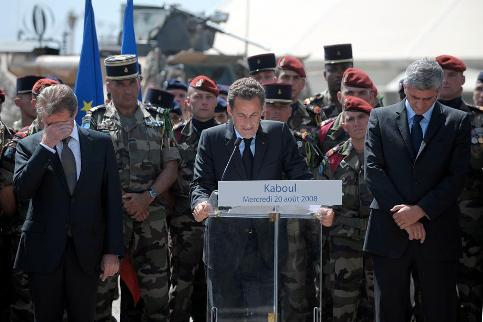
Standing between Bernard Kouchner, Foreign Affairs Minister and Herve Morin, Minister of Defence, the French President addressed the soldiers:
‘I came because I wanted to tell you that the job that you are doing here is essential. Why are we here? Because it is here that a part of the freedom of the world is in jeopardy. Here, the battle against terrorism is fought,’ he stated. ‘I have no doubt that is necessary we are here. I tell you in all conscience that if the decision to be here had to be made again, I would decide again the same. I don’t mean the patrol that came to grief nor the succession of events this week, but the decision to affirm what those who came before me decided… that the French army should be here.”
Standing beside the wall of armament warehouse, soldiers from the 8th Regiment parachute marine infantry exchanged words with the President. The soldiers recounted for him events of the day before, the Taliban ambush and the subsequent battle in Uzbeen Valley, of the district of Saroubi District, 50 km east of Kabul. President Sarkozy responded, "The best way to be faithful to your comrades is to continue this work, to raise your head, to act as soldier.”
Links to Figaro here and here.
Thanks to Michael Burleigh for the tip.
The Bear is Back - a note from Norman Berke
We recently received the following note from our sometime correspondent Norman Berke. While I disagree with some of Berke's analysis and prescriptions, this is all thoughtful, so we share it...
If I were a politician, or just an ordinary citizen, in any one of the Baltic States, or one of the former Eastern European Soviet satellites, or even down around Azerbaijan, I would be feeling nervous and mighty uncomfortable as a resdult of the Georgian crisis. And I would certainly hesitate about counting on American help, as indeed, the Poles are, in signing the missile agreement with the US. There is a clear signal of a sea change in geopolitics, a reversion to the time honored diplomacy of spheres of influence, briefly suspended when the Soviet Union imploded, leaving America alone as the world's superpower. Now we are back in the old days where central powers must respect each others backyard and where there are limits on each one's power, challenged only by military confrontation.
How to explain this to an America in the throes of the ultimate of political campaigns. Certainly not by Maccain, who would be in denial of any change in the geopolitical setting, and whose national security credentials are based on the unilateral military superiority of American forces. Nor by Obama, who, if he tried, would be accused of being unpatriotic, an appeaser, a betrayer of American interests, and worse.
And yet, the West cannot stand by in utter pusillanimity and face the possibility of a rampant, murderous Russia. This will literally be the first challenge the new president will face. The military option is off the table, simply not a remote possibility. What is left is soft power, the only option.
The West, Europe and America, are not without ammunition. There are powerful cards to play, they are economic, but they require the closest kinds of collaboration. Russia is still an unformed economy, with just one main basic resource, which they have been able to ride to their resurgence. Without it, they would still be in the third world. Here again is another compelling reason for the West to call upon all its considerable resources, and create a Manhattan Project- Marshall Plan combined over the next several years to develop alternative energy sources to drive down the price of oil. Russia needs huge amounts of capital to diversify and develop its economy. The capital, along with the technological expertise, can only come mainly from the West.These are powerful tools to thwart what is obviouly Russian expansionism..
This can only work when leadership understands the stakes and is in full agreement with the means to attain the desired result Not by posturing, military bluffing, hard-lining, but by soft power, economic power. By background, by both offhand comments and practised speeches, and judging by those he has chosen to surround himself. McCain simply does not have the mindset for this new era. Yet the American people, not at all militaristic by inclination, can still be fooled by the man on horseback.If this happens it will be a sad day in history and another step in what some observers are now calling its decline.
-- Norman Berke, August 17.
Election Demographic Analysis
Latest Poll Reveals 430 New Demographics That Will Decide Election
The video with their analysis is fascinating. Link HERE.
Pakistan – the Government’s Predicament Clarified
Over the last eighteen months I’ve been less worried about Iraq than Afghanistan… and worried about Afghanistan because of Pakistan.
Friends who travel there say Pakistan is a lovely place, with many gracious people. That said, it is also an unstable nuclear power, governed by a series of authoritarian governments, engaged in a hot border dispute with the pluralistic democracy (India) next door. The father of its nuclear program, A.Q. Khan, long ran a “bazaar” distributing technical knowledge to countries including North Korea and Iran. Its intelligence service has been riddled with Islamists who have a too-close relationship to a variety of violent extremist movements, including the al Qaeda-hosting Taliban. Its politicians, even its reform politicians, spring from a feudal system that still underpins their power base. The knee-jerk reaction of its intellectual class is post-colonial-grievance argument. (Instance: the brilliant young novelist Kamila Shamsie wrote in the Guardian shortly after 9/11 that America shared a portion of the blame for that tragedy since the US had disengaged from Afghanistan following the anti-Soviet jihad there; in fact Pakistan had prevented the US from any direct engagement with Afghanistan for the previous two decades, while the US had nevertheless been the largest supplier of aid to the country through the 1990s.)
Westerners sometimes misread the so-called “strongman” President Pervez Musharraf, who stepped down this, and they may have misread his reform instincts. Admittedly his habit of arresting judges didn’t help, but for a contrary view of his thinking read a précis of his graduate thesis at King’s College of Defense Studies… it’s describes exactly the path reformers recommend now, decades after he wrote it. Of course, when Musharraf signed an armistice with leaders in Pakistan’s independent tribal areas in the north and west of the country, westerners justifiably called into question how stalwart an ally he was in pursuit of the violent extremists taking refuge there. For his part, Senator Barack Obama earlier this year thundered dramatically and alarmingly that if Pakistan did not show itself more useful in confronting violent extremists in its country the US might need to bomb and invade it. (Presumably he meant the restive tribal areas in that country rather than Islamabad, but perhaps the Senator should reflect on his counsel about the utility of soft power.)
A civilian government is now fully in power in the country. One wonders: without Musharraf there to unite them in angry opposition, will the governing coalition hold. One would like to be hopeful, but given a history of alternating military dictatorships and crumbling democratic coalitions it is not easy. Certainly, one would not expect this government to be militarily more assertive against Islamic extremism than the recently departed general.
In the meantime, resurgent extremists have been destroying girls’ schools, eighty-seven schools in total, with another sixty-two schools closed by frightened teachers. Maulana Fazlullah, the chief of Tehrik-e-Taliban Pakistan, based in the Swat Valley, called female education "a source of obscenity," and ordered girls to go home and don the burka. In the past two weeks alone extremists reduced twenty-eight girls' schools to rubble.
Yet at this moment something very different and notable is also happening. What’s more, the activity is concentrated near Bajaur, cited as the most likely place for Osama bin Laden to have taken refuge. Let me say first that any instance of displaced populations is itself a tragedy, likely an indication of many untold tragedies; but in this instance it is likely also the first sign of a government pushback. The Australian reports this:
“ISLAMABAD: A human tide of more than 300,000 civilians has fled the al-Qa'ida badlands, amid indications that the fighting there has reached unprecedented levels, with the Pakistani army using massive firepower to attack jihadi militant strongholds. Helicopter gunships, fixed-wing strike aircraft, tanks and heavy artillery have been used in the onslaught.”
The fighting itself appears no less daunting than the refugee problem. This from from Syed Saleem Shahzad of Asia Times:
“When several hundred Pakistani troops backed by paramilitary forces on Friday launched an operation against militants in Bajaur Agency in the Federally Administered Tribal Areas of Pakistan on the border with Afghanistan, they received a most unwelcome surprise. News of the offensive, which proved to be the most bloody this year in Pakistan, had been leaked to the Pakistani Taliban and al-Qaeda militants by sympathizers in the security forces, and the army walked into a literal hail of bullets.
Contacts familiar with the militants told Asia Times Online that every hill had observers as the first military convoys entered Bajaur - the main corridor leading to the Afghan provinces of Kunar, Nooristan, Kapisa and the capital Kabul - and they were quickly under attack. In just a few hours, 65 soldiers were killed, 25 were taken prisoner and scores more were wounded. Under air cover, the soldiers retreated, leaving behind five vehicles and a tank, which are now part of the arsenal of the Taliban and al-Qaeda.”
The Pakistani government and military together are indeed doing what was never expected of them. What’s more, their predicament, facing an uncompromising enemy on its periphery while undermined by double-dealing Islamist-sympathizers within its security services, is clear.
Links: to The Australian story HERE, to Asia times HERE.
Also, in-depth assessments by B. Rahman of the conflict in the Federally Administered Tribal Areas can be read HERE and HERE.
Also see today's article in Washington Post, by Ahmed Rashid, author of ""Descent into Chaos: The United States and the Failure of Nation Building in Afghanistan, Pakistan and Central Asia."
GEORGIA - what can be done?
The actor Sylvester Stallone has stepped forward this week to endorse Russian vodka. One way to show your solidarity with plucky, independent Georgia is to boycott his movies. It's unbelievably easy to do. Perhaps you're doing so already without even realizing it. I've been doing it for decades in advance of this, in anticipation perhaps of just such an occasion.
Under the Elm, by Pierre Martory
- translated by John Ashbery
Under the elm for a long time
I've been waiting for you, O my soul.
Weeks follow each other like books
Perused, my thoughts elsewhere,
Full of music that's distracted too
Full of a deep buzzing where words images
Perceptions dwell in the jumble of memory
Of which our mind is composed.
And nothing comes to assert your coming
No other sign than smoke.
Is it you that we should have welcomed
When tenderness filled our hearts?
You that we should have discovered
On the shores of pity or of love?
I have not been taught to notice your presence
Even when reveille raises the limbs
Of a future happiness; even when
Tired of a long day I seek
Silence in the immense dark where I jettison
What differentiates the sun from death.
Hours accumulated, absurd riches,
I am ready to give up the trees and the cities
But I still hope to receive you, my soul,
Laden with my own eternity.
You who are me, who resembles nobody,
You that I must give back some day to who knows who.
Sasquatch Squashed
In other animal related news, hunters from Georgia... the southeastern US state... claim to have found Sasquatch, Bigfoot, and will present their evidence this afternoon in Palo Alto, CA.
They claim to have come on a dead example of the species, and have seen other examples nearby. The corpse, in one of the hunters' freezer right now, is seven feet tall, with red hair, and large human-like hands, and of course feet. REALLY BIG FEET. Sixteen inches! Here's the story via CNN, and the hunters' own site.
Next up, the abominable snowman.
UPDATE: Sadly the DNA sample turned out to be 96% possum, as reported here. The hunt continues.
UPDATE 2: "Bigfoot" was just a rubber gorilla suit frozen in a block of ice and sold to the hunters.
Summer Postcard from the Hills, India
In north London something has been messing around with the bins. The neighbors' dog, no doubt, the aged one that barks blindly, still not recognizing me, whenever I pass their gate. Meanwhile, another near neighbor received this missive from our friend Anuradha Roy, author of the recently-published An Atlas of Impossible Longing.
Roy writes:
Feeling rather shaken because as I was writing this email a leopard came andtook our neighbour's dog, a sweet, slightly demented little thing calledGoldie who had barked his heart out at Biscoot this morning, as everymorning. He stands on his hind legs and barks in a frenzy--such comical rage. Now there's much yelling and shouting down the hill, but too late.Last month another favourite, a short legged, bushy tailed brown-and-whitecalled Bobo had vanished.
A leopard. Panthera pardus, a protected species in India. We come across them on and off--crossing a road, sliding into the forest--after dark. From the safety of a car, they're magnificent. The town I live in is at the edge of a forest which has quite a lot of wildlife, the leopard included--and when they haven't enough prey in the forest, which they usually don't, they are always on the lookout for food. They love dogs--but not in the way we do!
The Slow Writing Movement
"I write so slowly I could write in my own blood without hurting myself."
- Fran Lebowitz
"We're Still Working Against You"
News reports have suggested that in the last few years Russian intelligence activities in Washington and London have reached levels comparable to that during the Cold War. The first time I heard this I found it hard to believe. The second time I was mystified. But Russia still surprises.
I've written before about SPY WARS, the extraordinary early-Cold War espionage memoir by the legendary spy Tennant H. Bagley.
One notable feature of the book is the short history that Bagley provides of the Soviet and Russian intelligence services. He charts a striking continuity in their operational tactics, from the days of Czar's secret police in the nineteenth century, though the revolutionary period, to Stalin's KGB, all the way to the FSB of today. What's more, throughout these different periods, across all the upheavals of Russian history, these services have been housed in the same building. Bagley, the former chief of counter-intelligence for CIA's Soviet section, knows whereof he speaks.
During the thaw of the 1990s Bagley met many of his former counterparts, on what he expected to be friendly terms (he had after all been retired for twenty years). In one instance, he describes sitting across from an old 'Chekhist,' to use the original name of Lenin's secret police, as Bagley himself does. The man leaned in and said sternly, 'We’re still working against you.'
Today, I believe it.
My earlier post on the topic here. More about SPY WARS here.
"Appeal to the UN"?
In regard to the Georgian-Russian conflict, Barack Obama has called for “talks among all sides" and said "the United States, the U.N. Security Council and other parties should try to help bring about a peaceful resolution.” Senator Obama looked forward to “an international peacekeeping force” under “an appropriate UN mandate.”
Likewise, a commenter over on Michael Burleigh's STANDPOINT blog: "In terms of political leadership, brinkmanship and the ability to becalm the situation, the combination of Saakashvili and Putin does not inspire terrific confidence. No doubt the UN Security Council will put a swift end to the hostilities."
I'm very impressed by Senator Obama's, and the commenter's, confidence in the UN bringing matters to a speedy and peaceful resolution. I do wonder how they anticipate member of the Security Council Russia will vote on such a resolution or mandate. ("VETO THAT!!")
As a fallback, perhaps we could count on Security Council member China asserting its "considerable moral authority" in the matter. Er, on second thought...
Meanwhile, Senator McCain has taken a stance akin to "Mr. Putin turn those tanks around." McCain's statement:
“Tensions and hostilities between Georgians and Ossetians are in no way justification for Russian troops crossing an internationally recognized border. I call on the government of Russia to immediately and unconditionally withdraw its forces from the territory of Georgia.”
One searches for parallels. Russia for their part had warned that the recognition of Kosovo would set a bad example for how to handle break-away aspirants, and seem determined to prove their point. Swedish foreign minister Carl Bildt has correctly drawn an analogy between Putin's "justification" for dismembering Georgia -- because of the Russians in South Ossetia -- to Hitler's tactics vis a vis Czechoslovakia to "free" the Sudeten Deutsch. Zbigniew Brzezinsk, national security advisor to President Jimmy Carter, has likened it to Stalin's grab of Finland in the 1930s, when the Soviets subverted by use of force the sovereignty of a small democratic neighbor.
My own concern is the parallel to Hungary in 1956, when the west encouraged an independent-mindedness in that country then in the Soviet shadow. When a spontaneous revolt formed, the west hinted to rebels that support in arms might be forthcoming. When the government propped up the Soviets actually did fall to the rebellion, and Soviet tanks rolled in and wiped out the rebels imposing a true iron curtain on that country.
I fear the Georgians will be dismayed to learn that neither the Europeans nor the US will come to their assistance against a determined Russian foe. I do hope I'm wrong.
One asks oneself why did Russia choose this moment? Could it be the discussion this spring of Georgia's joining NATO? Taking advantage of their leverage in the current high energy prices? Wrong-footing a lame-duck US president? The proposed missile shield? The looming legitimization of US soft power when Iraq is seen to be stable... and the attendant freeing up of US hard power?
Perhaps none of these. Most Soviet behavior in the Cold War arms race stemmed from internal economic and bureaucratic impulses. Do we even know that it was Putin's rather than Medvedev's decision?
Meanwhile, apropos Hungary 1956, see the novel Under the Frog, by Tibor Fischer, a London-born child of refugees from that rebellion. Fischer's account of members of the Hungarian national basketball team caught up in events of the day begins as a mordant comedy and ends in tragedy, and is very good.
Browne's Deal with the Mahdi Army (Updated)
Monday’s Times contains an extraordinary revelation by Deborah Haynes, about a deal between UK Defense Secretary Des Browne and Motada al Sadr’s Mahdia militia.
Haynes’s report is unlikely to be read widely in the US; but for those involved in military planning the facts she details must have been shocking when they came to light. She writes:
“A secret deal between Britain and the notorious al-Mahdi militia prevented British Forces from coming to the aid of their US and Iraqi allies for nearly a week during the battle for Basra this year. Four thousand British troops – including elements of the SAS and an entire mechanised brigade – watched from the sidelines for six days because of an “accommodation” with the Iranian-backed group, according to American and Iraqi officers who took part in the assault. US Marines and soldiers had to be rushed in to fill the void, fighting bitter street battles and facing mortar fire, rockets and roadside bombs with their Iraqi counterparts. Hundreds of militiamen were killed or arrested in the fighting. About 60 Iraqis were killed or injured. One US Marine died and seven were wounded.”
Someone should alert Senator Obama that this may be the result to expect when democratic parties enter into talks without pre-conditions with terrorists and rogues.
Update: On reflection, the most surprising aspect of the story may be that when the situation erupted the British commander in Iraq, Major General White-Spunner, was away on a skiing holiday.
Four months on, security in Basra continues to improve, but residents remain concerned that it may not last. As Haynes writes: "Eman Ali, 24, a university student who stopped attending classes during the height of the intimidation said,'My life has changed dramatically since then because like many women I was on the verge of being killed for refusing to follow the orders of the militia and wear a headscarf. Now I am back studying, and can move around more freely, but I still don't trust the situation."
Read the whole of Haynes’s report here, and her related story here.
Further update (live): Des Browne denies a deal was made. On the evening news this evening (monday), BBC correspondent Frank Gardner claims a pre-existing deal was in place, made the previous summer, involving the release of Mahdi army prisoners. BBC Foreign Editor Mark Urban backs him, and produces an interview clip with a British general who appears to acknowledge such an agreement. The shadow defence secretary Liam Fox says these questions demand further explanation.
Rather than "deal" perhaps it could be called an "accommodation"? If there was such an agreement did it happen after Gordon Brown assumed the role of Prime Minister, in June 2007?
Today's TIMES's lead editorial expands on the danger, noted above, of entering into talks without pre-conditions with terrorists and rogues. It's a matter of when, with whom, and in what context. Read the whole excellent edit HERE.
Meanwhile, this week al Sadr's army decided to pack it in, another milestone in Iraq. As noted by the WJS:
"In many respects, the story of the Mahdi Army's decline follows the same pattern as al Qaeda's: Not only was it routed militarily, it also made itself noxious to the very Shiite population it purported to represent and defend. It enforced its heavy-handed religious edicts, coupled with mob-like extortion tactics, wherever it assumed effective control. The overwhelming Shiite rejection of this brand of politics is another piece of good news from Iraq, as it means that Iraqis will not tolerate Iranian-style theocratic rule"
Read the latest commentary in the WSJ, whose Gina Chon broke the story yesterday HERE.
Americans, Blame Jim Cramer for Your Gas Prices
One year ago this week, in the Rant Heard Round the World, Jim Cramer, “Mad Money” commentator and former fund-manager, melted down live on CNBC, proclaiming “Armageddon” in the fixed income markets, and berated the Federal Reserve for sleeping on the job.
“My people,” he said, meaning his friends on Wall Street, “are bleeding.” The Fed, he claimed, had no idea how bad things were, and were going to get. His rant reached an audience far beyond the financial world, was certainly the most-watched youtube video on any economic topic ever… and made great TV, a cut above Peter Finch’s Oscar-winning performance as NETWORK’s Howard Beale. What’s more, regulators took note, and soon began to wake up, especially since the UK had its first bank run in more than a century, as Northern Rock fell victim to a constricted money market.
The Fed, for its part, did as he asked—it cut rates, and opened the discount window, lending directly to the banks. Some, in hindsight, now say they should have opted for one or the other, but not both. That has been the approach taken by the European Central Bank. Meanwhile, in America the Fed has unleashed a flow of cash into commodities, creating the bubble in oil prices.
House Speaker Nancy Pelosi can blame “speculators” for recent oil price, but traders were simply responding to market conditions created by these dual actions by the Fed. I blame Jim Cramer.
Sitting at Night, by Po Chu-I
Facing the courtyard at day's end, I welcome night--that dark
realm ripe for sitting at this lamp, looking into bright clarity.
No words for such depths of heart, I wonder who can share them.
That's when the moment allows a whispered howl: once, twice.
-translated by David Hinton
Apple’s New Line of Macbooks
Since Apple cryptically announced recently a “new product transition” to be debuted in September, speculation has been rife. Some have posited a touch-tablet computer, akin to a giant I-pod touch. But would someone really wish to type on such? Or read a new novel on one? Ask Amazon. Others have suggested an updating of the I-Mac that would merge with Apple TV. But people won’t watch TV at the same place as they’ll work on their desktop computer, let alone in the same seating configuration.
The answer is readily figured when you hear that Apple has ordered new touch-pads made of glass. The new Macbooks, then, will be placing the dashboard, the home to all those widget functions, not as an icon amidst many functions on your toolbar of your screen, but beneath your hands on the Macbook’s touchpad.
To get an idea of what this would be simply stand above a Macbook Air, and lay your I-phone down horizontally over the touch pad. Now imagine that machine blown up to a 15” screen. That will be a wonderful driving experience, especially if it had built-in 3-G wireless capability.
Chateau Maravenne, Evening
Back to France again soon, and back to... near La Londe, at the western end of the Massif des Maures, is Chateau Maravenne. Last August, late one afternoon, we stumbled upon it by chance when we were looking for a room. We'd spent the day near Cabasson at a beach (rustic, with white sand, and half-empty except for families with sandpails and shovels). Afterward, we decided to stay nearby rather than push on, and so we scanned phone book listings. The Chateau, a mile or two north of a light industrial park, was an old manor house, half-renovated, half shambolic, and set among vineyards. More about those vineyards in a moment.
Yes, they had a room, said Luc, a hulking mustachioed Provencal in shorts and flip-flops.
Was there somewhere we could eat?
He squinted and held up a knife... a paring knife. In his other hand was peach, a spiral of peach-skin hanging down from it.
After stowing our bags in a room upstairs, showering, a moment relaxing on the terrace outside our room, we took one of the half dozen tables in the garden. We ordered a bottle of rose, a product of those vines nearby. Fifteen euros, and superb. A photo of that bottle, taken with my cellphone, is above. Sometimes cellphone pictures, in all their bluriness, capture the right picture... call it "Nokia Impressionism." The plan for dinner that night offered bread with olive and anchovy spreads, home-made gravlax with creme fraiche, then osso buco Provencal... with local herbs as well as orange peel, and then tarte tatin. Twenty euros.
The next morning, before departure, browsing down among the wine barrels, we saw a farmer fill up a large plastic container from what looked like a gasoline hose in the wall. Two gallons of red to go.
We'd soon be staying with friends in Plascassier, and so bought them a bottle of the Reserve, twelve euros. That evening our copains kindly opened our gift and shared it out. Our host, after the first taste, pulled a face, as if he wished he'd put it back for himself rather than shared it out immediately.
Very good, he said. Yes, very good.
Postcard: North Yorkshire Moors
... picture, taken at a village fair, by Lucy Perceval.
SPY WARS by Tennant H. Bagley
An old-school espionage story from the early Cold War, “Pete” Bagley was the counter-intelligence officer who handled the noted case of the defector Yuri Nosenko. The question of whether Nosenko was a bona fide defector, or had been dispatched as part of a deception plot, tore the CIA apart for the better part of a decade. Some forty years later Bagley finally makes public his report, and it diverges considerably from the comfortable version of events the agency has long presented.
In The Spectator, Oleg Gordievsky described the author, one-time head of Soviet Block Counter-Intelligence for the CIA, as "one of the most respected and knowledgeable experts on Soviet espionage." The book, he said, was "perhaps the most amazing non-fiction spy book that has ever appeared during or after the Cold War."
After my second reading I turned to a series of "twenty unavoidable questions" posed by Bagley (to be found on the Yale Press website, at the bottom of the page HERE).
Bagley's questions are indeed unavoidable. What's more, his account was persuasive that the Russian defector could not have been who he said he was; that Nosenko could not have, as he’d claimed, reviewed the file of Lee Harvey Oswald; and that Nosenko's stories of how the KGB discovered the identities of two CIA moles in Moscow could not have been true. David Ignatius in the Washington Post wrote, "It's impossible to read this book without developing doubts about Nosenko's bona fides. Spy Wars should reopen the Nosenko case." I don't know what it would mean to "open" a case forty years old, but certainly a new generation of analysts and historians should examine the case. The account of the long history of deception operations, stretching back to Peter the Great, is alone worth the price of the book.
So, why did the Soviet's concoct such a deception? In the book Bagley argues that the KGB's real game was to steer the CIA away from realizing that the Russians had recruited an American code clerk in Moscow in 1949, and perhaps two others later on.
A code clerk... that's it? Or even three? Consider, then, that during WWII the Allies ability to read the German intentions through British capture of an Enigma encryption device helped give us the capacity to win that war.
One might now ask, as Ignatius does, What mind games are the Russian playing with us today?
Hard Questions for Senator Obama
I’ve been writing an occasional series, entitled “Hard Questions for Senator Obama,” here at Standpoint, and previously at my Main Point blog. The series was prompted by the Senator’s success, during the Democratic primaries, at eluding such hard questions. This eluding may have been a strategy to keep from being tied then to policy positions that would later hamper him in the general election. If so, that would be understandable, but clarification on many points of defense and foreign policy are now due.
One of the readers of this series has sent me a list of some questions being asked of Senator Obama, about his policies, inside the professional national security community. It follows here:
1. Why does Senator Obama advocate a surge of troops in Afghanistan though he considers a surge of troops in Iraq to have been a mistake?
2. Why is a stable Afghanistan crucial to US interests while a stable Iraq is not?
3. How long does Senator Obama expect to keep troops in Afghanistan?
4. Why is an open-ended commitment in Afghanistan manageable while the same in Iraq is not?
5. How much does Senator Obama expect to spend rebuilding Afghanistan?
6. Why is rebuilding Afghanistan affordable while rebuilding Iraq is not?
7. Why does Senator Obama consider the ethno-sectarian issues in Iraq to be nearly intractable while in Afghanistan they are something we can overcome?
8. If leaving Iraq will make the Iraqi government behave more responsibly, how will an increased presence in Afghanistan affect the Afghan government?
9. Why does Senator Obama advocate a "surge in diplomacy" and multilateralism in Iraq while simultaneously advocating unilateral action in the Pakistani tribal areas?
10. How large of a "residual force" will be left in Iraq and for how long?
My earlier “Hard Questions” are at Standpoint here, and here, and here, and at The Main Point here.
I’ve recently learned that another on-line commentator used the “Hard Question” rubric, a year and a half ago, for somewhat similar questions directed more broadly. I’ll be writing about that commentator, US Army Major Andrew Olmstead (dec. Diyala Province, Iraq, January 7, 2008), in an upcoming post. His "Hard Question" post here.
PULP: Billy Wilder on Raymond Chandler, part I
Earlier I mentioned STANDPOINT's inauguration of its "Pulp" column, and my own discussion of the genre with filmmaker Billy Wilder. Here's a choice bit from that interview, conducted shortly before he died.
JAMES SCOTT LINVILLE: I understand your collaboration with Raymond Chandler was tumultuous.
BILLY WILDER: Yes. Chandler had never been inside a studio. He was writing for one of the hard-boiled serial magazines, The Black Mask, the original pulp fiction, and he'd been stringing tennis racquets to make ends meet. Just before then, James M. Cain had written The Postman Always Rings Twice, and then a similar story, Double Indemnity, which was serialized in four or five parts in the Black Mask. They don't have those serial magazines anymore, but in Germany they were very popular. At the end of that week's excerpt you're left with a great feeling of suspense. I understand that thousands of people would wait near the docks for the arrival of the boat coming from England with the new chapters of a Dickens novel. Paramount bought Double Indemnity, and I was eager to work out with Cain, but he was tied up working on a picture at Fox, called Western Union. A producer-friend brought me some Chandler stories from The Black Mask. You could see the man had a wonderful eye. I remember two lines from those stories especially: "Nothing is emptier than an empty swimming pool." The other is when Marlowe goes to Pasadena in the middle of the summer and drops in on a very old man who is sitting in a greenhouse covered in three blankets. He says, "Out of his ears grew hair long enough to catch a moth." A great eye. . . but then you don't know if that will work in pictures because the details in writing have to be photographable. I said to Sistrom let's give him a try. Chandler came into the studio and we gave him the Cain story, Double Indemnity, to read. He came back the next day--"I read that story. It's absolute shit!" He hated Cain because of Cain's big success with The Postman Always Rings Twice. He said, "Well, I'll do it anyway. Give me a screenplay so I can familiarize myself with the format. This is Friday. Do you want it a week from Monday?" "Holy shit," we said. We usually took five to six months on a script. "Don't worry," he said. He had no idea that I was not only the director but was supposed to write it with him. He came back in ten days with eighty pages of absolute bullshit. He had some good phrases of dialogue, but they must have given him a script written by someone who wanted to be a director. He'd put in directions for fade-ins, dissolves, all kinds of camera moves to show he'd grasped the technique. I sat him down and explained we'd have to work together. We always met at nine o'clock, and would quit at about four-thirty. I had to explain a lot to him as we went along, but he was very helpful to me. What we were doing together had real electricity. He was a very, very good writer, but not of scripts. One morning, I'm sitting there in the office, ten o'clock and no Chandler. Eleven o'clock. At eleven thirty, I called Joe Sistrom, the producer of Double Indemnity, and ask, "What happened to Chandler?" "I was going to call you. I just got a letter from him in which he resigns." Apparently he had resigned, because while we were sitting in the office with the sun shining through I had asked him to close the curtains and I had not said "please." He accused me of having as many as three martinis at lunch. Furthermore, he wrote that furthermore he found it "very disconcerting that Mr. Wilder gets two, three, sometimes even four calls from obviously young girls." Naturally. I would take a phone call, three or four minutes, to say, "Let's meet at that restaurant there" or "Let's go for a drink here." He was about twenty years older than I was, and his wife was older than him, elderly. And I was on the phone with girls! Sex was rampant then, but I was just looking out for myself.
From "Billy Wilder, The Art of Screenwriting, copyright: James Linville, 1996. Read the whole thing in The Paris Review Interviews, Vol. 1
More on Wilder here.
Polly Borland's Bunny - a Photofantasy
... Polly Borland's much anticipated, and slightly disturbing, photo series "Bunny" has debuted at Michael Hoppen Gallery in London where it remains on view.
Damien Hirst, who has bought one of each print from the exhibition, has now published a book of this series.
Robert Hass - Our Lady of the Snows
In white,
the unpainted statue of the young girl
on the side altar
made the quality of mercy seem scrupulous and calm.
When my mother was in a hospital drying out,
or drinking at a pace that would put her there soon,
I would slip in the side door,
light an aromatic candle,
and bargain for us both.
Or else I'd stare into the day-moon of that face
and, if I concentrated, fly.
Come down! come down!
she'd call, because I was so high.
Though mostly when I think of myself
at that age, I am standing at my older brother's closet
studying the shirts,
convinced that I could be absolutely transformed
by something I could borrow.
And the days churned by,
navigable sorrow.
Robert Hass is the former US Poet Laureate. Posted with the author's permission, and with assistance from the heroic Jeannie Vanasco.
Gonzo - Hunter S. Thompson, and his Photography
Given his later “Gonzo” style of journalism, many are not aware that when he began his career, Hunter S. Thompson wrote straight-forward, well-reported journalism and, in an early novel, finely-observed fiction. He was also once a photographer, as seen in this image from an exhibition at Michael Hoppen Gallery in London.
Thompson life and later drug-fueled antics are now celebrated in a just-released documentary, “Gonzo,” by Alex Gibney, the filmmaker behind “Taxi to the Dark Side.” The question remains though whether “Fear and Loathing in Las Vegas” or any of his work hold up. It’s a highly-amusing book, but derivative of Terry Southern’s seminal journalism “The Blood of a Wig.” Is “F&L” an example of late sixties paranoia and mad-cap libertarianism, or is it a pastiche and send up? Will he be remembered for his work, or for his outsized, cartoon-ish celebrity persona.
In any case, this photograph, entitled “Sandy and Aga, Big Sur,” is beautiful and gives a glimpse of the vision from which Thompson turned away.
Thanks to Michael Hoppen Gallery for the image.
More Photos from the Iranian Missile Launch in Daji, Isfahan Province
As noted in yesterday’s edition of “Lost Illusions,” Standpoint’s newly-inaugurated media column, Iran is suspected of having doctored photos of its recent missile test.
The photos in question have been used over the last week on the front pages of The Los Angeles Times, The Financial Times, The Chicago Tribune and several other newspapers, as well as on BBC News, MSNBC, Yahoo! News, NYTimes.com and many other major news Web sites.
This week President Mahmoud Ahmadinejad announced plans to travel to New York to present a dossier of evidence to the United Nations showing that during their test the United States and its allies deployed experimental missile defense systems to disrupt the launch.
STANDPOINT magazine, through one of its vaunted moles in the British government, has obtained the dossier of photos from the missile launch that took place in Daji (somewhere east of Isfahan). In an exclusive, we publish them here on line.
STANDPOINT sought comment on Ahmadinejad’s Daji dossier from British Foreign Minister David Miliband. Speaking to us, Miliband underscored that “the government of Iran continues its productive engagement in the Three Party Talks involving Germany, Britain and France. We’ve reassured Iran that from these three parties their country faces no unilateral action…”
When STANDPOINT interrupted to point out that both the United States and Israel have also been engaged in diplomatic efforts, and any pressure exerted might instead be characterized as “cinque-lateral,” the Foreign Minister exploded: “What was that?! Chin-kwa-what? That’s just the sort of racist… I knew your magazine was going to turn out to be a bunch of right-wingers. Let me make clear that any action against Iran would proceed through the UN and not without the moral authority of China behind it!”
STANDPOINT next contacted New Yorker magazine investigative journalist Seymour Hersch and showed him the pictures via e-mail. Regarding the first photo, Hersch said he was given to understand, via an unnamed disgruntled CIA official promised a high State Department post in the Obama administration, that Japan had requested from the Pentagon bunker buster bombs. Japan’s intention apparently was not to target North Korea’s covert nuclear program directly, but instead to provoke an earthquake on the sino-pacific continental shelf that would unearth Japan’s own biological anti-missile apparatus. “God help us, it looks as if the Japanese unleashed it instead on Iran. The horror.”
STANDPOINT next contacted Israel’s Directorate of Military Intelligence, and spoke with Major General Amos Yadlin. Presented with the Daji dossier, Yadlin said, “If this is your idea of a joke, brandishing these faked photos, it’s in very bad taste. You’re aware no doubt that a half century ago our people were scattered across Europe and a maniac with genocidal ambitions progressed more than a third of the way toward his aim… while England declined to bomb the railroad tracks to the gas chambers. Afterward, we gathered into a nation to try to protect ourselves from something like that ever happening again. Now another maniac threatens to wipe our nation from earth and nearly has the tools to do so in his hands… while Europe continues its fruitless talk. In the face of this, you show me cartoons and make jokes?”
Yadlin then peered closer at the photo of the putative American U-SAM Interceptor System in action. Examining it, he pronounced, “I could do that.”
Hat tip for images to Are We Lumberjacks and Boing Boing.
Akira Kurosawa's STRAY DOG
A few page-clicks over, STANDPOINT has created a regular "Pulp" column, paying heed to genre fiction and films. Here's to that.
Many of the finest filmmakers did their finest work in what some, incorrectly, call the lesser genres. Billy Wilder's film noir "Double Indemnity," an adaptation of the James M. Caine novel, compares well to his original "Sunset Boulevard," and in some ways paved the way for that later work. In an upcoming post, I'll offer Wilder's account of working on that adaptation with Raymond Chandler, from a conversation I had with the director shortly before he died. (It was a contentious relationship and in the end Wilder was legally enjoined by the studio from brandishing his riding crop during working hours. A limit was also placed on the number of calls he was allowed to accept from young ladies.)
This week I've been re-watching Akira Kurosawa's film noir "Stray Dog" (1949). That film had its genesis as an unpublished police procedural novel that the great Japanese filmmaker himself wrote over a feverish two month period.
"Stray Dog" tells the story of the frantic search by a rookie cop (Toshiro Mifune) for his stolen Colt pistol, which to his shame had been lifted from him on a bus. A manhunt, lead by the rookie's mentor, begins after the stolen gun is used in a murder. The action throughout takes place during a heatwave in a bombed-out post-war Tokyo. One thing that gives the film such psychological depth is that both cop and killer are from the same background and are the same age... though it's never mentioned both must have been recently de-mobilized from the defeated Imperial Army. There's a sense of "there but for the grace of God go I."
The mini documentary in the Criterion Collection edition recounts a stir over the opening shot of a dog panting feverishly. The film premiered during the American occupation of Japan, and a busybody American woman associated with the ASPCA accused Kurosawa of having injected the dog with rabies to get that wild-eyed effect. This was in the wake of post-war revelations about "scientific" experiments performed by the Japanese imperial army. Apparently this woman was persistent, obsessed even, and brought suit. It was the one blot on an otherwise happy production.
Of course, to get the shot Kurosawa simply had his team take the dog on a run for a few minutes on a hot day.
See STANDPOINT's Pulp column HERE.
Ernest Hemingway's Shortest Story
Hemingway once said his best work was a story he wrote in just six words:
"For sale: baby shoes, never worn."
Henry James had a penchant for telling abbreviated stories via telegram.
These two were forerunners, I suppose, of those in Japan now creating short stories for the cell phone... a form, come to think of it, highly adaptable to the internet.
Look for more such here then...
Obama Unleashes Pint-Sized Secret Weapons
... and apparently this will be the only media appearance by his children, who are darned cute and very normal seeming. One wishes he would have chosen another program.
Video HERE.
Obama... with Iraq on the Verge of Victory
Friday we commented HERE on Barack Obama’s “refinement” of his Iraq position and predicted further such.
We noted that it was important for the candidate now to define what “War” he had been “against”… the invasion of 2003, the subsequent counter-insurgency effort devised by General Petraeus and his Australian strategist David Kilcullen in support of the pluralistic, democratically-elected government in Baghdad... or the long “engagement” dating from sporadic bombing inflicted by the US and UN on a recalcitrant Iraqi regime throughout the 1990s? (Regarding this last, on occasion the Bush Administration has noted that the US and allies were technically in a state of war, albeit one suspended, since the end of the Gulf War in 1991, and that only a conditional “cessation of hostilities,” not an armistice, had been agreed.)
Obama has pledged both to “end the war” and “support stability in Iraq.” Of course one way to accomplish those aims would be to WIN the various conflicts in Iraq, including those against al Qaeda, now composed of a rump collection of fighters being pummeled in their last urban redoubt in Mosul, as well the Shiite militias, confronted in Basra and aligned to some degree with Muqtada al Sadr and/or Iran, who may yet reach some other accommodation with the Iraqi government.
Iraqi forces, along with the Coalition, look on the verge of accomplishing just such a victory.
Slate’s Mickey Kaus waggishly suggests this “tipping point” may lead to an Obama “flipping point.”
As for the battle of Mosul, now being spearheaded by the Iraqi Defense Forces, coverage this Sunday by Marie Colvin of the Times, who is embedded there, is singular… by which I mean it is the ONLY news coverage of this notable event. Colvin describes this battle as “the culmination of one of the most spectacular victories of the war on terror.”
“After being forced from its strongholds in the west and centre of Iraq in the past two years, Al-Qaeda’s dwindling band of fighters has made a defiant “last stand” in the northern city of Mosul. A huge operation to crush the 1,200 fighters who remained from a terrorist force once estimated at more than 12,000 began on May 10.... Last Friday I joined the 2nd Iraqi Division as it supported local police in a house-to-house search for one such bomb after intelligence pointed to a large explosion today."
Read the rest HERE.
The Belmont Club blog does offer extraordinarily in-depth context and analysis HERE.
The New York Times had indeed reported a month ago that al Qaeda in Iraq had been flushed from the western provinces and were re-grouping in Mosul, but has overlooked subsequent developments. Agence France-Presse is in comparison looking comprehensive. As Instapundit noted, if there is bad news coming from Iraq it can be found in The New York Times and on CNN. If there is genuine good news, you can expect a main-stream media blackout and should instead look to the blogs… Mudville Gazette, Bill Roggio, The Small Wars Journal, etc…
Another blogger, Michael Yon, distinguished himself by prolonged reporting from the field, being one of the first to report with brutal honesty when the military strategy under the Coalition Provisional Authority was failing, and why, and subsequently documenting Iraq Sunni Tribes’ growing disaffection with the fundamentalist militants, once led by Abu Musab Zarqawi, whom they had been hosting and sometimes fighting alongside.
Fourteen months ago the end of that alliance could be foretold from a Yon post, quoting a tribal sheikh as he spoke of his militant guests: They kill other Muslims, they drink, they rape, they steal, they kill innocent children as well as their own hostages. They are not Muslim.
There you may find one more as-yet-untold story. Al Qaeda’s own deputy leader, Ayman al-Zawahiri, deemed Iraq to be the central battlefield and the future center of a movement they would foster. The people of western Iraqi, who briefly lived under a wing of this incipient, soi dissant Islamist Caliphate, judged al Qaeda to be un-Muslim, barbaric, and they spat them out.
There may now be no population in the middle east better inoculated against the perverted ideology Zawahiri and Osama bin Laden have been peddling.
UPDATE: I've just received a note from the above-mentioned Marie Colvin of THE TIMES. So far as Colvin can tell she was the only western news reporter at the Battle of Mosul. She has since returned to Baghdad.
If there's a journalist in the Mosul vicinity will they please link-up and log-on?
The Apotheosis of Alan Greenspan
Over the weekend I met a man who very recently, in a matter of weeks, lost two billion dollars of other people's money... as well as a large share of his own fortune. Speculation: I wouldn't have had the opportunity to encounter him, a charming and good person I was happy to meet, if rather than in London we were in Tokyo... or Saudi Arabia, which does not share Japan's tradition of self-service.
Quite apart from that, I had dinner on Saturday with an economist friend who'd attended the World Economic Forum in Davos earlier this year. He was to appear on a panel along with former US Secretary of the Treasury Alan Greenspan to discuss some aspects of the global economy. Greenspan, however, upstaged him and the other participants in an unusual way... by giving his presentation via hologram, transported in from a high-tech studio in DC. It reminds one... Greenspan should long ago have stopped encouraging people to believe he is God. He kept interest rates too low for far too long, and ignored warnings about dangers in the mortgage market.
My economist friend here adds "And as with God only part of the audience saw him (with the hologram you can only see 120 degrees...)"
The Hard Question for Obama on Iraq
Barack Obama has had an Iraq problem building over the last ten months. Ever since General Petraeus’s Iraq counter-insurgency strategy, involving “the surge” of troop deployments in theater, has shown signs of success, the Democratic Party and its attendant commentators have been in a quandary.
Last summer, as the Sunni tribes of Anbar abandoned any alliance with the foreign Islamist militants they’d been hosting and switched sides to cooperate with the US Army, the New York Times editorial page, following the lead of Obama foreign policy advisor Samantha Power, called for the immediate withdrawal of coalition troops, and acceptance of the prospect of the division of Iraq along sectarian lines--in essence, the possibility of a managed ethnic cleansing. The perversity of such a policy being advanced by Power, the author of the definitive tome of policy failures that led to genocide in Rwanda, went un-remarked.
Meanwhile, Anbar Province, the so-called Wild West, the cradle of the insurgency, encompassing Fallujah, Ramadi and Saddam’s hometown of Tikrit, was made peaceful by Iraqi forces, whose own numbers and competency has surged. With assistance from coalition forces, the Iraqi army and militia crushed al Qaeda there, and spat them out. Last week, also largely overlooked by the media, control of Anbar Province, along with two other previously restive provinces, was handed to the sovereign government of Iraq. Extensive coverage is available on the Agence France-Presse website (link to come).
The Democrats confronted, then, in the face an emerging strategic victory in the Middle East, achieved at the cost of more than 4,000 American lives, the question: was this something voters were prepared to abandon after November?
When Samantha Power suggested some months ago, in an interview on Hard Talk, perhaps not, she was promptly “thrown under the bus” of the Obama campaign.
Yesterday, in a move long anticipated by conservative bloggers in America, Obama, an early opponent of “the Iraq war,” softened his Iraq Withdrawal Timeline, stating in a news conference: "I would be a poor commander in chief if I didn't take facts on the ground into account. The pace of withdrawal would be dictated by the safety and security of our troops and the need to maintain stability."
His shift here opens the question of what has been “The Iraq War.” Was its onset the March 2003 invasion? Or, as some in the Bush administration argued, has the US been legally in a state of war since the first Gulf War, including throughout the 1990s as the Clinton administration sporadically bombed the recalcitrant regime of Saddam Hussein?
In fact, we may soon see Barack Obama, who made his “anti-war” stance a centerpiece of his presidential campaign, become the first prominent Democrat to recognize a distinction between the brief 2003 war to overturn the regime of Saddam Hussein, and the more recent counter-insurgency effort to support the democratically-elected, pluralist government now sitting in Baghdad, as they desperately try to build a civil society.
It is, after all, possible to have opposed the first, and yet support the latter of those two wars.
Similar sentiment here.
My Last Poem by Manuel Bandeira
I would like my last poem thus
That it be gentle saying the simplest and least intended things
That it be ardent like a tearless sob
That it have the beauty of almost scentless flowers
The purity of the flame in which the most limpid diamonds are consumed
The passion of suicides who kill themselves without explanation.
- translation from the Portugues by Elizabeth Bishop
Note: In 1951, poet Elizabeth Bishop received a $2,500 travel grant to circumnavigate Latin American. She landed in Santos, Brazil that fall, intending to stay two weeks, she lived there fifteen years.
Missive: Jay McInerney, and the Wine He Drank
McInerney wrote:
"That would be a 1997 Coche Dury Meursault Caillerets that I had a couple of days ago at Louis Quinze in Monaco. It had a nice grilled bread nose and a strong mineral crushed gravel element for a Meursault, and I always prefer rocks to fruit when it comes to white burgundy. It was a more of a Kate Moss Meursault than a Kate Winslett Meursault. Also we were drinking it with Ducasse and his wife in the kitchen of the restaurant, where he has a little dining table, so the context, as always, was part of the pleasure.
"Since I mention context... I should mention the turbot roasted with scallions, lemon and capers which we were drinking it with."
Charles Burnett's "The Killer of Sheep"
This week to the British Film Institute's Southbank Theater comes the legendarily unavailable film "The Killer of Sheep," written and directed by Charles Burnett.
What a wonderful movie.
Not much in the way of story, nonetheless the film has a gaze that's penetrating yet generous to its characters. It was shot in the black Los Angeles ghetto of Watts in the mid-1970s, over a series of weekends on a budget of less than $10,000. It proceeds through the eyes of Stan, a sensitive dreamer growing detached and numb from the toll of working at a slaughterhouse. he finds consolatin in moments of simple beauty: the warmth of a teacup against his cheek, slow dancing with his wife to the radio, holding his daughter.
The film won the Critic's Award at the 1981 Berlin Film Festival, but due to legal problems over the use of music in its soundtrack, resolved after three decades only last year, it has rarely been exhibited. In 1990, the US Library of Congress declared it a national treasure and placed it among the first 50 films entered in the National Film Registry for its historical significance. In 2002, the National Society of Film Critics also selected the film as one of the 100 Essential Films of all time.
One thing I especially loved was the constant stream of oblique glimpses into their lives. Example... filmmakers are always taught to get into a scene quickly without entrances and exits, to begin "in medias res." Burnett, instead, begins one scene with kids in a little handstand competition on their front porch. Clearly they're bored out of their skulls. After a good while of this, the father, coming home from work and in a "mood,' enters the frame, distractedly brushes their hovering feet away from his face, dumping the kids over, and lumbers in the front door. Somehow hilarious, and an entrance invested with so much psychological material. Genius rarely comes so offhand.
- JSL
Further comment on Burnett HERE, on my other site.
Blog Roll
- Ace of Spades
- Arma Virumque
- Art Forum
- Arts & Letters Daily
- Daily Star
- Foreign Policy
- Hitchcock Blonde
- IWPR
- Indian Country
- Instapundit
- Iraq The Model
- Lapham's Quarterly
- London Review
- Luna Park
- Michael Yon
- N+1
- New York Review
- Nouriel Roubini
- Ominvoracious
- Pajamas Media
- Politico
- Prospect
- Real Clear Politics
- Small Wars Journal
- The Belmont Club
- The Main Point
- The New Yorker blog
- The Pour
- The Rest is Noise
- The Volokh Conspiracy
- Virginia Quarterly Review
- Wordplay
- al Jazeera
