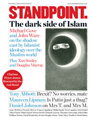



In this New Year double issue, we have highlighted different aspects of what we call “the new Terror”. There is an obvious allusion to the original Terreur of the French Revolution, which saw the guillotining of thousands in Paris and massacres of up to half of the entire civilian population in the Vendée region. Then there was the Great Terror under Stalin, which according to the authoritative estimates of the late Robert Conquest killed up to two million. Though the word “Terror” is not usually applied to Nazi Germany, the “New Order of Europe” stepped up repression to a genocidal level. Terror under Hitler ceased to be a matter of purges and pogroms and instead became the means by which humanity itself was to be racially purified.
The new Islamist Terror of the 21st century has so far exacted a global death toll at least in the hundreds of thousands, most of them civilians. This Islamist Terror differs from the French and Russian ones in that most of the casualties are inflicted by terrorist organisations rather than a state apparatus, although some of these groups have taken on state functions and, conversely, some regimes (notably Assad’s) have resorted to terrorist tactics. What makes the new Terror comparable to those of the past, however, is that Islamist organisations use terrorism to crush resistance to their revolutionary ideology. The caliphate set up by Islamic State makes claims to universal jurisdiction that in some respects exceed those of revolutionary France, Soviet Russia or Nazi Germany. The use of terror not only to intimidate the Muslim world, but also non-Muslims in the West, goes beyond Communist subversion practised during the Cold War. The new Terror is the vanguard of an anti-Western imperialism, intended to make Islam dominant not only as a religion but also as a political system.
In so doing, however, the terrorists are altering the reputation of Islam, just as the Terror overshadowed the French and Russian revolutions.
What is to be done? In the face of attacks such as that on Paris in November, it is tempting to abandon all hope of solutions. That, though, would be a counsel of despair. The West in general, and Europe in particular, are quite capable of defending themselves. What we lack are not the financial or even military resources, but the motivation and inspiration to resist the new Terror. It is here that Hilary Benn’s speech is so significant. It shows that even on the Left, which has in general been reluctant to stand up and be counted, there are grounds for hope. And it suggests that in making the case against the new Terror, politicians and other public figures would be wise to return to a simpler, clearer, morally unequivocal vocabulary. If offence is given in the cause of confronting evil, let the offended ponder whose interests are served by taking offence. Perhaps it is time for them, too, to do their bit — not only for Syria, but for Western civilisation.
The new Islamist Terror of the 21st century has so far exacted a global death toll at least in the hundreds of thousands, most of them civilians. This Islamist Terror differs from the French and Russian ones in that most of the casualties are inflicted by terrorist organisations rather than a state apparatus, although some of these groups have taken on state functions and, conversely, some regimes (notably Assad’s) have resorted to terrorist tactics. What makes the new Terror comparable to those of the past, however, is that Islamist organisations use terrorism to crush resistance to their revolutionary ideology. The caliphate set up by Islamic State makes claims to universal jurisdiction that in some respects exceed those of revolutionary France, Soviet Russia or Nazi Germany. The use of terror not only to intimidate the Muslim world, but also non-Muslims in the West, goes beyond Communist subversion practised during the Cold War. The new Terror is the vanguard of an anti-Western imperialism, intended to make Islam dominant not only as a religion but also as a political system.
In so doing, however, the terrorists are altering the reputation of Islam, just as the Terror overshadowed the French and Russian revolutions.
What is to be done? In the face of attacks such as that on Paris in November, it is tempting to abandon all hope of solutions. That, though, would be a counsel of despair. The West in general, and Europe in particular, are quite capable of defending themselves. What we lack are not the financial or even military resources, but the motivation and inspiration to resist the new Terror. It is here that Hilary Benn’s speech is so significant. It shows that even on the Left, which has in general been reluctant to stand up and be counted, there are grounds for hope. And it suggests that in making the case against the new Terror, politicians and other public figures would be wise to return to a simpler, clearer, morally unequivocal vocabulary. If offence is given in the cause of confronting evil, let the offended ponder whose interests are served by taking offence. Perhaps it is time for them, too, to do their bit — not only for Syria, but for Western civilisation.
Like this article? Share, save or print using the icons below:


3:01 PM
2:12 PM