


Britain has always been a magnet for the ambitious. At last month’s Beijing summit Theresa May was greeted by the Australian prime minister Malcolm Turnbull as an old mate: in the 1970s they had met at Oxford. Such serendipity happens for a reason. British universities and schools educate the world’s elites: the combination of intellectual excellence, political stability and economic dynamism is hard to beat. Now, for the first time in a generation, Mrs May has been given an opportunity by Brexit to act independently on the global stage, to set an example that will make the world take notice. The last time that happened was when her office was held by another upwardly mobile grammar school girl: Margaret Thatcher.
It is true that for the years of Tony Blair’s premiership between 9/11 and the invasion of Iraq, British prestige, especially in the United States, stood very high; but that opportunity was wasted. Unlike Mrs Thatcher, Mr Blair did not make the most of his influence in Washington. Nor did David Cameron, who made the naive and fatal mistake of supposing that the British people could be told how to vote by an American president. His departure not only from Downing Street but also from the Commons will leave the field clear for Mrs May to build her own, more intelligent relationship with the new occupant of the White House.
That brings us to next month’s US election. The whole future of the West — and perhaps of the rest — will depend on it. Hillary Clinton’s fragile health and her even more fragile reputation make a vote for her almost as much of a leap of faith as one for Donald Trump. But here is the difference: America has had presidents rather like Mrs Clinton before. One of them was even married to her. She is a known unknown. It is perhaps an understatement to say that Mr Trump would be an unknown unknown of an unprecedented kind. The result may well turn on whether he can reassure voters that he can be trusted with their security. Would a Trump presidency mean the end of Nato? It would almost certainly make the Atlantic a wider ocean, culturally as well as politically.
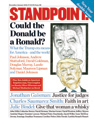
This issue of Standpoint focuses on American politics. Yet the impact of what happens on November 8 will be felt far beyond the United States. We are already talking about populism as if we were back in the 1930s, but the greater threat is isolationism of Left and Right. If anyone doubts that the world still needs its policeman, let them study the “Massive Punishment and Retaliation” plan published last month by the South Korean Defence Ministry. It warns that Pyongyang, a city of 2.5 million, will be “reduced to ashes and removed from the map” as soon as a North Korean nuclear attack is deemed imminent. Even if such a pre-emptive strike were successful in crippling Kim Jong-un’s regime, would his ally China ignore it? Only one nation could prevent such a conflict escalating into a Second Korean War — or even a Third World War. God bless the United States of America.
It is true that for the years of Tony Blair’s premiership between 9/11 and the invasion of Iraq, British prestige, especially in the United States, stood very high; but that opportunity was wasted. Unlike Mrs Thatcher, Mr Blair did not make the most of his influence in Washington. Nor did David Cameron, who made the naive and fatal mistake of supposing that the British people could be told how to vote by an American president. His departure not only from Downing Street but also from the Commons will leave the field clear for Mrs May to build her own, more intelligent relationship with the new occupant of the White House.
That brings us to next month’s US election. The whole future of the West — and perhaps of the rest — will depend on it. Hillary Clinton’s fragile health and her even more fragile reputation make a vote for her almost as much of a leap of faith as one for Donald Trump. But here is the difference: America has had presidents rather like Mrs Clinton before. One of them was even married to her. She is a known unknown. It is perhaps an understatement to say that Mr Trump would be an unknown unknown of an unprecedented kind. The result may well turn on whether he can reassure voters that he can be trusted with their security. Would a Trump presidency mean the end of Nato? It would almost certainly make the Atlantic a wider ocean, culturally as well as politically.
This issue of Standpoint focuses on American politics. Yet the impact of what happens on November 8 will be felt far beyond the United States. We are already talking about populism as if we were back in the 1930s, but the greater threat is isolationism of Left and Right. If anyone doubts that the world still needs its policeman, let them study the “Massive Punishment and Retaliation” plan published last month by the South Korean Defence Ministry. It warns that Pyongyang, a city of 2.5 million, will be “reduced to ashes and removed from the map” as soon as a North Korean nuclear attack is deemed imminent. Even if such a pre-emptive strike were successful in crippling Kim Jong-un’s regime, would his ally China ignore it? Only one nation could prevent such a conflict escalating into a Second Korean War — or even a Third World War. God bless the United States of America.
Like this article? Share, save or print using the icons below:


5:10 AM