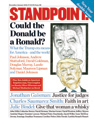



I cannot agree with the Pope’s analysis. There is a problem with Islam and violence, as many Muslims (but evidently not at Al-Azhar) now recognise. Benedict XVI was closer to the mark in his 2006 Regensburg address, which quoted a Byzantine emperor reminding the West of Muhammad’s “command to spread by the sword the faith he preached”. Much criticised at the time, it has proved to be prophetic. A significant minority of the world’s 1.6 billion Muslims do want a war of religion.
This view accords with Samuel Huntington’s “clash of civilisations”, published 20 years ago, to which John Torode pays tribute. What, though, can we do, when even the arsenal of democracy, the United States, seems tempted to turn its back on the Atlantic alliance that has sustained the West for 75 years? In August 1941, Winston Churchill met Franklin Delano Roosevelt on board the battleship Prince of Wales so that the two leaders could sign the Atlantic Charter. This was no declaration of war on Nazi Germany or Imperial Japan, but a general declaration of faith in democratic values, carefully drafted to accommodate American isolationism. It included an article pledging that “all of the nations of the world, for realistic as well as spiritual reasons, must come to the abandonment of the use of force.” Now, as then, the West is reluctant to accept that turning the other cheek just won’t do. Yet Churchill saw the Charter as “a plain and bold intimation that after the war the United States would join with us in policing the world”. Alexander Woolfson defends Nato, the nearest thing we have to a global police force, against its detractors. It has kept the peace for generations — but only by deploying overwhelming force.
After the signing, Churchill, Roosevelt and their crews gathered for a joint service. Among the hymns they sang was “O God, our help in ages past”, a rousing version of Psalm 90 set by Isaac Watts that has always been popular among sailors for its invocation of God as “our shelter from the stormy blast”. Churchill’s choice of David’s ancient Psalm — as holy to Jew as to Christian, as poignant to the godless as to the God-fearing — moved his American guests more than any political declaration. Four months after this, the inauguration of Atlanticism, the Prince of Wales would be sunk by the Japanese. Churchill noted: “Nearly half of those who sang were soon to die.”
Despite our parting, Britain and Europe both still need shelter from the stormy blast of Islamist terror. On the eve of Trafalgar, Nelson prayed: “May the Great God, whom I worship, grant to my Country and for the benefit of Europe in general a great and glorious victory.” Today, as Theresa May seeks to unite a newly independent nation with our allies against the common foes of Western Civilisation, we need her to show a little of the Nelson touch.
This view accords with Samuel Huntington’s “clash of civilisations”, published 20 years ago, to which John Torode pays tribute. What, though, can we do, when even the arsenal of democracy, the United States, seems tempted to turn its back on the Atlantic alliance that has sustained the West for 75 years? In August 1941, Winston Churchill met Franklin Delano Roosevelt on board the battleship Prince of Wales so that the two leaders could sign the Atlantic Charter. This was no declaration of war on Nazi Germany or Imperial Japan, but a general declaration of faith in democratic values, carefully drafted to accommodate American isolationism. It included an article pledging that “all of the nations of the world, for realistic as well as spiritual reasons, must come to the abandonment of the use of force.” Now, as then, the West is reluctant to accept that turning the other cheek just won’t do. Yet Churchill saw the Charter as “a plain and bold intimation that after the war the United States would join with us in policing the world”. Alexander Woolfson defends Nato, the nearest thing we have to a global police force, against its detractors. It has kept the peace for generations — but only by deploying overwhelming force.
After the signing, Churchill, Roosevelt and their crews gathered for a joint service. Among the hymns they sang was “O God, our help in ages past”, a rousing version of Psalm 90 set by Isaac Watts that has always been popular among sailors for its invocation of God as “our shelter from the stormy blast”. Churchill’s choice of David’s ancient Psalm — as holy to Jew as to Christian, as poignant to the godless as to the God-fearing — moved his American guests more than any political declaration. Four months after this, the inauguration of Atlanticism, the Prince of Wales would be sunk by the Japanese. Churchill noted: “Nearly half of those who sang were soon to die.”
Despite our parting, Britain and Europe both still need shelter from the stormy blast of Islamist terror. On the eve of Trafalgar, Nelson prayed: “May the Great God, whom I worship, grant to my Country and for the benefit of Europe in general a great and glorious victory.” Today, as Theresa May seeks to unite a newly independent nation with our allies against the common foes of Western Civilisation, we need her to show a little of the Nelson touch.
Like this article? Share, save or print using the icons below:


