



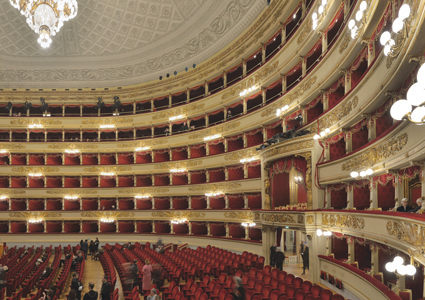
 Access all arias: La Scala in Milan has lightened up (Wolfgang Moroder CC BY-SA 3.0)
It has taken me more than half a century of dedicated opera-going to get to the source of it all, and before I start making excuses let me say it was La Scala’s fault. That house made itself harder to get into than Hatton Garden’s jewellery vaults.
Back in the pre-email era, if you ever managed to get someone to answer the switchboard in Milan the response was invariably a blast of machine-gun Italian comprehensible only to a highly-trained Donizetti comprimario. And, if you were lucky enough to get put through to the press office, you met levels of self-importance and xenophobia rivalled only at Bayreuth. It took me a while to appreciate the anguish of press people who, passionate about art, worked as mediators between the irreconcilable forces of artistic vanity and democratic transparency. But I digress.
Back in the days of London peasoupers, my first opera house was Sadler’s Wells, cheap and cheerful on the number 19 bus route. Anyone turning up in fur coat or black tie got laughed off the top deck. The old Wells, before they redid it in Lottery-money steel and chrome, was a medieval bear-pit where singers stepped on stage at their own risk. English was sung with queenly precision. I saw The Marriage of Figaro twice before grasping it was a comedy, so fierce was its fundamentalist application of English elocution Everything at the Wells felt existential, an edginess that persists at its successor company, English National Opera.
Covent Garden I never warmed to. I went there a lot for ten years while researching its history and I came to love the Keynesian idea that world-class opera might regenerate the English economy. But there was not much to love in loadsamoney City types who turned the crush bar into an after-hours trading floor and board members who treated paying opera-goers with snooty condescension. I’ve had great nights at the Garden but I always feel I’m there under tolerance, or on probation.
Vienna I took to like a starlet to the casting couch. Although it is not the same edifice Gustav Mahler once ruled — that was shredded by Soviet bombs in 1945 — atmospherically it still is. Lorin Maazel, director in the early 1980s, told me he occupied Mahler’s room. The auditorium, empty at noon, reeked of beeswax and sulphur. The posh seats were as partisan as the standing places. The staff canteen served Czech cuisine. And the performances, often riotously unrehearsed with a deputy concertmaster stepping up to conduct, continued a tradition of Schlamperei — slovenly laxity — that Mahler himself had failed to expunge. I once attended six nights in a row and cannot remember a single outstanding feature.
But if the State Opera disappointed, there was always the Volksoper, the Theater an der Wien, the Kammeroper and a dozen fringe companies that popped up in dark cellars around the Ring. Vienna was my first opera heaven. You never forget the first.
Like this article? Share, save or print using the icons below:


3:01 PM
11:12 AM
11:12 AM