


I assume that readers do not believe that the CIA, the Mafia, the military-industrial complex or some other manifestation of the System ordered the murder of JFK. Conspiracy theories about the Kennedy assassination, once everywhere, are now confined to the diminishing audience for Oliver Stone's movies. I am not sure, however, that you can say, hand on heart, that you have not thought for a fleeting moment that maybe there just might be something in the following propositions:
- That Nato governments and their tame journalists invented the "atrocities" committed by Slobodan Milosevic's Serbia and her allies in order to justify a war to expand the empire of neo-liberalism into the southern Balkans;
- That Prince Philip, along with the British and French intelligence services, arranged the death of Diana, Princess of Wales, because she was about to marry a Muslim;
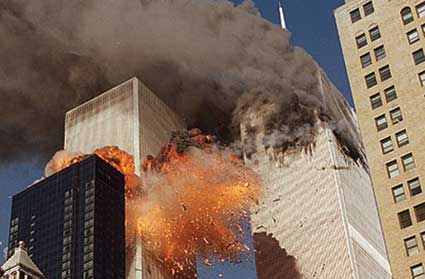
- That the 9/11 atrocities in New York and Washington were an "inside job" organised by a rogue faction within the US intelligence agencies or maybe the Bush administration itself to justify war in the Muslim world;
- That Israel warned Jews to stay away from the World Trade Centre on 9/11 but allowed the slaughter of gentiles to stoke up hatred of Muslims;
- That the Jews, once again, formed a "lobby" in the US that pushed America into a needless war against Saddam Hussein;
- And that the Bush and Blair administrations knew in advance that Saddam Hussein had no weapons of mass destruction worthy of the name but lied and went to war under a false prospectus.
In the past 15 years, vast numbers of people have believed one or more of the above. For a decade after Diana's death, polls reported that between one-fifth and one-third of the British public thought she had been murdered — even though to sustain that conviction they had to accept that the conspirators must have known in advance that she would decide not to stay in Mohamed Fayed's Paris Ritz, what car she and Dodi Fayed would leave in once they had resolved to move on, who would be driving the car, where and by which route it would travel and — finally and bafflingly — that the poor woman would forget to put on her seatbelt.
A 2006 poll by the Pew Research Centre asked Muslims in Indonesia, Egypt, Turkey, Jordan and Pakistan whether Arab terrorists carried out the September 11 attacks. A majority in all countries — and a huge majority in Pakistan — replied that they did not. More than half of British Muslims (56 per cent) agreed that the hijackers were innocent stooges of a devilish plot, and one-quarter went on to say that "the British government was involved in some way" with the 7/7 atrocities on the London Transport system. More than 100 million people have watched Loose Change, a slick and mendacious documentary which opines that a missile, not an airliner, hit the Pentagon, and that a secret government agency faked the recordings of panicked calls from the doomed passengers.
Meanwhile, around the Middle East, and increasingly among western intellectuals, anti-Semitic conspiracy theories that ascribe supernatural power to Jewish influence are so prevalent no one has found a way to measure them.
With the collapse in the authority of elected politicians in Britain, the first — and often, the second and third reaction — to the untimely death of a significant figure or unexpected disaster is to mutter "cui bono" rather than "how sad". The British Left thought in the 1980s that the Tory press kept Labour in opposition by brainwashing the gullible population. In the 1990s, the Right followed suit and decided that the liberal BBC stopped voters realising that the Conservative Party best represented their interests. All paranoid belief systems hold that a powerful conspiracy controls the media, turning the masses into the victims of what 20th-century Marxists called "false consciousness" and Noam Chomsky calls "manufactured consent". It is fair to say that the conviction that democracy is a sham because hidden forces control the flow of information to the electorate extends far beyond the old Left and the cultish disciples of Professor Chomsky. Most politically committed people would be lucky to get through their lives without slipping into this version of conspiratorial thinking in moments of despair.
Until recently, examining paranoid politics was not a respectable occupation for serious writers. Stephen Jay Gould once wrote that few of his scientific colleagues wanted to spend years looking for fraudulent science when they could be concentrating on making their own discoveries. The same unwillingness to waste precious time protected fraudulent history. The effort needed to go through the shifting assertions of, say, the 9/11 "truth" campaigners would question the researcher's sanity as much as the sanity of his or her targets. Such studies of paranoia as there have been followed the format of Louis Theroux's Weird Weekends, where the role of the journalist is to confirm the audience's sense of its own superiority by inspecting American survivalists or racial supremacists, much as Georgian gentlemen examined the lunatics of Bedlam.
The rise of radical Islam with its medieval manias about Jewish conspiracies and Crusader intrigues and the wild fears the disasters of the Bush administration provoked are driving out unwarranted superciliousness, and not before time.
The Times columnist David Aaronovitch has just published Voodoo Histories (Jonathan Cape), an examination of paranoid politics from the Protocols of the Elders of Zion to the myths surrounding the suicide of the British government WMD expert David Kelly. Although Aaronovitch deploys a dark wit and extraordinary patience as he lays bare the psychology of conspiracism, he is no doubt that the "idea of conspiracies" has more power to cause harm than actual conspiracies. In September, Francis Wheen will release Strange Days Indeed: The Golden Age of Paranoia (Fourth Estate), which holds up the crisis of the 1970s as a mirror for our frightened times. Early next year sees Anthony Julius's study of British anti-Semitism, a work of impressive scholarship, which ends with an account of how the traditional conspiracy theory of the far-Right crashed through the central-reservation barrier to deform the thinking of the Left.
I use the terms "Right" and "Left" out of habit, but I cannot pretend that they help. In 1963, at the high point of post-war liberalism, Richard Hofstadter delivered his celebrated lecture "The Paranoid Style in American Politics" and thought that he was describing a conservative pathology. Hofstadter was a good historian and accepted that his definition of paranoid included the populist theory from the late 19th century that an international conspiracy of bankers was impoverishing the common man and the pacifist fantasy that arms manufacturers had tricked America into entering the First World War. But Joseph McCarthy's hunts for communists in the 1950s were at front of his mind and he directed most of his fire against conservative nativist movements, which had raged throughout American history against Catholic and Jewish immigration and Masonic, Jesuit and communist conspiracies. "A distinguished historian has said that one of the most valuable things about history is that it teaches us how things do not happen," Hofstadter concluded after surveying the sorry field. "It is precisely this kind of awareness that the paranoid fails to develop. He has a special resistance of his own, of course, to developing such awareness, but circumstances often deprive him of exposure to events that might enlighten him — and in any case, he resists enlightenment. We are all sufferers from history, but the paranoid is a double sufferer, since he is afflicted not only by the real world, with the rest of us, but by his fantasies as well."
November 1963 was not the best time for liberal complacency. The assassination of John F. Kennedy on the 22nd of that month began a feast of leftist conspiratorial thinking that was to grow ever more gluttonous after the deaths of Marilyn Monroe, Robert F. Kennedy and Martin Luther King. Almost immediately, thoughtful leftists noticed a change for the worse. The veteran journalist I. F. Stone lamented in 1964, "All my adult life as a newspaperman I have been fighting in defence of the Left and of sane politics, against conspiracy theories of history, character assassination, guilt by association and demonology. Now I see elements on the Left using the same tactics in the controversy over the Kennedy assassination."
Even then, Stone thought he could divide conspiracy theories into their left- and right-wing versions. You cannot get away with that now. Francis Wheen quotes with approval the reaction of the New Yorker to the bombing of Oklahoma City by Timothy McVeigh in 1995: "Views that have long been shared by the far Right and far Left [have] come together, in a weird meeting of the minds, to become one and permeate the mainstream of American politics and popular culture. You can call it fusion paranoia."
Just so. To ask if Gore Vidal was behaving like a left- or a right-wing writer when he hovered over the mass graves of Oklahoma City and the Twin Towers straining for reasons to blame the US government makes no sense. He was not acting with the political motives even the crudest propagandists possess, but revealing himself as a characteristically modern type — an ecumenical conspiracy theorist, who would rather believe that 2 + 2 = 5 than ever trust an official report.
Aaronovitch goes further and not only dismisses the importance of conventional political affiliations but questions the traditional reason for fearing conspiratorial ideas, best put by Norman Cohn in Warrant for Genocide, his classic study of the Protocols of the Elders of Zion. "There exists," Cohn wrote,
"...a subterranean world where pathological fantasies disguised as ideas are churned out by crooks and half-educated fanatics for the benefit of the ignorant and superstitious. There are times when this underworld emerges from the depths and suddenly fascinates, captures and dominates multitudes of usually sane and responsible people, who thereupon take leave of sanity and responsibility. And it occasionally happens that this underworld becomes a political power and changes the course of history."
The idea that conspiracy theories bubble up from below, like bad smells from a dank drain, and infect previously level-headed intellectuals is absurd, Aaronovitch argues. Paranoid ideas often begin among the educated and move on to dominate the supposedly ignorant masses, as the history of communism proves. Nor are conspiracies always dangerous. The Vatican may be exasperated by the phoney histories, which culminated in The Da Vinci Code, but Dan Brown's readers are generally harmless and occasionally regular churchgoers. Aaronovitch shows that the paranoid do not always believe in a gigantic conspiracy as the motive force of history. They can nod along with wholly irrational ideas about the death of David Kelly or Princess Diana, without thinking that scheming Jesuits, Jews or multinational corporations secretly control the planet. When people think "that the British Royal Family executes its more awkward members, that Robert Kennedy had a poisoned suppository inserted into Marilyn Monroe before being assassinated by a Manchurian Candidate, or that the Roman Catholic Church has for two millennia been suppressing the truth about the secret bloodline of Christ" they are driven as much by a psychological need as a totalitarian ideology. Their delusions impose a comforting coherence on the mess of life and randomness of death. By "suggesting that there is an explanation, that human agencies are powerful and that there is order rather than chaos," the conspiracy theorist places himself in a sophisticated elite that discerns connections where the multitude sees only happenstance.
As a conclusion, Aaronovitich's notion that the paranoid, like the poor, will always be with us is both convincing and unsatisfactory. His dissection of psychological states fails to say when we need to stop analysing and start worrying. More pertinently, it fails to say whether we need to start worrying now.
In the past century, there have been two lethal upsurges in paranoid fantasies. Both produced their damage in global recessions. Everyone learns the story of the 1930s at school. Francis Wheen makes a good case for including the disasters of the 1970s on the curriculum.
The current 1970s nostalgia — a gruesomely dishonest spectacle for those of us old enough to remember what we would rather forget — makes no mention of Chairman Mao presiding over the murders of millions of real and imagined enemies in the Cultural Revolution, with the assistance of his terrifying wife, Jiang Qing. Mao's doctor noticed paranoid symptoms as early as 1958, while Madame Mao would have alarmed the most tolerant psychologist with her insistence that all the rooms in her various homes had to be kept at a constant temperature of 21.5 degrees centigrade in winter and 26 degrees in summer. Even when the thermostat confirmed that her requirements were being met she would scream at her underlings, "You falsify the temperature! You conspire to harm me!"
In the US, Richard Nixon, whose agencies were illegally bugging tens of thousands of Americans, was caught by his own White House bugging system telling Bob Haldeman, "Homosexuality, dope, immorality in general — these are the enemies of strong societies. That's why the communists and the left-wingers are pushing this stuff, they are trying to destroy us! You know it's a funny thing, every one of the bastards that are out for legalising marijuana is Jewish. What the Christ is the matter with the Jews, Bob? What is the matter with them?" In West Germany, the Baader-Meinhof gang and other left-wing terrorist groups took up arms because they claimed that the democratic Federal Republic was really a Nazi state. They then subscribed to the Nazis' paranoid conspiracy theory and used those arms to target Jews and firebomb synagogues.
Meanwhile, unemployment, inflation, strikes and a civil war in Northern Ireland pushed members of the British establishment into mental collapse. Sir William Armstrong, Edward Heath's chief civil servant, had a spectacular crack-up at a Ditchley Park conference. "Sir William sought out his namesake Robert Armstrong, the PM's principal private secretary, and said they must talk in a place that was ‘not bugged'," Wheen writes. "Robert Armstrong led him to a waiting room where Sir William stripped off his clothes and lay on the floor, chain-smoking and expostulating wildly about the collapse of democracy and the end of the world. In the middle of this chiliastic sermon, as the naked civil servant babbled about ‘moving the Red Army from here and the Blue Army from there', the Governor of the Bank of England happened to walk into the room. According to Robert Armstrong, he ‘took it all calmly'."
The same could not be said of Heath's successor. Bewildered by the failure of social democracy and presiding over a Downing Street court which was boiling with jealousies and plots, Harold Wilson called in two journalists and told them:
"I see myself as a big fat spider in the corner of the room. Sometimes I speak when I'm asleep. You should both listen. Occasionally when we meet, I might tell you to go to the Charing Cross Road and kick a blind man standing on the corner. That blind man may tell you something, lead you somewhere."
He resigned shortly afterwards.
For all Gordon Brown's attempts to imitate Richard Nixon, history does not repeat itself. Western countries are far less ideological now than in the 20th century. But our soupy liberalism offers little protection against the infections which laid low previous generations.
Even on the extremes, a love of violence does not motivate a majority of people who make excuses for the death cults of radical Islam. Anti-Americanism plays its part, but the postmodern liberal ideology that dominates the fringe as surely as it dominates wider society, matters more.
It is not only in academia and on the remnants of the Left that you encounter the argument that to prefer democracy to tyranny in other cultures, or the rights of women to the demands of misogynist clerics, is to announce yourself as insensitive brute or interfering imperialist. Across the West, you find the incoherent feeling that only dogmatists think they have the right to assert that medicines which have passed double-blind trials are superior to homeopathic remedies or that one woman's theories on the death of Diana or the dangers of the measles, mumps and rubella vaccine are better than another's.
Aaronovitch, Wheen and Julius all warn against the dangers of shallow tolerance. Wheen puts the case for the prosecution best when he writes: "Irrationality is both cumulative and contagious. You start by reading your horoscope in the newspaper; then you dabble in chakra balancing or feng shui, saying that it is important to keep an open mind; after a while your mind is so open that your brains fall out, and you read the Protocols of the Elders of Zion without noticing anything amiss." Permissiveness and the needs of commerce fit together well. Respectable publishers no longer feel ashamed about printing profitable tosh they would have been too embarrassed to have on their lists a generation before. David Aaronovitch sees the same collapse of standards in the supposedly regulated television industry, where commissioning editors want to combine novelty with shock value and feel no compunction about revealing "the hidden truth" even when they know that the "truth" they reveal is fantasy. The overworked and underpaid assistant producers who labour beneath them on documentaries, daytime chat shows and around-the-clock news are left in no doubt that they must find suitably controversial material to hold the attention of the audience. They produce a version of fusion paranoia, not because they are themselves paranoid but because there is money in the madness. The triviality of a time that places a virtue on abstaining from judgment allows them to escape the censure they deserve. Once honest rogues shrugged their shoulders and admitted that they were just turning a profit by giving the public whatever nonsense it wanted. Their pious successors get away with covering up the chase for ratings and revenues with self-justificatory cries of "we need to hear the other side" and "we're just asking difficult questions", and fail to realise that they are breaking down old prohibitions while they are about it.
In his examination of how the crude forgery of the Protocols came to inspire the murder of millions, Norman Cohn was being properly sardonic when he wrote of "usually sane and responsible people". Sensible societies throw cordons sanitaires around dangerous ideas, because they know that "usually sane and responsible people" cannot be counted on to see their flaws. After the Second World War, the ideas of Nazism became taboo in Europe — get too close to them and you were denounced. To my exasperation, my comrades on the Left have worked hardest to pull down the barriers by providing platforms for Islamist radicals they would denounce as "fascists" if they had white skins. Predictably, the far-right British National Party has broken out of its cage. It can now announce that its version of neo-fascism is not as extreme as ideas tolerated without objection in polite society. As culpable as the pseudo-Left are all the clueless journalists and civil servants in the mainstream who think it is virtuous rather than cowardly to be non-judgmental about ideas that demand to be judged.
To see why we ought to worry, go back to my original list of modern conspiracy theories, which I confess to not choosing at random. Instead of asking the paranoid's question, "Who benefits?" ask instead, "Who loses?" When wealthy Westerners broadcast the idea that Serb militias were responding to Western aggression, they dismissed the cause of the persecuted Bosnian Muslims. All the conspiracy theorists about Iraq block from their minds any thought for the tens of thousands blown to pieces by al-Qaeda in Mesopotamia. From the mild argument that "America had it coming" to the full fairytale that "America did it", what unites those who spin justifications about the crimes of radical Islam is that they have no sympathy for or interest in the largely Muslim populations of the poor world that it terrorises and oppresses.
The real damage Western conspiracists do is not to Western societies — or perhaps I should say is not only to Western societies — but to the victims of real conspirators with the power to kill.


- How Jeremy Corbyn's Coup Hijacked Labour
- Corbyn's Signpost Back To The Ghetto
- Unionists, Don't Despair: Scotland Is Not Lost — Yet
- Britain's Apologists For Child Abuse
- Lift The Fee Cap And Set Universities Free
- The Story Behind One Dead Man's Penny
- Hitler's 'Ecological Panic' Didn't Cause The Holocaust
- Meet The Montalvos: The First Global Family
- Mr Gove, Here Is Our Statute of Liberty
- A British Bill Of Rights
- Something For Nothing Just Won't Do Any More
- Ditch Ed Miliband's Crazy Energy Legacy
- The English Public School: An Apologia
- An Open Letter To Nicky Morgan
- Escape The Heat: Head To London's Crow's Nests
- Collusion Cut Both Ways In The Troubles
- Decline Of The East? The Chinese Say No
- Conservative, Moi? Jamais De La Vie!
- How To Rescue Iraq From Obama's Folly
- Europe Must Never Again Betray Its Jews

2:04 AM
4:11 PM
2:07 PM
6:06 PM
3:06 PM
2:06 PM
11:06 PM
2:06 PM
10:06 PM
2:06 PM