



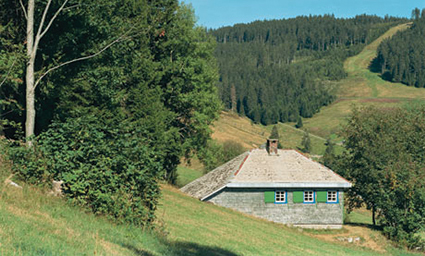
Heidegger's hut has become a place of pilgrimage
An innocent just arrived in this small mountain resort would notice the landscape and the modern church and consider a room with en-suite bathroom, satellite TV and parking. These mixed assets would define Todtnauberg, were it not for the name Martin Heidegger, the German who blackened 20th-century philosophy.
For more than 50 years, he worked up here in his hut at a simple desk looking east. He has a street named after him, with urban pavements and lighting, which shows even mountain tops are not safe from town planning. There's also a Martin Heidegger Walking Tour. The village, once isolated, now easily reached by bus or car, curls steeply up the mountain at 1,100 metres. The tour, the Rundweg, starts beside the large brick youth hostel and follows the contour line some 200 metres higher. Designed by the family in 2002, it displays information which represents their considered view.
"Wer groß denkt, muß irren. A great thinker is bound to make mistakes," Board Number One quotes him. Heidegger, the man whose philosophy came very close to the Nazi spirit in the 1930s, is notorious for not apologising for the Holocaust and not removing offensive passages. Accused in his 1929 book on Kant of forcing German philosophy into an alien mould, he insisted postwar on the unaltered text, since "everyone keeps accusing me of force" and "thinking people learn all the better from their mistakes". If this is one of a number of indirect "apologies", it seems grudging. Much of the problem was character. He hated confrontation. As his supercritical student Karl Löwith put it: "The natural expression of his face included a working forehead, veiled face, and lowered eyes, which now and then would take stock of a situation with a short and swift glance. If someone temporarily forced him into a direct look by speaking to him, then this extremely disharmonious face, jagging angularly in all its features, would become somewhat reserved, wily, shifting and downright hypocritical...What was natural for it was the expression of cautious mistrust, at times full of peasant cunning." The emotionally hopeless letters Heidegger wrote to Hannah Arendt, the Jewish political philosopher with whom he fell in love when she was his student, are a key. Evasive in love, he was stubborn in achievement and recalcitrant by nature. Like his semi-literate parents, he was a head-down, uncommunicative type in the old rural mould. The extraordinary thing is that he also gave this stubborn, self-concealing character to truth and philosophised on that basis.
There's still snow on the northern slope of this glacial valley beneath the 1,493-metre Feldberg peak. Underfoot, patches of compacted, glistening snow scattered with pine needles invisibly feed gullies of slush. There's no one else around to share the assertion on Board Two that Heidegger resigned as the Nazi Rector of Freiburg University over the dismissal of two colleagues. However, Hugo Ott in his Martin Heidegger: A Political Life (Fontana Press, 1988) disagrees. Heidegger fully commended the spirit of 1933. When he resigned a year later, the Nazi Party had rejected him as not malleable enough. Meanwhile, he took on board the required anti-Semitism in academic life.
Most Heideggerians have to wrestle with themselves here and say, yes, but his lifetime's work is not worthless. Indeed not. As Board Two adds, "Something primeval and an obsession with the origins of being" inspired it. He came to Todtnauberg to think about Being. Cue for this visitor to amble down the steep slope behind the famous work hut and place her hand unthinkingly on its flank, as if it were a sick beast. Some of the silvery wooden shingles have fallen off over winter, leaving a vulnerable patch beneath the green-painted shutters and blue-painted window frames. The family insist on privacy because they still use the hut, but there are no fences and no people.
The steep-roofed, three-roomed retreat is traditional for this valley and only its height above the rest and its plainness mark it out. Adam Sharr's scholarly monograph, Heidegger's Hut (MIT Press, 2006), longed for evidence that the master instructed his craftsman to build the shack in a Heideggerian way in 1922, but found none. His young wife Elfride discovered the area on a skiing holiday and when her husband fell in love with it, he chose a plot and she had the hut built with money from her parents. The result tucks neatly into the hillside and, in the local manner, causes nature no offence. Heidegger got this traditional discernment of the peasant-artisan back into philosophy, not architecture. As towns began to build over green fields and cars to clog the streets of his native Messkirch, he asked if modern life wasn't concreting over truth, rendering it no longer accessible.
What a marriage kept this man going. Just as Nietzsche saw the querulous bourgeoisie beneath Wagner's gods, Wotan and Fricke, so one can see, with the help of a lifetime of Martin's letters to his wife, a story of high-mindedness and banality. He wrote Being and Time (1927) up here in spartan conditions. When it made his career, Elfride saw her moment. No sooner established in a chair in his dear Freiburg, her husband was offered the country's top job in his subject, in Berlin. When he refused it, Elfride invited Freiburg to pay for the electrification of the hut in gratitude, which they did, in 1931. Martin's serial infidelities notwithstanding, the Heideggers were married for 60 years. She couldn't anchor him sexually, but Elfride got her own back by spending a last night with his corpse. Sitting on last year's grass, remembering the icy professional photographs of their coupledom taken up here to mark his 75th birthday, I'm struck by how he kept the creativity he brought to philosophy, giving it a value close to a work of art, so distant from his life's companion.
Board Three insists the hut remained spartan, and that only in 1962 did it acquire a little radio to keep Heidegger in touch with the Cuban missile crisis. This influential German soulkeeper, both of whose sons were Russian prisoners of war, was addled by the Russian threat both pre- and post-war. Like Hitler, Heidegger made good use of the Bolshevik threat, conflating it with America into a mechanistic devil totally opposed to the good German spirit. Like Adorno, his Jewish shadow in exile, he thought the devil of instrumentality was crowned by the Enlightenment. When he was already at the height of his first fame, many German philosophers, including his former teacher Edmund Husserl, concluded that Heidegger wasn't doing their subject any more, but something of his own.
"Forests store/Streams tumble/Rocks endure/Rain descends./Thresholds wait/Springs gush/Winds dwell/Blessedness feels." Heidegger's occasional poems, which he rightly preferred to call "Moments of Thought", contain little distillations of his message, like the last two lines here on Board Three: "Winde wohnen/Segen sinnt: Winds dwell/ Blessedness feels." Heidegger passionately rejected cogitation in pursuit of truth, hence blessedness as an extra and superior sense.
As I stand on this mountaintop, pressed to consider Nature and Truth and two hot wars and a cold one, Karl Popper's wartime damnation of German philosophy in The Open Society and Its Enemies comes to mind. Popper attacked Idealism from Plato to Hegel as being essentially undemocratic. Heidegger attacked that same tradition almost contemporaneously and concurred that what led to untruth was subjectivity, or the old German habit of inwardness. Against the German grain, he wanted to privilege the world outside. That Heidegger tried to relieve the German tradition of the burden of metaphysics and endow it with a new empiricism is a fact obscured by his oblique style. It's why the most interesting work being done on him today is in connection with the pragmatic Wittgenstein.
The little poem displayed on Board Three expresses Heidegger's feeling, however, that a German empiricism could never go deep enough if it didn't supplement technical language with poetry. So, with language, one finds him on the way back to that inwardness he disowned. Utterances like "Wind Dwells" have reminded generations of Heideggerians of Rainer Maria Rilke. The comparison irritated Heidegger, for Rilke surely embodied the old inwardness. Exactly.
The achievement then, and what the poet and philosopher shared, is that they occupied common ground in their love of things. As he sat in Todtnauberg, Heidegger enumerated all the things around him and through the window: "The stone on the path and the clod of ploughed earth, the jug...And the well and the cloud in the sky and the thistle in the field, the leaf in the autumn wind and the hawk over the wood...The hammer...The shoe, the axe and the clock." Any future metaphysics, wrote the English poet Gerard Manley Hopkins in 1871, must get away from Aristotle-Aquinas, and above all Hegel, and defer to the haecceity — the thisness — of things. Religious empiricism might name that aim. It's surely no coincidence that Hopkins and Heidegger 50 years later struggled with their faith and shared a love of the medieval mystic Duns Scotus, who rejected other-worldliness in favour of haecceity, a word he coined.
Evidence of that spirit of religious thisness can be found in work of Heidegger's recommended on the next panels as having been written up here. The Contributions to Philosophy, 1938-9, are hard work but anyone can appreciate the meditations on place in The Experience of Thinking. These volumes, and another, Speeches, from the Collected Works, can be borrowed from the
local library while you're here on holiday. That's Germany for you. I always admire the seriousness when I meet it. Meanwhile, the tip to read Speeches quietly steers the reader enthusiastic for thisness back to the infamy of the pro-Nazi Rectoral Address of May 1933, and there's honesty in that. It means, I think, that to try to understand, and accept, Heidegger is a constant balancing act and a hovering mystery.
Great men came to visit him after the war in Todtnauberg, including the theologian Rudolf Bultmann, the novelist Ernst Jünger, the physicist Werner Heisenberg and the poet of the Holocaust Paul Celan. Heidegger couldn't say the right things directly to Celan either. With his ban from teaching for five years after the war, he became famous as his activity shifted from academic to guru. Since he hated academic life and despised the triviality of "life down there" at the university, he ought to have been less rattled but he had a nervous breakdown. Then, as a sui generis philosopher whose fame had spread abroad, from the late 1950s, he was happier again.
I like him for the attention he pays to labour and work, subjects he passed on to Arendt and which, as craft, are busy resurfacing today. I dislike his anti-intellectualism. His formula for bringing together brains and brawn in an ideological crusade pinpoints exactly where the tramlines carrying Marxist-Leninism and Nazism to their destinations crossed over. Anti-intellectualism is also wretched as such. A better course for a thinker who despises thinking might be to give up, rather than pretend he is a craftsman in his workshop.
One goes back through one's own education, political and artistic, up here, with the soul of water running, gushing, spilling everywhere, 10cm of snow like wet sugar underfoot, icy air and the occasional convector blast of warm sunshine. I've come to Heidegger, who would have been 120 this year, warily and late, but I know I haven't wasted my time coming to Todtnauberg when, the Rundweg over, there's time enough to explore the church I so admired from the bus stop.
Built in 1967, "because the old one was too small for the burgeoning congregation", it seems to embrace just that spirit which the student of Heidegger's hut could not find in a lesser building. It has the steep roof of local style and an eye-grabbing clock tower in modern wrought iron. The placing of the two, in relation to the surrounding hills, and the rise of the main street, is perfect. Inside, the rounded space is lit through broad friezes of abstract stained glass in the pale green of grass, the grey-white of snow and mountains and the lightning-strike red of grace. The whole surface is crossed by tracks: ski-tracks, animal tracks, sled tracks, paths of the kind that so fascinated Heidegger he made them his dominant motif. To philosophise is to follow a path, even if finally it leads to a dead end. Lord, what beauty is in being here in St Jakobus, far more so than in nature outside. This is what human being, Heidegger's Dasein, can rise to.
I don't want to re-Christianise the philosopher who began as a Catholic theologian, only to put him back in his place. As Elfride wrote to their priest back in 1919, "My husband has lost his faith and I have failed to find mine." Not only is Heidegger, as a lapsed Catholic, more Duns Scotus than Aquinas, he was always more interested in a system of worship and an account of eternity, than he was a lover of Jesus. What destroyed the system for him was modern biology: Darwin at his broadest point of impact. The theme is taken up in Being and Time, that God didn't make the world, nor us. We are just thrown into being to make some sense of our passing occurrence in this place. We occur in it like the stone on the path and the thistle in the field, except that we are human beings, who have responses like anxiety and care and a sense of that truth that is so reluctant to show itself. Arendt called Heidegger the philosopher of our exposure to history, "ein Philosoph der Geschichtlichkeit". He taught that not only does the human individual die, but whole human worlds die down and die off too. How can that be bearable?
Not surprisingly, for himself, he chose to dwell in a world, up here, that has changed very slowly since his day.


- Beirut: Hariri — An Assassination Too Far
- New York: A ‘Post-racial’ American vs an Old Coot
- Pristina: Kosovo's Liberal Islam
- Oslo: Courage and Cowardice in Scandinavia
- ONLINE ONLY: Washington, D.C.: It's Not Rocket Science!
- La Hague: Recycling the French Model
- Jerusalem: No Via Media for Anglicans
- ONLINE ONLY: Beirut: Blood Holiday
- Rome: Arrivederci Roma
- Darfur: Panic at the Palace
- ONLINE ONLY: Letter from Bamian
- Caucasus: Diary, August-September, 2008
- ONLINE ONLY: South-East Asia: The Demons of Ignorance
- New York: Diary
- Ypres: Never Say Never Again
- New York: A Cousin in the White House
- Caracas: Chávez's Secret Fan Club
- Prague: Diary
- Park City, Utah: Movie that Pulls Aside the Veil
- Beirut: Blood on the Streets
- India: Tariq Ali's Plan for Pakistan
- Berlin and Cologne: A Tale of Two German Cities
- Mumbai: On the 'Slumdog' Trail
- Budapest: Screwed Left, Right and Centre
- Paris: Mayhem in the Marais
- Stanford, CA: Intellectual Life Under Obama
- Colombia: A Nation Reborn
- Paris: Prisoner of the Barbarians
- United States: The Path to Rome via San Francisco
- ONLINE ONLY: Black Russian
- South Africa: The ANC'S Health Lesson for Obama
- Lisieux, France: Relics of Thérèse
- Germany: Heidegger - Being, Time and Place
- Moscow: Putin's Empire Strikes Out
- Connecticut: My Battle Against Google
- Montana: Home From Home on the Range
- Siberia: In Search of the Gulag
- Rio's Heart of Darkness
- Mogadishu: Armageddon on Steroids
- Havana: The Castros Will Not Be Absolved
- Kaliningrad: Russia's Outpost in Europe's Heart
- Bishkek: Bloodsoaked Revolution
- Bishkek: Downfall of a Dictator
- Oslo: Signing OFF on Human Rights
- Bajaur: A Talk with the Taliban
- Bahrain: Women Drivers Welcome Here
- Tajikistan: In Search of the Yeti
- ONLINE Only: Ankara's Proxy
- Johannesburg: Hard Pressed
- Istanbul: Press Freedom Alla Turca
- Xinjiang: Taming China's Wild West
- The Lesson of Oz
- The Surge is Working — So Far
- A Tale of Love, Bulls and Goats
- Old-order Collapse
- Egypt's New Dawn Chorus
- From Carthage to Kasserine
- After Gaddafi: A New Libya Emerges
- To the Polo Saddle Born
- The Settlements: Life Between the Lines
- Exposed: Carnita's Cover Story
- "At last, I feel proud to be Libyan"
- Books Do Furnish a Little Freedom
- Fat Chance for Christie—This Time
- Easy Lies the Head that Wears the Crown
- Putin's Chinese Whispers
- Cain Isn't Able and Newt Defies Gravity
- The Ten Years' War against the Taliban
- We The People Say: Get Out of The Way
- Wanted: A New Ronald Reagan
- Time to Crunch the Numbers
- Who's Really Supreme?
- From Art as Life to Blood and Soil
- Talking Tactics
- The Wagner Family Soap Opera Rolls On
- Winning the Veepstakes
- Romney Takes a Risk with Ryan
- Window Brothels Get the Red Light
- Can Romney Spring an October surprise?
- Canada's Crusader for Conservatism
- No-Go Areas on the Campaign Trail
- Republicans Must Avoid Civil War
- Norway's Problem with Anti-Semitism
- Turks, Arabs and Jews: The Middle East in Crisis
- Nations United in Hypocrisy
- Siberia: Shamans, Spies and the Secret Police
- Barracked by Obama's Oratory
- Women Come Last in Syrian Refugee Camps
- The Dawn of Obamageddon
- Americans Know Her True Worth. Do We?
- Hapless Hollande’s French Farce Flops
- Save the NYPD So It Can Save the City
- Obama's Secrets Start Unravelling
- Syria Isn't Bosnia: Don't Arm the Rebels
- Who Can Stop Hilary in 2016?
- Teaching China's Anglophiles
- On Pilgrimage with the Hasids
- From Eastern Europe to the East End
- True Grits
- The Rise and Rise of Marine Le Pen
- Cold Comfort On Global Warming
- Hunting the Lynx with the Old Believers
- High-tech Israelis Aim For The Moon
- The Russians Are Coming
- The Turbulent Minister is Right
- Bad Times for Good Samaritans
- This Expat Paradise is a Woman’s Nightmare
- Two Generations Lost to Communism
- Strangers in their own Holy Land
- The Isles are Full of Big Noises
- The Kurds: Israel's not so Improbable Allies
- Islam and Innocence: Canada’s Predicament
- The Fifth Republic’s Darkest Days?
- Let's Make Putin's London Cronies Sweat
- The Global Politics Of Netanyahu's Victory
- A Grim Prospect For South Africa's Jews
- No End In Sight To The Exodus From Libya
- Undeterred, Erdogan Usurps Ataturk's Legacy
- Gaza Withdrawal Symptoms
- Red Flags Flying Over Parliament Square
- Mutinous Talk In The Highlands
- Our Principles Are All We Have
- Why The Swedes Have Had Enough
- Canada's First Nations Come Last
- Islam and the French Republic
- Unconventional Convention
- The Dying Days Of Zuma's South Africa
- I'm Not Antisemitic, But...
- The ELM, Dispatches and Awlaki
- A Larger Than Life Predator

- Cultural Climate Change
- Opposites meet in the land of Scrugletopia
- The Battle Against The Philistines Never Ceases
- Home from home for the Bolshevik elite
- Can Macron Save France — Or Is He Its Undertaker?
- How The EU Elite Paved The Way For Populism
- Why France Is Revolting Against The Ancien Regime
- A Decent Woman Betrayed By Her Gruesome Twosome
1:07 PM
5:12 AM
9:10 PM
3:10 AM