



The universities are in crisis. Lord Mandelson, the minister responsible, has announced a £1 billion cut in the government's £14 billion budget, and the universities have cried panic. Margins throughout the sector are already so tight, and so many universities are already in deficit, that the chairman and the director general of the Russell Group, the association of the 20 leading universities, have confirmed that "it will take just six months to bring Britain's higher education system to its knees". The president of Universities UK, which represents all 133 British universities, has admitted that "as many as 30 universities may not survive" and that "institutions face having to close hundreds of courses, with fewer academic staff and bigger classes." More than 160,000 students face being turned away from degree courses in the autumn because demand is rising while the number of places falls.
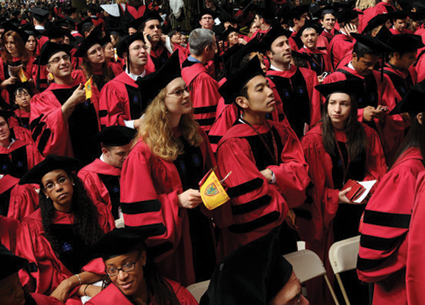
If they can't pay, the university will: Students at a Harvard commencement ceremony
Meanwhile, the University and College Union has predicted that up to 14,000 staff will be made redundant. Some leading universities, including Imperial College and King's College London, have already announced redundancies, while Leeds (where up to 750 staff may have to go) is just one of the universities where staff have voted to strike.
Yet this university crisis is unnecessary and has been caused by inappropriate government policies that crowd out private money.
The myth about universities is that they are public goods. The myth asserts that ordinary people would not, if left to their devices, invest sufficiently in their own and in their children's university education. Yet history disproves the myth. The universities were created by the private sector and their misfortune is that they have been nationalised under conditions that have displaced the private money that would have sustained them in good health.
The first European university was founded by students in Bologna around 1100, initially as a private law school to meet the burgeoning demands of the commercial courts. Soon universities were being created at Montpellier, Padua and other Mediterranean cities, as private student or professorial initiatives. By 1210, Oxford and Cambridge had also been set up as private foundations. But the medieval Church and state did not appreciate independent intellectual power bases, and soon, following the Church's takeover of the University of Paris (1160), all the European universities had been brought under its control, which is why so many academic titles, such as chancellor, dean, doctor, professor and lecturer are ecclesiastical in origin.


- Now Or Never
- Who Will Heal This Divided Country?
- What Made The West Great Is What Will Save Us
- Shock And Awe: Tales Of A Washington Insider
- We Shouldn't Let Old Men Rot Away In Jail
- Arnold Wesker’s Bid To Build A New Jerusalem
- Our EU Deal Gives Us The Best Of Both Worlds
- Brexit Would Save Us And Set Europe An Example
- Are Both Sides Playing By The Referendum Rules?
- Should We Stay Or Should We Go?
- Ignore Project Fear: Brexit Won't Ruin Us
- Uncontrolled Immigration Means Finis Britanniae
- The Next US President Must Carry A Big Stick
- Can Clinton Or Trump Crack The US Tax Code?
- How to Survive the Fourth Industrial Revolution
- The Spectre Of Mayor Khan's Islamist London
- Students Are Leading The Free Speech Fightback
- Fortress Europe Faces An African Migrant Tsunami
- Trump May Be Bad, But What Comes Next Will Be Worse
- Myth Of Stressed-Out Soldiers On The Street

5:04 PM
8:03 PM