



Walsingham in north Norfolk has, architectural historians report, one of the finest extant medieval high streets in Britain. The merchant houses are packed tightly together, some with first floors that overhang the pavement, others half-timbered with leaded windows, many Grade One listed, most restored but a dwindling bunch in a sad state of neglect.
The story of this time-capsule of a village, buried deep in the lanes of the Norfolk countryside, hinges on a single year — 1537. This was when Henry VIII ordered the dissolution of the monasteries following his break with the Pope in Rome. Before that date, for almost 500 years since the Virgin Mary was believed to have appeared there to a local noble woman, Richeldis de Faverche, Walsingham had been one of the greatest Marian shrines in Europe, those historic merchant houses the fruit of the trade generated by pilgrims who walked, often barefoot, along a route that stretched back first to Ely and then London. Every English king from Edward I had prayed there, including Henry VIII himself who came in 1519 to give thanks to Our Lady of Walsingham for the birth of a short-lived son.
And after that date? Well, time effectively stood still. With the abbey and its vast priory church reduced to rubble by royal command, there were no more pilgrims and no more trade, and the high street had only the local farming community to serve. Most of the buildings were mothballed or left to rot. It was only in the 20th century that a modest revival began, with the re-establishment of first a Catholic shrine and then an Anglican one (their separateness is a lingering scar of the Reformation).
Overall, though, little has changed in Walsingham in half a millennium. Walking up its high street, from the roughly triangular Friday Market at the foot of the village to Common Ground, the-not-quite-square at its centre, it takes little effort to imagine myself back in pre-Reformation times. But what, I find myself wondering, would the rest of England look like now if it had remained Catholic?
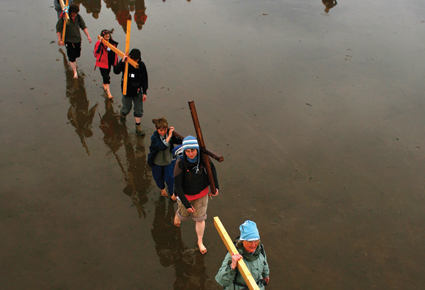
Catholic camaraderie: Pilgrims across the mud slakes to Lindisfarne (Getty Images)
It seems I am not the only one asking the question. Last month, more than 700 people gathered in London's Royal Geographical Society to debate the motion "England Should Be a Catholic Country Again". It was, said the Spectator which had organised the event as part of a rolling series, the biggest crowd it had attracted so far. Remarkably, the proposers — headed by a genial but effective Cardinal Cormac Murphy-O'Connor — carried the day. Granted, this one result hardly counts as evidence of a major shift in religious sentiment in our officially Anglican but largely secular and sceptical society, but it is arguably a sign that something may be stirring in our
national soul.
For centuries after the Reformation, English Catholics, despite being oppressed by penal taxation, exclusion from public life and the constant threat of mob violence, imprisonment and execution, continued to pray in their Recusant priest-holes for their country's return to the Roman fold. I am just old enough to remember beseeching God with my Christian Brother teachers in the early 1970s for the restoration of "Mary's Dowry" as England was known.
Soon after, though, the phrase fell out of use. This was the new age of ecumenism. When Cardinal Basil Hume referred, in an interview in 1993, to "the conversion of England", he immediately retracted his remarks after they had caused deep offence to Anglicans. The irony was that Hume, of all English Catholic church leaders, had done most to exorcise the ghosts of the Reformation. Yet here in 2010 was Murphy-O'Connor once again arguing for precisely such a conversion, though he still shrank from actually using the word.
The meat of the debate was about restoration, a return to Catholicism, and so raised all the usual technical, constitutional questions, such as the fate of the Act of Succession of 1701 which still, in our egalitarian times, enshrines a particular form of discrimination that Harriet Harman has strangely not yet attacked with her customary vigour, namely the exclusion of Catholics and their spouses from the throne. Perhaps she judges us a legitimate target of enshrined prejudice. But my question as I make my pilgrim's progress through Walsingham is a different one. What if the Reformation had never dug a ditch between the vast majority of the English and the religious practices and traditions of their Catholic past?
The answer would be a catalogue of horrors, according to those who opposed the motion in the Spectator debate. A Catholic England, they said, would ban condoms, abortion and homosexuality. Such a scenario seemed to anticipate a theocracy, run by placemen (and, of course, they would be men) of the Pope, a Catholic version of Taliban rule in Afghanistan. No doubt the Inquisition would be lurking somewhere in the background too.
It is a cruel distortion in both historic and contemporary terms. When Desiderius Erasmus, the 16th-century Dutch humanist and reformer, visited Catholic England pre-Reformation, he declared it among the most enlightened places in Europe. Meanwhile, today, the list of officially Catholic countries in Europe doesn't stretch much beyond the 110 acres of the Vatican City State. Fellow members of this sodality — Malta, Monaco and Liechtenstein — may not have rushed conspicuously to embrace the liberal mores of the contemporary Western European society around them, but neither have these self-confessed Catholic micro-states incorporated the Universal Catechism word-for-word into their codes of law.
A better perspective comes courtesy of countries where Catholicism is not (or no longer) the state religion, but where it retains a significant residual place in the culture — Italy, France, Spain, Ireland. All offer clues as to what we lost by breaking with Catholicism. And yes, some of it was good riddance-hypocrisy, abuse and corruption. But there is another side. A Catholic culture — and I am clearly biased as a Catholic, but hopefully have a wider perspective having lived my entire life in England — tends to be better at addressing openly and emotionally the big questions of life, suffering and death.
One obvious difference arises from the lack of inhibition in culturally Catholic countries around public displays of religious faith, whether they be the wayside shrines that litter Irish and Italian highways, or the kind of procession that I joined one Good Friday a few years ago in southern Spain as it bore a life-size Christ on the cross shoulder-high and with great emotion through the streets of the port city of Tarifa. Last year, on the same anniversary of Jesus's crucifixion (and in a Catholic culture I probably wouldn't feel the need to explain Good Friday), I journeyed to the Holy Island of Lindisfarne to join a small group of pilgrims as they carried five large crosses across the mud slakes that separate the ancient sacred site of Saint Cuthbert's seventh-century monastery from the Northumbria mainland. As we set off, on a chilly April morning, Bank Holiday day-trippers stopped their cars to gawp at us, jaws slack at the impenetrable masochism of what we were doing.
Their undisguised incomprehension is a mark of how out of touch post-Reformation Britain has become with the tradition of remembrance, penance and pilgrimage that thrives elsewhere in Catholic Europe. Before Henry rejected the Pope's authority, such spectacles as the one I joined in with at Lindisfarne were commonplace, and their demands well understood by participants and observers alike as groups trudged along the lanes and byways of Britain from shrine to cathedral, abbey to holy well. That tradition ended in 1537 when such destinations were wiped off the map.
Subsequently, the very practice of pilgrimage was suppressed by Puritans who regarded it as too showy, too self-centred and probably too enjoyable. Today, it is all but lost to ignorance. Now acts of Christian witness lead to their participants being labelled, in Tony Blair's chilling phrase (when explaining why he kept quiet about his own faith when in Downing Street) as "nutters".
Walking with those "nutters" at Lindisfarne, I found a camaraderie and infectious good humour, despite the mud, the cold and the weight of the crosses. It immediately reminded me of being in Tarifa when, though we were carrying a shockingly real representation of the battered corpse of Jesus through the streets, the communal singing of hymns and reciting of the rosary lent the procession an air of carnival.
Catholic cultures do have that communal ability to take the sting out of the trials and tribulations of life. The traditional Irish wake may not change by one iota the finality of death, but it eloquently expresses the human solidarity of family, friends and neighbours in the face of life's great mystery. Compare that with our current cold efficiency, sanitising death in hospices, whisking away the corpse as soon as possible in euphemistically labelled Private Ambulances, and then encouraging the grief-stricken to get on with life as the best way of avoiding the terrible social gaffe of being morbid.
Piety is here taken as both negative and primitive, but in Catholic cultures it has an earthy wisdom to it, as Lady Antonia Fraser, the historian and biographer of several of the key Reformation figures, explained to me: "I put my mind back to what I loved about the Catholic Church as a 14-year-old convert, and in fact it's what I still love about it more than 60 years later: it was the religious use of the seasons, the acknowledgement and celebration of the seasons of the year via the feasts of the Church including the penitential seasons. So I still date my letters with such things as ‘22 November, Feast of St Cecilia', which of course celebrates music, to say nothing of Candlemas, just past, which was originally the feast of the lambs, transformed by the Church. So in a Catholic England we would still have all this holy roistering."
But perhaps conjuring up a picture of a still-Catholic England doesn't only have to be a labour of imagination or the result of a trip to out-of-the-way places such as Walsingham. Last year a reliquary containing the bones of the 19th-century Catholic saint, Thérèse of Lisieux, came to these shores. Public veneration of relics, while still commonplace in Catholic Europe, hasn't been seen on any scale in Britain for 500 years. Yet more than 300,000 people queued up to stand in front of the elaborate wooden box (some of Thérèse's bones are on view in Lisieux, but the reliquary was sealed) and many were visibly moved by the experience.
That visceral dimension to Catholic culture was also on display at the National Gallery in London at the start of the year in The
Sacred Made Real, an exhibition of extreme Spanish religious art. It is hard to imagine it even being staged 20 years ago, but numbers attending the show exceeded all expectations. A British taste for the trappings of Catholicism that has lain dormant for five centuries may just be reawakening.
The same point, of course, was made in 1997 following the death of Diana, Princess of Wales, when public grief was unrestrained. In its aftermath, the hard shoulders of British highways now boast plenty of the sort of roadside monuments to those killed in car accidents that have long been a feature of Italian autostradas and Spanish mountain passes. Like Walsingham, they could be seen as prompts to reconsider one of the great "what ifs" of our history.


- Will Trump's foreign policy revolution fail?
- After Draghi departs, eurozone deluge looms
- The poor need the rich to always be with us
- Is the mental illness epidemic just a myth?
- No need to sell your oil shares just yet
- Can Macron wear the General's uniform?
- Trump prefers energy dominance to Paris
- A spectre haunting Europe: Karl Marx
- The battle for British Muslims' integration
- Did Winnie's crimes open Nelson's eyes?
- Belated revenge of the 1968 generation
- Jean-Paul Sartre: the supernova of the far Left
- Presidents for life Putin and Xi menace the West
- Nation states could save the Middle East
- The Trump Presidency is bigger than the man
- Great power politics means greater dangers
- The new project fear shames Whitehall
- Technology menaces childhood and culture
- The onslaught against the West's moral codes
- The Brexit cringe — Mrs T would say 'No!'

1:05 PM
4:04 AM
8:04 AM
8:04 AM
4:04 PM
10:04 AM