


Whether inevitably or not, the controversy over Iraq and the war on terror led to more than a little distance between the Bush administration and British Conservatives, although not necessarily distance between US conservatives and their UK "small c" conservative friends. Ironically, many American conservatives were also busily distancing themselves from Bush for mistakes both domestically and internationally, so British separateness itself was not exceptional. But something else was also at work, at least viscerally. Perhaps because the growing ambivalence about Bush among US conservatives was neither well articulated from the American side nor well understood on the British side, the American perception in the past five years is that British Conservatives generally, albeit not universally, were drifting away from the US and the special relationship.
As these positions and feelings evolved, they became embodied in Cameron, who was (at the time) not well known to US Republicans and/or conservatives, and seemingly quite uninterested, at best, in meeting or developing relationships with his natural American allies, and perhaps ambivalent on the "special relationship" itself. Once again, this distance was not reflected in visible hostility or explicit statements from Cameron or his close advisers or the Shadow Cabinet, but it was an attitude. Indeed, it was the absence of any visible manifestation of interest in the US that communicated diffidence and coolness.
Of course, that coolness doesn't substantially distinguish Cameron from Gordon Brown, who remained consistently low-profile in the US, certainly compared to the likes of Blair or Margaret Thatcher. Brown's desire to put clear blue water between himself and the increasingly unpopular Bush was politically understandable, but the PM made no particular effort to move closer after Obama took office, not even for the equally understandable reason of basking in the president's global popularity. Give Brown credit for consistency. In fact, Obama's coolness and diffidence was a perfect prescription for further, even more rapid deterioration in the transatlantic relationship. Certainly, bestowing on Queen Elizabeth an iPod already loaded with Obama's own speeches seemed a major step in that direction.
Nonetheless, Cameron looked good to Americans compared to Nick Clegg, who revelled in being far more distant from the US, more pro-EU and more anti-Israel. (Many US observers would characterize Obama exactly the same way.) Clegg's performance in the groundbreaking TV debate among the three major party leaders briefly made him a serious contender and therefore brought him his first major exposure in the US. Conservatives were appalled at Clegg's exotic collection of beliefs.
So, all in all, it appeared pre-May 6 that whichever candidate became PM, Anglo-US relations were not likely to pick up in the short term, and certainly not in personal terms among the leaders. Coolness at the top nonetheless does not and cannot obscure the underlying commonality of interests and values that forms the special relationship's foundation. Where that foundation seemed to be cracking, however, was over the EU. Ever since Britain joined what we now only hazily remember as the Common Market, it has intensely debated whether its relationship with "Europe" should be primarily economic, or whether it is inevitably more political, an "ever closer union". And make no mistake, that means less distinct nationhood for Britain. Like a cube of sugar in a hot cup of tea, we would see Britain disappearing.
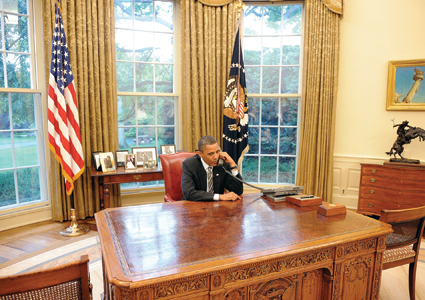
It's good to talk: Obama congratulates Cameron on the evening he became Prime Minister


- Trump Is No Loser, But Government Will Be Harder
- Trump's Appeal Is More Roosevelt Than Reagan
- The Trump Presidency: A Worst-Case Scenario
- We Cannot Take Liberal Democracy For Granted
- No Need To Fear Russia. The Bear Is Broke
- Who Will Do Justice To Our Judiciary?
- Trust Westminster On Brexit: It's All We've Got
- Back to the "Future Of Socialism", Mr Corbyn?
- Would The Little Lady Like A Wee Dram?
- The Coalition We Need To Defeat Islamism
- Are We Losing The War On Home-Grown Terror?
- Cameron Gave Libyans A Chance. Pity They Blew It
- Brexit Will Give Global Free Trade A Boost
- The Real EU Referendum Winner May Surprise You
- Is Theresa May The True Heir To Mrs Thatcher?
- Race To The White House Through The Looking-Glass
- Brexit Gives Us A Historic Opportunity
- American Conservatives Must Stand Up To Trump
- Cicero's Analysis Of Decline Offers Lessons For The West
- Deepdene: Rise and Fall of the House of Hope

10:06 PM
1:06 PM