



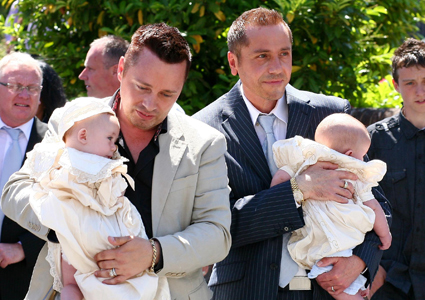
 Designer babies: Barrie and Tony Drewitt-Barlow with Aspen and Saffron, the first of their five children (PA Photos)
Barrie Drewitt-Barlow is passionate about fatherhood and speaks lovingly of his five children. But he is no ordinary dad. Barrie and his partner of 11 years, Tony, were determined to start a family despite the obvious difficulties.
The couple, both wealthy businessmen, realised their dream ten years ago with the birth of twins Aspen and Saffron. The babies were a product of the sperm of both men, an egg donor and a surrogate mother. Since then, the Drewitt-Barlows (the men merged both of their second names) have added another three children to their brood and have spent at least £700,000 doing so. The couple has pioneered a growing and ethically questionable trend among gay men and lesbians — using surrogates and other fertility procedures to produce designer babies.
Today, the "Gaybe" revolution is booming. Although surrogacy and related fertility services are still accessed mainly by heterosexual couples, gay men are increasingly demanding equity.
Known by some critics as "reproductive trafficking", surrogacy is an ethical minefield. Heterosexuals will use their own eggs and sperm but will rent a womb for the gestation, whereas gay men will need to use in vitro fertilisation (IVF) and the eggs from a donor in order to impregnate the surrogate.
Prior to the Drewitt-Barlows' pioneering act, gay men accepted that having their own children as couples was impossible. In the past, lesbian couples would decide which one would carry the child and then ask a male friend to donate sperm and then self-inseminate. Today, they are more likely to use one of Britain's commercial sperm banks.
While children's homes are full to bursting with abused, neglected and unwanted children, increasing numbers of lesbians and gay men are making their own, often spending huge amounts of money in order to conceive.
IVF was developed in the 1970s as a response to infertility, with the first so-called test-tube baby being born in 1978. None of the major religions had, in 1978, an official policy on artificial insemination but the Roman Catholic Church raised the strongest objections at the time.


- A Recipe For Disaster
- Culture And Politics In The Age Of Trumpery
- Will Labour Listen To Its Eurosceptic Voters?
- Would Brexit Play Into Putin's Hands?
- Why Brexit Could Be A Blessing For Europe
- Will The Pollsters Get It Right On The Referendum?
- The Great Illusion: Why We Are Still Europe’s Fall Guys
- Make June 23 Britain’s Independence Day
- Don't Pit Generations Against Each Other
- Let Justice Be Done Though The Liberal Heavens Fall
- A Fascist Coup In Poland? Give Us Poles A Break
- It's Sharia, Not Alcohol, That Threatens Women
- Double Games Of The UK Muslim Brotherhood
- The Land Where History Repeats Itself As Tragedy
- Holocaust Survivors Are Still Waiting For Justice
- Rhodes, Race, And The Abuse Of History
- Shame On The Liberals Who Rationalise Terror
- France, Islam, And The Second Class Sex
- Isis Is Not Invincible — If The West Has The Will
- After Paris, Who Will Speak For France?

- Shame On The Liberals Who Rationalise Terror
- Beyond Obama: Advice To The Next President
- The Establishment Is In Denial — Yet Again
- Is There A Right Way To Write?
- The Cowardice Of John Le Carré
- Double Games Of The UK Muslim Brotherhood
- Two Languages And The Chasm Between Them
- Did Burke Betray The Cause Of Liberty?
3:11 PM
6:10 AM
6:10 PM
9:10 AM
11:09 AM