



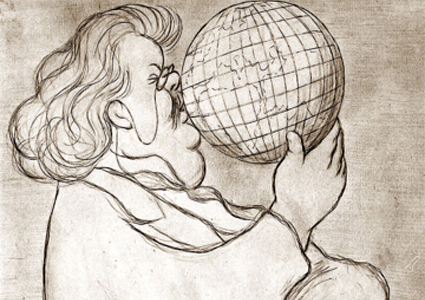
G. K. Chesterton: Larger than life
This little volume will do good. I cannot think of a better Christmas present for almost anybody, of all ages and both sexes. The young, especially, do not know enough about GKC. Among their elders, there is a lot of prejudice against him, especially those who have something to do with education. He is kept off official reading lists, curricula and degree courses. Although, in his last years, he showed himself a fine broadcaster, the BBC establishment has always hated him. His Father Brown stories have never been serialised on TV, though they are a natural.
Why this hostility? One explanation often advanced is that he was anti-Semitic. I have never been able to see this. His odd and aggressive brother, Cecil, was certainly an anti-Semite. So was his friend and associate Hilaire Belloc. GKC was involved in the Marconi campaign against Lloyd George and Rufus Isaacs. But that was all. GKC lacked all the characteristics of the real anti-Semite: love of conspiracy theory, bitterness, huge hidden hatreds and violence of thought. It is significant that he saw through Hitler before anyone else in England, issuing dire warnings from 1932 onwards. Before his death in 1936, he even predicted Hitler would begin the Second World War with a grab at Poland.
A more likely explanation for the hostility is GKC's Christianity, which was always strong and culminated in his becoming a Catholic in 1922. It was the centre of his intellectual and emotional life, and he nearly always brought it into the argument — that was what the secular Bloomsbury types, and the people they influenced, could not abide. To people such as E. M. Forster, Lytton Strachey and the Woolfs, he was everything they most hated in a writer. The fact that he never wrote or said a mean, cruel or malicious word was an additional reason for disliking him, for it proved (in their opinion) that he was a hypocrite. GKC had a childlike, innocent soul, and he kept it pure all his life. They could not believe such a person existed.
There is another reason for the academic hostility to him — and this was, and is, openly avowed: his inaccuracy. Now it is true he was inaccurate. But then so are most academics, much more so than most men and women of letters. As a reviewer, I am constantly astonished at the careless errors I find in books written by dons occupying high university posts and enjoying inflated reputations. But dons go through the motions. They pay lip-service, and genuflect, to scholarship. They pile on the footnotes, bibliographies and other academic scaffolding. GKC would have none of this. He thought it all as out of place in his books as in a daily paper. He was, and saw himself as, a journalist, producing books periodically because what he had to say on particular topics required more space than a newspaper or magazine could offer. He was not ashamed to be a journalist, knowing himself to be truthful, serious and anxious to enlighten, enlarge and glorify the minds of his readers. He was, in fact, without any of the intellectual and moral faults characteristic of journalists.
GKC was, and is, a source of envy. He was prolific without being commonplace. His extraordinary facility did not make him a hack. His versatility was never superficial. He wrote a certain amount of nonsense but it was not, I'd say, more than five per cent of his huge output. He was often profound. He was nearly always original. He usually makes you think, even on hackneyed subjects, and even if, after you have thought, you decide he is wrong, you feel the effort worthwhile. He gives value. He seldom arouses resentment. You don't throw the book down in disgust. You may put it aside for a time but you come back to it. If you have a Chesterton shelf, it is well used: dingy, battered perhaps, scruffy volumes, often without covers or spines, dog-eared, scrawled in, but never dusty. He was, and is, envied because there is so much to envy, above all that wonderful flow of thoughts and that astonishing capacity to set them down on paper.
Bevis Hillier's little book is excellent in its way, and I have enjoyed it and recommend it. But what I would really like is a complete GKC — everything he ever wrote, including his countless articles for the Illustrated London News and his own papers, the Eye-Witness and GK's Weekly, all put sturdily between hard covers. I believe something of the sort is being attempted in America, but I would like to see a good university press doing it here, in facsimile, as has been done with Mark Twain, and sold cheaply. Failing that, I would like some republications. St Francis and Thomas Aquinas, for instance, both short, should be made into one volume. So should his best literary biographies, Dickens and Browning, possibly with Stevenson added to make a trilogy. Heretics and Orthodoxy ought to be published together. And, say, half a dozen volumes of essays, and two of poetry. That would do for a start.
Although GKC aroused, and continues to arouse, hostility in academia and certain official establishments, I don't think anyone who actually knew him well ever disliked him. Most loved him. He has attracted few biographies because there was no dark side or hidden side. He attracts legends and anecdotes, though. Some are true. It is true, for instance, that, incessantly travelling to and from speaking engagements, he got muddled and once sent a telegram to his wife: "Am in Market Harborough where ought I to be Gilbert." The telegram has been preserved and Hillier has tracked it down: British Library Add. Mss. 73276A.
There should be a book of photographs, drawings and cartoons of GKC. It is fascinating, for instance, that his shape changed fundamentally. He was once a tall rake, becoming a tall balloon. His dress was invented for him by his wife, as the only solution to an insoluble problem — wide, soft, dark hat, enveloping cloak, nondescript things underneath, and a cane. It is interesting, as Hillier reveals, that his maternal grandfather invented a garment known as "Grosjean's Celebrated Trowsers". GKC was unique in his time, and such characters come along very rarely in our history. The only one akin to him, in my time — without his genius — was Malcolm Muggeridge. I was fortunate to know Malcolm well, and treasure my memories of him, and remember the wise advice he gave me. But I wish I had known GKC. Now that we have started off with Newman, ought we not to make Chesterton a saint? Much better material.


- Conduct Unbecoming: The Classical Commentaries of Norman Lebrecht in Standpoint
- Propaganda Shouldn’t Pay
- The US Can Still Help Save Syria — and Iraq
- A Putrid Pact between Devils
- Strangers in their own Holy Land
- The Taboo of the Tombola
- Putin has his Useful Idiots on the Left and the Right
- Underrated: Tony Abbott
12:03 AM
3:12 AM
10:12 PM
6:12 PM
6:12 PM
5:12 PM