



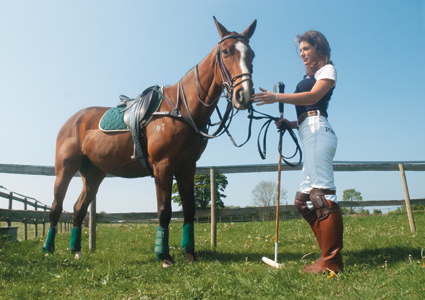
Beginner's chukka: Alev Scott and her polo steed (Chris Lucas)
Halfway through a particularly vigorous chukka, I am wondering how I got here and how I am still alive. A relatively unhorsey Anglo-Turk, I hold in my left hand the reins of a Grand National hopeful, and in my right a spindly mallet with which I must hit a ball speeding into the distance. Two Argentines have materialised on either side of me, an aggressive equine motorcade. Foreseeing a collision in which I will be squashed like the soft, white filling of an empanada, I rein the beast in with some difficulty and pray for the seven minutes to be up.
I would love to confirm that polo playing is as sexy as Jilly Cooper suggests, but alas I cannot. Exhausted, embarrassed, covered in bruises which are the result of ineptitude rather than reckless talent or romps in the hay with Juan, I have never felt less sexy in my life. Yet there is a certain thrill in the sport that is magnetic, even if actual participation at beginner level is as unglamorous as it gets. I did not come here to play; yet here I am.
Argentina is the home of polo and no place for a beginner like me. The level of play floats on an effortless plane far above the standard in Europe or America; the game is less about the strain and violence of charging into someone else's horse or line of fire and more about balletic twirls on hind legs and nonchalant semi-dismounts to reach an impossibly-placed ball. This is mostly due to the fact that Argentine children grow up on horseback, hat-free and care-free, thwacking mallets around at breakneck speed from the age of about three. English children, suited and booted in immaculate kit, have to wait so long for Daddy to sign all the waiver forms before they can so much as sniff a horse that they have no hope of catching up with their Argentine counterparts. Where Daddy does trump Papa, though, is in the financial department; pretty much any Argentine pony is his for the taking, and although flying ponies back to the UK is not as prevalent as it was three or four years ago, it is still done because anything other than Argentine stock is simply not acceptable. Embryos are the other option; a high-ranking polo mare is played at tournaments almost all year round so maternity leave is out of the question. Instead, her embryos are sold for up to $400,000. Adolfo Cambiaso is the national polo hero and his mares are the most coveted on the market; he sold the cloned embryo of one of his favourites for $1 million. No doubt a clone of the great man himself will be the next excitement on the market.
In England, you have to have money to play polo. In Argentina, it helps if you come from one of the big polo dynasties but there are heartwarming tales of grooms climbing up the ranks, all because of their extraordinary horsemanship and immersion in their employer's lifestyle. A groom will play with his boss during practice, maybe give him some tips on a weak nearside backhand, train his herds and generally become a horseman par excellence. A chance to play in a proper match could be his ticket to stardom. This is the kind of player the Argentines love above any other — the Evita of the horse world, a talented everyman lording it over his more privileged fellows.
The more egalitarian nature of Argentine polo is not confined to player level. While polo as a spectator sport is primarily for the wealthy Manolo-wearing classes in England, in Argentina it is much more of a national sport — everyone knows the top players, supports some club or other and would give their last peso to attend the top tournament at Palermo, Buenos Aires. The fact that many Argentines don't own a single horse, let alone the 10 or 12 thoroughbreds required by top players, does not make the world of polo inaccessible to them or detract from their enthusiasm. It is the game itself that grips them; during a big match, the stands are thronged with passionate fans from all walks of life, all absorbed in the visual feast of speed and skill before them. They gamble, they heckle, they voice their opinions on a poor pass or change of horse without reservation. A young child barely able to spell will have a view on Cambiaso's latest rival. It is intimidating.
All this is in stark contrast to the way polo is viewed, or rather not viewed, in England. Cartier is controversially pulling out of polo sponsorship, partly because the international Cartier match held at Guards Polo Club in Surrey has been notorious for its pitifully empty stands in recent years. Socialites with absolutely no interest in watching the game but optimum interest in which player is being cuckolded by his own groom stand in huddles in the marquee, sipping champers and eyeing up the rival stilettos equally unsuited to tottering across lawns strewn with horse manure. In this aspect, Jilly Cooper is entirely right — the sheer money involved in polo necessitates a certain level of snobbery, and there is a kind of WAG equivalent present in force at most matches played in Britain. Extensions replaced by tasteful highlights, suntans developed over a lifetime of holidays rather than procured from a bottle of St Tropez Airbrush, they are much the same species. And while they may pretend not to be fazed by the news that Prince Charles has just arrived in a helicopter, there is a marked shift towards the mouth of the marquee, accompanied by a somewhat distasteful fumbling for BlackBerrys.
The other kind of phoney polo aficionado is the supposedly avid player who cannot play. He or she is often a former failed Pony Club member, determined to overcome the ghosts of childhood humiliation by purchasing membership to the polo equivalent of Chinawhite — Beaufort Polo Club in Gloucestershire. These dubious characters often find their way to Argentina, vainly seeking the hallmark of authenticity. Argentina is cashing in on that reputation in a big way, and there is a perfect symbiosis between the Argentine's need for cash and the polo phoney's need to spend it. Caused in part by the government's policy of keeping the price of beef unfairly low, many former working estancias (ranches) have abandoned cattle-rearing and been converted into boutique polo clubs.
Here, one can receive personal tuition from an ex-pro in the morning and totter off to the infinity pool after lunch. These places are seriously swish and cater perfectly to the needs of Fiona the Phoney who professes to love the high paced cut and thrust of the game but whose wrist is secretly rather sore from all the stick and ball practice before lunch. Decked out in top of the range kit and knee pads which will probably never come into contact with anything except the ground, she also owns a T-shirt which reads: "Eat. Sleep. Polo" for down time at the pool. It is highly likely that she owns or hires extremely valuable horses which she can't control, and the Argentine groom will watch in disbelief as she gaily canters off into the distance, stirrups flying, in the opposite direction to the ball. Afterwards, she will say, "Great game! Open, speedy. Loved it," and ignore any talk of goalscoring. She will not, however, ignore the tentative attentions of Juan. Therein lies the beautiful union of a couple who are each, in their own way, the underdog.
Fiona is crucial to the polo economy. Estancia owners make some money buying and selling horses among themselves, but their main clients are clueless Europeans who come and play, quite fancy a few of the horses they have been given, and fly them back to the UK or wherever home is. Even better for the estancia owners, some buy the horses and keep them on site for next time they're over. Ramon Santiago, a local estancia owner and Argentine patron, controls a good portion of the market; anyone who is anyone plays chez Santi. Weakened by childhood polio, he cannot ride himself but owns hundreds of horses and is an authority on emerging talent. Adolfo Cambiaso was a young protégé of his, making him both literally and metaphorically the Godfather of polo. He tells of a Frenchman who was dissatisfied with all the horses he was given to ride at the estancia and demanded to try the three horses kept in another field.
"I told him these were the worst horses I had. He say, don't lie to me, I know they are the best. So I give him the horses, they are really s**t, and he wants to buy them all!"
Santiago claims to have sold the animals to the Frenchman, who presumed he had got a good deal and outsmarted the devious Argentine into the bargain.
The arrogance of foreign "patrons" (moneyed sponsor-players) does not stop there. Imagine a rotund version of Roman Abramovich insisting on playing on his own team and you will have some idea of the ridiculous nature of polo patronage. This is how it works: if you have lots of money and think you look good in polo whites, you buy up some high-goal Argentine players, trot onto a field somewhere near Buenos Aires with them and watch as they win a tournament for you.
It is highly embarrassing for the Argentine players, who have to make some kind of pretence of involving their patron in the game. One passes to "Abramovich", who wheezes and knocks the ball towards a member of the opposite team; luckily, another of his players dives in, lobs it well away from the patron's danger zone and the game continues. Who is patronising whom? On a polo field thronged with highly-strung horses, mallets and a lethal ball, the patron-player scenario is lunacy on an epic and very expensive scale.
I am neither patrona nor ruthlessly talented ingénue, hence combining the worst features of both — incompetence and penury. Yet I am having a great time, when not in fear of my life. This fear is not confined to the physical; the ramifications of breaching polo etiquette are about as terrifying as a flying hoof in the face.
My first match was disappointing; I spent it hovering on the peripheries, trying to look as though I was cannily anticipating a change in the direction of play.
When it was over I galloped off the field in some semblance of horsemanship. Other players were curiously slow to join me. A few minutes later, a well-meaning lady took me aside and told me in no uncertain terms that I had just committed the most grievous offence possible: leaving the field without thanking each member of the opposing team.
"And you should never gallop off, you know. Most disrespectful."
"To whom?"
"Your pony! Only the most arrogant players do that."
So there we are: I am not only talentless but arrogant with it. Perhaps I would be better off back in Turkey playing buskasi, a form of polo played with a dead goat and hooks instead of ball and mallets. A little messy by the sixth chukka but more affordable and delightfully Manolo-free.


- Beirut: Hariri — An Assassination Too Far
- New York: A ‘Post-racial’ American vs an Old Coot
- Pristina: Kosovo's Liberal Islam
- Oslo: Courage and Cowardice in Scandinavia
- ONLINE ONLY: Washington, D.C.: It's Not Rocket Science!
- La Hague: Recycling the French Model
- Jerusalem: No Via Media for Anglicans
- ONLINE ONLY: Beirut: Blood Holiday
- Rome: Arrivederci Roma
- Darfur: Panic at the Palace
- ONLINE ONLY: Letter from Bamian
- Caucasus: Diary, August-September, 2008
- ONLINE ONLY: South-East Asia: The Demons of Ignorance
- New York: Diary
- Ypres: Never Say Never Again
- New York: A Cousin in the White House
- Caracas: Chávez's Secret Fan Club
- Prague: Diary
- Park City, Utah: Movie that Pulls Aside the Veil
- Beirut: Blood on the Streets
- India: Tariq Ali's Plan for Pakistan
- Berlin and Cologne: A Tale of Two German Cities
- Mumbai: On the 'Slumdog' Trail
- Budapest: Screwed Left, Right and Centre
- Paris: Mayhem in the Marais
- Stanford, CA: Intellectual Life Under Obama
- Colombia: A Nation Reborn
- Paris: Prisoner of the Barbarians
- United States: The Path to Rome via San Francisco
- ONLINE ONLY: Black Russian
- South Africa: The ANC'S Health Lesson for Obama
- Lisieux, France: Relics of Thérèse
- Germany: Heidegger - Being, Time and Place
- Moscow: Putin's Empire Strikes Out
- Connecticut: My Battle Against Google
- Montana: Home From Home on the Range
- Siberia: In Search of the Gulag
- Rio's Heart of Darkness
- Mogadishu: Armageddon on Steroids
- Havana: The Castros Will Not Be Absolved
- Kaliningrad: Russia's Outpost in Europe's Heart
- Bishkek: Bloodsoaked Revolution
- Bishkek: Downfall of a Dictator
- Oslo: Signing OFF on Human Rights
- Bajaur: A Talk with the Taliban
- Bahrain: Women Drivers Welcome Here
- Tajikistan: In Search of the Yeti
- ONLINE Only: Ankara's Proxy
- Johannesburg: Hard Pressed
- Istanbul: Press Freedom Alla Turca
- Xinjiang: Taming China's Wild West
- The Lesson of Oz
- The Surge is Working — So Far
- A Tale of Love, Bulls and Goats
- Old-order Collapse
- Egypt's New Dawn Chorus
- From Carthage to Kasserine
- After Gaddafi: A New Libya Emerges
- To the Polo Saddle Born
- The Settlements: Life Between the Lines
- Exposed: Carnita's Cover Story
- "At last, I feel proud to be Libyan"
- Books Do Furnish a Little Freedom
- Fat Chance for Christie—This Time
- Easy Lies the Head that Wears the Crown
- Putin's Chinese Whispers
- Cain Isn't Able and Newt Defies Gravity
- The Ten Years' War against the Taliban
- We The People Say: Get Out of The Way
- Wanted: A New Ronald Reagan
- Time to Crunch the Numbers
- Who's Really Supreme?
- From Art as Life to Blood and Soil
- Talking Tactics
- The Wagner Family Soap Opera Rolls On
- Winning the Veepstakes
- Romney Takes a Risk with Ryan
- Window Brothels Get the Red Light
- Can Romney Spring an October surprise?
- Canada's Crusader for Conservatism
- No-Go Areas on the Campaign Trail
- Republicans Must Avoid Civil War
- Norway's Problem with Anti-Semitism
- Turks, Arabs and Jews: The Middle East in Crisis
- Nations United in Hypocrisy
- Siberia: Shamans, Spies and the Secret Police
- Barracked by Obama's Oratory
- Women Come Last in Syrian Refugee Camps
- The Dawn of Obamageddon
- Americans Know Her True Worth. Do We?
- Hapless Hollande’s French Farce Flops
- Save the NYPD So It Can Save the City
- Obama's Secrets Start Unravelling
- Syria Isn't Bosnia: Don't Arm the Rebels
- Who Can Stop Hilary in 2016?
- Teaching China's Anglophiles
- On Pilgrimage with the Hasids
- From Eastern Europe to the East End
- True Grits
- The Rise and Rise of Marine Le Pen
- Cold Comfort On Global Warming
- Hunting the Lynx with the Old Believers
- High-tech Israelis Aim For The Moon
- The Russians Are Coming
- The Turbulent Minister is Right
- Bad Times for Good Samaritans
- This Expat Paradise is a Woman’s Nightmare
- Two Generations Lost to Communism
- Strangers in their own Holy Land
- The Isles are Full of Big Noises
- The Kurds: Israel's not so Improbable Allies
- Islam and Innocence: Canada’s Predicament
- The Fifth Republic’s Darkest Days?
- Let's Make Putin's London Cronies Sweat
- The Global Politics Of Netanyahu's Victory
- A Grim Prospect For South Africa's Jews
- No End In Sight To The Exodus From Libya
- Undeterred, Erdogan Usurps Ataturk's Legacy
- Gaza Withdrawal Symptoms
- Red Flags Flying Over Parliament Square
- Mutinous Talk In The Highlands
- Our Principles Are All We Have
- Why The Swedes Have Had Enough
- Canada's First Nations Come Last
- Islam and the French Republic
- Unconventional Convention
- The Dying Days Of Zuma's South Africa
- I'm Not Antisemitic, But...
- The ELM, Dispatches and Awlaki
- A Larger Than Life Predator

- Cultural Climate Change
- Opposites meet in the land of Scrugletopia
- The Battle Against The Philistines Never Ceases
- Home from home for the Bolshevik elite
- Can Macron Save France — Or Is He Its Undertaker?
- How The EU Elite Paved The Way For Populism
- Why France Is Revolting Against The Ancien Regime
- A Decent Woman Betrayed By Her Gruesome Twosome
7:06 PM